

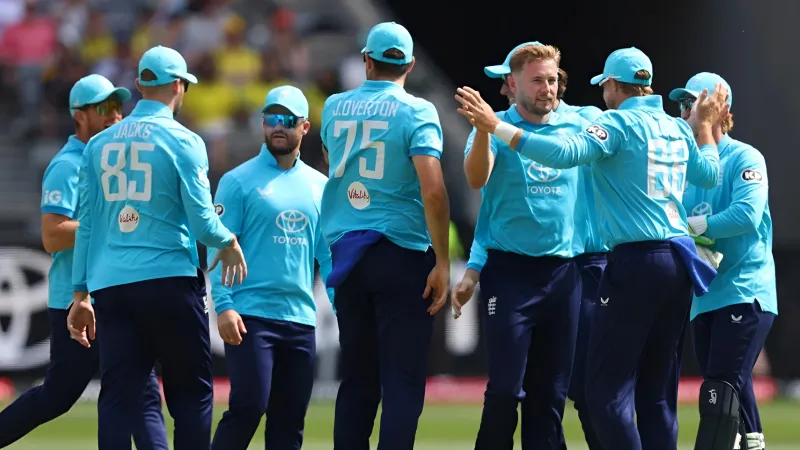

England will begin their T20I series against Australia with the opening match, aiming to make a strong statement against their arch-rivals. The contest will provide both teams with an opportunity to assess their combinations and build momentum ahead of the remaining matches.
England have several explosive batters and versatile all-rounders in their squad, giving them the flexibility to adapt to different match situations. However, facing Australia will be a stern test, particularly against their experienced fast-bowling attack.
The first T20I will be played at the Melbourne Cricket Ground (MCG) on Saturday, November 21, with the first ball scheduled for 7:15 PM local time (1:45 PM IST). England enter the series after winning the three-match ODI series 2-1, and Harry Brook will continue to captain the side in the shortest format.
Top order: Phil Salt, Tom Banton, Jacob Bethell
Phil Salt is expected to open the innings alongside Tom Banton. Salt’s return from a quad injury is a major boost for England, as he is one of their most destructive batters in the shortest format. His ability to attack the opposition’s fast bowlers from the first over could help England make the most of the Powerplay.
Banton is another exciting option at the top. The right-hander has been in excellent touch, having scored a century in the second ODI against Australia. His 121-run knock in Adelaide demonstrated his ability to dominate quality bowling attacks, and England will hope he carries that form into the T20I series.
Jacob Bethell could bat at number three. The left-handed batter’s return to the squad after recovering from a knee injury provides England with another dynamic option. His ability to play attacking strokes against both pace and spin makes him a valuable addition to the top order.
Middle order: Harry Brook, Jordan Cox, Will Jacks
Captain Harry Brook is expected to occupy the number four position. The England skipper is one of the most versatile batters in the team and can adapt his approach according to the match situation. His responsibility will be to anchor the innings when required while maintaining an aggressive scoring rate.
Jordan Cox could follow Brook at number five. The wicketkeeper-batter has been in good form during the ODI series against Australia, scoring 67 in the second match. His ability to rotate the strike and accelerate towards the end makes him a useful option in the middle order.
Will Jacks is likely to bat at number six. The all-rounder offers explosive hitting and can also contribute with his off-spin. His versatility gives Brook additional flexibility when deciding the batting order and bowling combinations.
All-rounders and bowling attack: Sam Curran, Jamie Overton, Liam Dawson, Adil Rashid
Sam Curran is expected to feature at number seven. His return from injury strengthens England’s balance, as he can contribute with both bat and ball. Curran’s left-arm pace, variations and ability to bowl at the death make him an important part of the bowling attack.
Jamie Overton could be the other pace-bowling all-rounder in the XI. His ability to generate pace and bounce, along with his lower-order hitting, provides England with another valuable option.
Liam Dawson is likely to be selected as the specialist left-arm spinner. His control and ability to bowl economically in the middle overs could prove useful against Australia’s aggressive batting lineup.
Adil Rashid should lead the spin department. The experienced leg-spinner remains one of England’s most dependable wicket-taking options in T20 cricket. His variations and ability to deceive batters in the air could be particularly important on the MCG surface.
Luke Wood is expected to complete the playing XI. The left-arm pacer offers variety and can swing the new ball, while his variations provide an additional option during the death overs.
England’s Predicted Playing XI
- Phil Salt
- Tom Banton
- Jacob Bethell
- Harry Brook (c)
- Jordan Cox
- Will Jacks
- Sam Curran
- Jamie Overton
- Liam Dawson
- Adil Rashid
- Luke Wood
Disclaimer: This blog post reflects the author’s personal insights and analysis. Readers are encouraged to consider the perspectives shared and draw their own conclusions.