

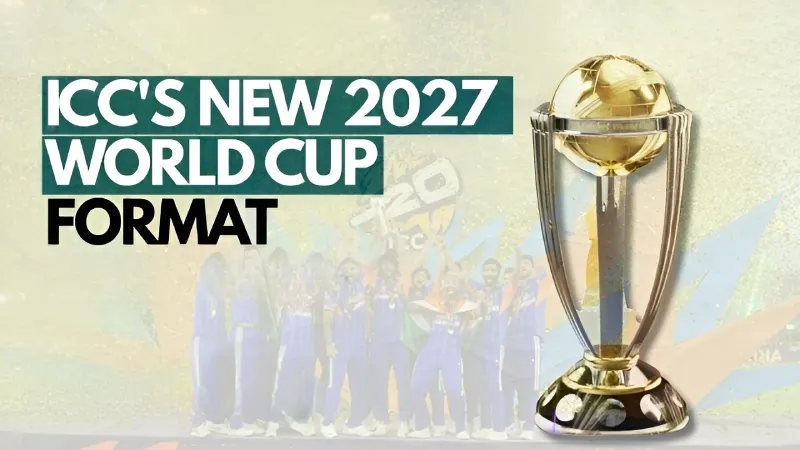

The ICC’s new three-stage system turns the 2027 World Cup opener into a survival test for the lowest-ranked qualifiers. Fourteen teams remain in the draw, but three of them must fight through a two-match knockout round before the group stage starts. South Africa, Zimbabwe and Namibia host the event in October and November 2027, with twelve sides guaranteed a full group campaign and three others facing instant elimination. That change is already reshaping how associate nations plan their qualification journeys and how ranked teams view their route to the semi-finals.
Inside the New Three-Stage Tournament Blueprint
The 2027 World Cup keeps its fourteen-team format, but the knockout path now runs through three rounds. Round one, the survival round, has the three lowest-ranked qualifiers play a round-robin, with only the top finisher advancing. Round two expands to twelve teams in two groups of six, each guaranteed five fixtures. Round three, the Super 7, adds the best fourth-placed side to the group toppers, with four of seven reaching the semi-finals.
ICC ODI World Cup 2027 Super Series format
Where a team starts the tournament depends on how it qualifies. Hosts South Africa and Zimbabwe, plus the eight highest-ranked ODI sides by September 30, 2026, walk into the group stage with five guaranteed matches. The global qualifier winner joins them there too. None of those three routes reaches the final seven automatically; every side must still finish top three in its group or grab the best fourth-place spot.
Entry Tier | Pathway | Starting Stage | Guaranteed Matches | Super 7 Entry |
Full Member Hosts | Co-host rights (SA/Zimbabwe) | Round 2, Groups | 5 matches | Not guaranteed; top 3 in group or best 4th |
Top 8 Ranked Teams | ODI Rankings cut-off, Sept 2026 | Round 2, Groups | 5 matches | Not guaranteed; top 3 in group or best 4th |
Global Qualifier Winner | 1st in Global Qualifier | Round 2, Groups | 5 matches | Not guaranteed; needs group form |
Global Qualifier 2nd-4th | 2nd-4th in Global Qualifier | Round 1, Super Series | 2 matches; out if series not won | Not guaranteed; only winner advances |
Teams finishing second, third and fourth in the global qualifier face a tougher deal. They open in the survival round with only two matches guaranteed, eliminated at once if they fail to top that mini-table. Only the winner then joins the group stage, still needing a top-three finish.
The Qualifiers Staring at Elimination
The survival round only touches the three lowest-ranked qualifiers, ranked twelfth to fourteenth overall. Of the four sides through the global qualifier, only the eleventh-ranked finisher walks straight into the group stage. The other three drop into the round-robin, where two will be gone inside a fortnight. Scotland is the clearest example: the only 2026 side that must requalify, now facing this two-match cliff edge.
Associate Nations and the Cost of the Cut
Eight associate nations spend a full campaign, thirty-six League Two matches apiece, just to reach the global qualifier. Clearing it no longer guarantees a real World Cup campaign, since two of three sides in the survival round exit after two matches. Netherlands captain Scott Edwards spoke through the World Cricketers Association about how jarring that shift feels, calling qualification a huge achievement and the changed reality deeply disappointing. The ICC framed the change as a way to add consequence earlier.
A Structural Divide Between Cricket’s Tiers
Nothing changes for the eleven full members ranked in the top bracket: they walk into the group stage with five matches guaranteed, whatever happens in the survival round. That guarantee is the real dividing line the new structure creates. Established teams get a full campaign; the lowest-ranked qualifiers get two matches and no room for a bad day.
The World Cricketers Association has been blunt about what that means for the sides most affected. Its position is that the revised format undercuts the opportunity fourteen-team expansion was meant to deliver, since qualification alone no longer guarantees a genuine campaign for some countries. Years of planning and personal sacrifice from associate players now hinge on two matches instead of a full group stage.
Whether that trade-off is fair will shape how the next eighteen months of qualifying are covered. But the numbers are set: the ICC ODI World Cup 2027 Super Series format leaves the smallest margin for error exactly where cricket can least afford to lose new audiences.
Should the ICC guarantee every 2027 qualifier a full group-stage campaign, or does a two-match survival round add the jeopardy this tournament needs? Share your take below.
Frequently Asked Questions (FAQs)
What is the ICC’s Super Series stage at the World Cup?
The Super Series is a round-robin between the three lowest-ranked qualifiers, with only the top finisher advancing to the group stage. Two teams are eliminated after playing just two matches each.
How many teams qualify automatically for the 2027 World Cup?
Ten teams qualify automatically, made up of hosts South Africa and Zimbabwe plus the eight highest-ranked ODI sides by September 30, 2026. The remaining four spots come from the ten-team global qualifier.
Why are associate nations upset about the new qualification format?
Associate nations are frustrated because sides that survive thirty-six League Two matches can still be eliminated after two Super Series games. The World Cricketers Association says this dilutes the opportunity originally promised by fourteen-team expansion.
How many teams will actually play at the 2027 World Cup?
Fourteen teams remain part of the tournament, matching the originally announced expansion. Two of those fourteen are eliminated in the Super Series before the group stage begins.
What happens to teams that finish 2nd to 4th in the global qualifier?
Those three teams drop straight into the Super Series instead of the group stage, guaranteed only two matches. Only the Super Series winner among them advances to face the twelve group-stage sides.
Disclaimer: This blog post reflects the author’s personal insights and analysis. Readers are encouraged to consider the perspectives shared and draw their own conclusions.