
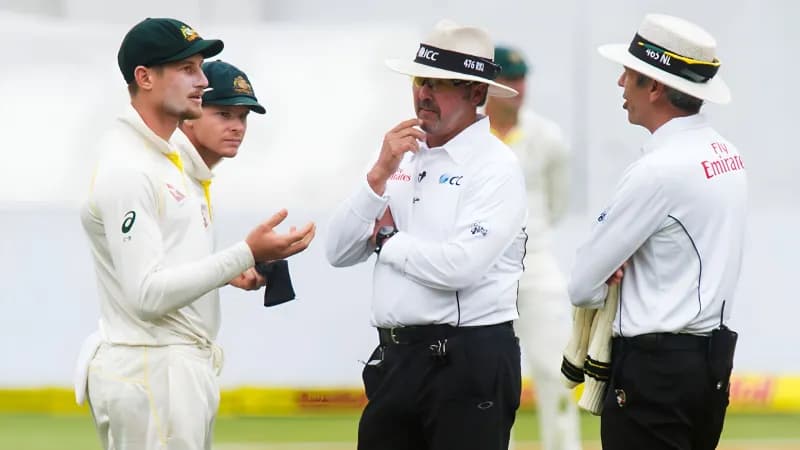
The punishment has grown far heavier. Before 2018, a player caught altering the ball faced a Level 2 charge, which at worst meant a full match fee and two suspension points, while the ICC now treats it as a Level 3 offence carrying up to 12 points, or six Tests out. Saliva has been outlawed as well. The trigger was Cape Town on 24 March 2018, when television cameras picked up Cameron Bancroft working on the ball with sandpaper. Usman Khawaja’s new book has now raised a harder question about enforcement.
Law 41.3 and the Old Penalties
The offence was on the books long before Bancroft. Law 41.3 in the MCC’s 2017 Code already made it illegal for any player to do anything that alters the condition of the ball, under clause 41.3.2. Umpires then award five penalty runs to the other side, whose captain may also ask for a new ball.
The personal sanctions were mild by today’s standards. As a Level 2 charge, it meant a fine of half of the match fee and up to two suspension points. Bancroft was docked 75 per cent of his fee and given three demerit points. Steve Smith, the captain, faced a separate conduct charge, lost his entire fee and was banned for one Test.
Ball tampering rules Test cricket Sandpapergate
Cricket Australia went much further than the ICC. Bancroft got nine months, while Smith and David Warner each got 12, then added leadership bans: another year for Smith and Bancroft, life for Warner.
Warner’s lifetime ban did not last. In 2022, the board changed its code so players could apply for a review, and in October 2024, a review panel cleared Warner to lead again.
Year | Rule Change | Governing Body | Penalty |
2017 | Law 41.3 in new Code | MCC | 5 penalty runs |
Early 2018 | Ball tampering rated Level 2 | ICC | 50-100% fee, up to 2 suspension points |
2018 | Upgraded to Level 3 | ICC | 4-12 suspension points |
2020 | Temporary COVID saliva ban | ICC | 5-run penalty |
2022 | Permanent saliva ban | MCC, ICC | 5 penalty runs |
2022 | Sanction reviews allowed | Cricket Australia | Ban can be modified |
2025 | Saliva ball change optional | ICC | 5-run penalty stays |
ICC Raises the Price After 2018
The ICC reclassified ball tampering as a Level 3 offence in July 2018, effective from October. It also pushed the Level 3 ceiling up to 12 suspension points, from eight. Twelve points equals six Tests or 12 ODIs, and the minimum sanction became four points, the same as two Tests.
Dinesh Chandimal, charged just before the switch, received two suspension points plus the loss of his match fee. Nicholas Pooran of West Indies felt the new scale in 2019, picking up four points after scratching the ball during an ODI. Domestic leagues set their own limits, and Fakhar Zaman was banned for two PSL matches in 2026, the most that league allows for a first offence.
Saliva Ban Changes Ball Management
Saliva shining stopped with the pandemic in 2020, though sweat stayed legal. In October 2022, the MCC’s Laws began treating saliva like any other illegal method, and the ICC turned its temporary ban into a permanent one.
A 2025 playing-condition tweak means umpires no longer have to change the ball simply because saliva has touched it. The five-run penalty still applies. It is meant to stop spit being used to force a fresh ball.
Khawaja’s Book Revives the Enforcement Question
In Sabr, Khawaja claims the entire 2018 touring party knew the sandpaper was being used. He also writes that tampering was widespread in the Sheffield Shield, names Victoria as perhaps the most skilled at it, and describes himself as complicit even though he says he never touched the ball illegally. Pat Cummins rejects his version of 2018, and Scott Boland disputes what he says about Victoria.
Cricket Australia will not reopen its investigation, but it does plan an independent forum for players. Khawaja dates the Victorian habits to the 2000s and 2010s, and nothing reported so far suggests they carried on after Cape Town. His contested account tests the old system’s record at catching cheats; it says nothing about whether the new one works better. The ball tampering rules Test cricket Sandpapergate left behind prove one narrower point, which is that getting caught now costs far more.
Do tougher bans actually stop ball tampering, or has Khawaja exposed a habit the old system simply never caught? Tell us in the comments.
Frequently Asked Questions (FAQs)
What happens to a player caught tampering with the ball?
The ICC treats it as a Level 3 offence, which brings between four and 12 suspension points. On top of that, umpires can give the opposition five penalty runs.
Can bowlers still use saliva on the ball in Tests?
No, saliva has been banned for good by the ICC since 2022. Sweat is still allowed, and since 2025, umpires do not have to replace a ball just because saliva touched it.
What was the Sandpapergate scandal about?
It was the moment Cameron Bancroft was filmed rubbing sandpaper on the ball during the Cape Town Test in March 2018. That match was the third Test of Australia’s series in South Africa.
How long were Smith and Warner suspended after Cape Town?
Cricket Australia suspended both players for 12 months, while Bancroft received a nine-month ban. Warner also picked up a lifetime leadership ban, which a review panel lifted in October 2024.
Which players were punished for the 2018 ball tampering incident?
Steve Smith, David Warner and Cameron Bancroft were the three players Cricket Australia sanctioned. Khawaja’s claim that the wider touring group knew is disputed by Pat Cummins.
Disclaimer: This blog post reflects the author’s personal insights and analysis. Readers are encouraged to consider the perspectives shared and draw their own conclusions.