

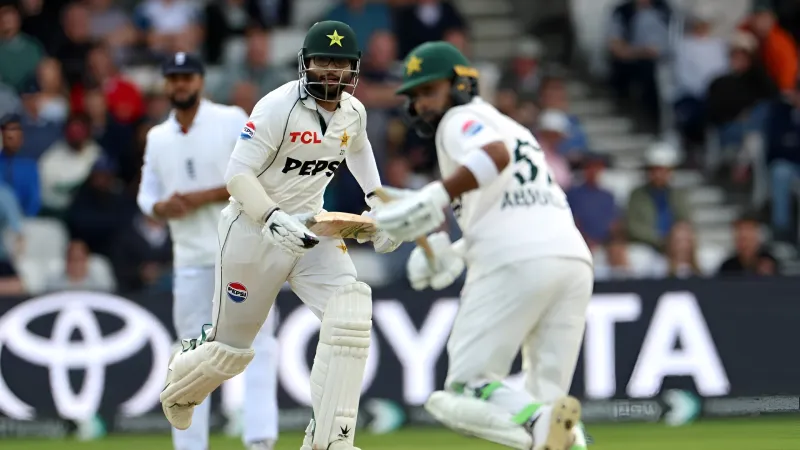

Pakistan’s white-ball batting is now collapsing in exactly the passages that have wrecked their Test cricket throughout 2026. Once early wickets fall, the middle order freezes instead of rebuilding, and that has proved true against Bangladesh, West Indies, England and Australia alike, across Tests, ODIs and T20Is. Shakeel, Agha and Rizwan all built promising early reputations that have since eroded sharply under scrutiny, and selectors keep naming the same three men while waiting for form to turn before results collapse the batting order even further.
Batting Fragility Took Root Back In 2024
Pakistan’s top order used to buy the middle order time to settle. That stopped working in 2024, when the average opening stand sank to 23.03, the lowest of any Test nation bar Ireland.
Shakeel, Agha and Rizwan were meant to absorb that pressure and rebuild from wobbly starts. Shakeel averaged 77.25 across his first 15 Test innings, then fell under 29 across his next 31, and Agha’s role has grown even as his contributions have shrunk.
Pakistan Middle Order Collapse Test Cricket 2026
Three separate Test series in 2026 tell the same story against different opponents. In Bangladesh in May, Pakistan lost 2-0: at Dhaka they slid from 210 for 1 to 230 for 5 in a single session, four wickets down for 20 runs as Shakeel fell for a duck to Mehidy Hasan, then managed just 232 at Sylhet after losing four wickets for 79.
Against West Indies in July, a middle-order collapse followed Babar Azam’s run out for 88, and Pakistan lost the first Test by 90 runs, their eighth consecutive away Test defeat across four continents. At Headingley in August, they slid from 117 for 3 to 171 all out, seven wickets falling for just 54 runs, before a second innings of 135 sealed defeat by an innings and 103 runs inside three days.
Format | Series | Key Collapse | Result |
Test | vs Bangladesh (May 2026) | 210-1 to 230-5 in 1 session; 232 all out in 2nd Test | Lost series 2-0 |
Test | vs West Indies (Jul 2026) | 120 all out in 1st Test 2nd innings; Babar 88 in 2nd Test | Drew series 1-1 (Won 2nd Test) |
Test | vs England (Aug 2026) | 117-3 to 171 all out (last 7 wickets for 54 runs); 2nd innings 135 all out | Lost 1st Test by innings and 103 |
ODI | vs Bangladesh (Mar 2026) | Bowled out for 114 in 1st ODI; middle order collapse | Lost series 2-1 |
White Ball Format Shows The Same Failure
Pakistan’s Test collapses were never going to stay contained to red-ball cricket, and 2026 proved that fast. Against Bangladesh in the ODI series in March, the middle order was picked apart after the first match, and Pakistan lost that series 2-1.
Against Australia in June, they restricted the hosts to 231, only to implode for 190, losing six wickets for just 78 runs in 16.3 overs as Nathan Ellis took 4 for 33. At the T20 World Cup, the same middle order could not accelerate after promising starts, and Pakistan exited at the group stage without ever fixing the flaw.
Technique And Mentality Failures Compound Each Other
Pakistan’s problem is not purely technical. When a key wicket falls, batters tend to loosen technique instead of regrouping, and that pattern has repeated across format after format in 2026.
Shakeel’s failure to review a plumb LBW shout at Headingley, a call replays suggested he could have overturned, showed exactly this mental lapse compounding an existing technical weakness. Babar Azam’s hand injury before the England tour removed Pakistan’s most experienced middle-order batter entirely, leaving Agha to captain a batting unit that was already short of composure under pressure.
The Batting Unit Needs Urgent Structural Fixes
Selection changes alone cannot repair what is now a systemic failing built across two years of cricket. Pakistan needs batters capable of handling lateral movement and targeted spin without losing shape, plus a stronger domestic pipeline producing middle-order options beyond the same three names.
With two Tests still to play against England and no Babar Azam available, the urgency could not be greater. Fixing the Pakistan middle-order collapse Test cricket 2026 has exposed will take longer than one series, and ignoring it risks turning a rough year into a lost cycle.
Can Shakeel, Agha and Rizwan turn this around against England, or does Pakistan need fresh middle order blood before the next series? Tell us your pick in the comments.
Frequently Asked Questions (FAQs)
Why does Pakistan’s middle order keep collapsing?
Pakistan’s specialist batters lose shape technically and mentally the moment an early wicket falls instead of rebuilding. That exact pattern has repeated across Tests, ODIs and T20Is throughout 2026, including three separate series defeats.
Who bats in Pakistan’s middle order right now?
Saud Shakeel, Salman Agha and Mohammad Rizwan remain Pakistan’s established middle order trio. Babar Azam missed the England tour with a hand injury, leaving Agha to captain the side in his place.
How many times has Pakistan collapsed in 2026?
Pakistan have suffered at least five major batting collapses across formats in 2026 alone. That tally includes two Test series against Bangladesh and England plus one each against West Indies and Australia.
Is Pakistan’s batting crisis about technique or selection?
Both problems are feeding each other inside the same struggling batting unit right now. Selectors keep recalling the same three players even as their technique against swing and spin keeps failing.
What has gone wrong for Pakistan’s cricket team this year?
Pakistan have lost eight consecutive away Test matches and exited the T20 World Cup at the group stage. Babar Azam’s injury before the England series only deepened an already fragile middle order.
Disclaimer: This blog post reflects the author’s personal insights and analysis. Readers are encouraged to consider the perspectives shared and draw their own conclusions.