

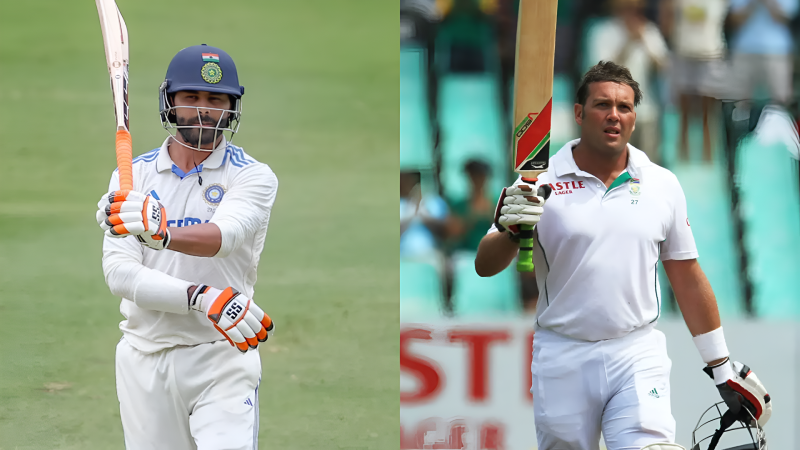

At the same 61-Test mark, the gap between them is startlingly small: just 0.059 of a ratio point. That number undercuts most of what gets said about this comparison, since Kallis is usually treated as untouchable and Jadeja as merely useful by comparison. A widely repeated claim in 2025 said Jadeja had broken Kallis’ all-time record for the longest reign as the world’s top-ranked Test all-rounder. Wisden checked the numbers and found that specific claim false, though a narrower, real comparison survives underneath the correction.
A Record Claim That Wasn’t True
Reports in May 2025 claimed Jadeja had set an all-time record by spending more than 1,150 consecutive days ranked the world’s number one Test all-rounder. Wisden investigated the claim and found it false. Kallis actually held that ranking from December 2006 to December 2011, a run of 1,827 days, nearly 700 longer than what was being celebrated as a record.
What Jadeja did surpass was a shorter, earlier Kallis stint of 1,149 days between 2002 and 2005, which got misreported as the full career record in several outlets at the time. The genuine comparison that survives the correction is narrower and more interesting than the headline ever was: how the two men’s numbers actually stack up at an identical career stage, Test for Test.
Ravindra Jadeja vs Jacques Kallis all-rounder ratio
Wisden’s own February 2023 analysis put a number on that stage-by-stage comparison using what it called an all-rounder ratio, batting average divided by bowling average.
Player | At 61 Tests | Batting Average | Bowling Average | Ratio |
Garry Sobers (1960s peak) | approx 61 | approx 57 | approx 35 | approx 1.83 |
Jacques Kallis | 61 | approx 50 | approx 31.6 | 1.581 |
Ravindra Jadeja | 61 (approx Feb 2023) | approx 36.5 | approx 24 | 1.522 |
Imran Khan | 61 | approx 32 | approx 22 | approx 1.47 |
At the same point in their careers, Kallis sat at 1.581 and Jadeja at 1.522, a gap of just 0.059. A ratio above 1.5 has historically been reserved for a small handful of genuine greats of the format, Sobers and Imran Khan among them.
A Metric That Strips Away Bias
Batting average divided by bowling average sounds simple, but Wisden described it as era-proof in a way raw run and wicket totals rarely are. A ratio above 1.0 means a player scores more runs per dismissal than they concede per wicket, a clean way of measuring genuine two-way value.
Wisden also noted the metric is less skewed toward batting-heavy all-rounders like Sobers and Kallis than a simple gap between the two raw averages would be on its own. Only four players in the format’s entire history have finished their careers above the 1.5 mark, which is exactly why a gap of 0.059 at the same career stage matters more than it might first appear on paper.
Where The Numbers Still Diverge
By 86 Tests, Jadeja’s ratio has climbed to roughly 1.545, built on a batting average near 38.73 and a bowling average around 25.07. That narrows his gap to the 61-Test Kallis mark down to 0.036, noticeably closer than it was at the equivalent earlier stage of his career.
Kallis’ full career figure sits far higher, around 1.696, built across 166 Tests on a batting average of 55.37 and a bowling average of 32.65. That number is the highest ever recorded for any player with 200-plus wickets and 5,000-plus career runs combined. Jadeja’s lower batting average remains the limiting factor keeping his own overall figure well below that historic peak for now.
Can The Gap Close From Here
Jadeja is 36 and still an active member of India’s squad, with Tests in Sri Lanka coming up on a Galle surface that has historically rewarded all-round contributions from spin-bowling batters especially. Sustaining both averages near their current levels would keep pushing his own ratio steadily toward 1.6 over the coming seasons.
Closing the remaining distance to Kallis’ finished career mark depends on repeating something close to his own 2023-24 peak, 527 runs and 48 wickets in a single calendar year, sustained across a longer final stretch of his career from here. The Ravindra Jadeja vs Jacques Kallis all-rounder ratio comparison will keep tightening either way, but reaching Kallis’ final number rather than just his 61-Test mark is a considerably taller order.
Does a 0.059 gap at the same career stage change how you rank Jadeja among the format’s great all-rounders? Drop your take in the comments.
Frequently Asked Questions (FAQs)
How long was Jadeja ranked the world’s number one Test all-rounder?
He held the number one ranking for 1,151 consecutive days as of May 2025. That is not an all-time record, since Kallis held the top spot for 1,827 days.
What is Jacques Kallis’ career batting average in Tests?
Kallis retired with a career batting average of 55.37 across 166 Test matches. He also took 292 wickets at a bowling average of 32.65 over that same span.
Is the claim about Jadeja breaking an all-time record true?
No, Wisden confirmed the record claim circulating in 2025 was false. Kallis held the number one ranking for 1,827 days between 2006 and 2011, longer than Jadeja’s run.
How many Test wickets does Ravindra Jadeja have?
He has taken 334 wickets in 86 Tests at a bowling average of 25.07. He has also scored 3,990 runs in that span at a batting average near 38.73.
Who are considered the greatest Test all-rounders by this kind of ratio?
Kallis, Sobers and Imran Khan are usually named among the greatest by career ratio. Kallis finished around 1.696, with Sobers close behind at his 1960s peak near 1.7.
Disclaimer: This blog post reflects the author’s personal insights and analysis. Readers are encouraged to consider the perspectives shared and draw their own conclusions.