

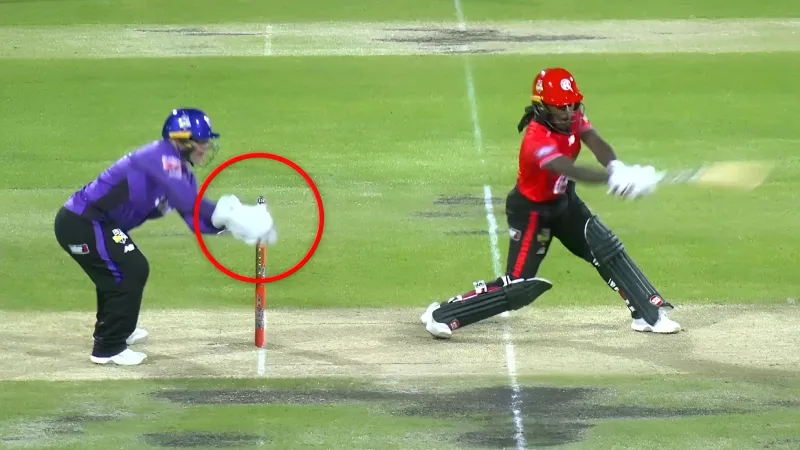

A wicketkeeper has to stay wholly behind the stumps until the ball is struck or goes past the wicket, and any breach is a no-ball that gifts the batters a run. That very law decided the game in Hobart on 4 November 2026. Melbourne and Hobart were tied on 154 with a single ball remaining, and Lizelle Lee gathered that last delivery ahead of the stumps. The umpires signalled no-ball, the extra run arrived, and the Renegades won without needing a Super Over.
The Final Delivery in Hobart
Hobart posted 7 for 154, built around Nicola Carey, who top-scored with 62 off 43 balls. Melbourne then needed five from the last three deliveries to win. Deandra Dottin found the third-man rope with an edge off the second-last delivery, and the scores were suddenly level.
Dottin swung and missed, but replays showed Lee gathering the ball ahead of the stumps. The umpires called no-ball, and the single extra run settled the contest at 6 for 155, a four-wicket win. Nobody needed a Super Over, even though the players had already started to gather for one.
WBBL 2026 Wicketkeeper No Ball Rule
The relevant clause is Law 27.3.1. It requires the keeper to remain entirely behind the stumps at the batter’s end from the instant play begins on that delivery. That duty lapses once the ball hits the bat or the batter, crosses the stumps line, or the batter sets off for a run.
Law 27.3.2 gives the umpire at the striker’s end the job of calling and signalling the no-ball. The batting side collects one extra run, which in Hobart happened to be the winning one. Gloves count as part of the keeper, a point the 2025 IPL case in the table below turned on. Intent plays no part in the decision, so even an accidental drift forward is punished.
Keepers Who Changed Matches
The keeper position has overturned wickets at global events, and in Hobart it created a run instead. Klaasen’s gloves cost Sunrisers a catch in 2025, while Campbelle in 2024 and Latham in 2023 each lost a stumping chance for the same reason. The glove line, rather than anyone’s intention, decides each call.
Taken together, the four rows show how much a few centimetres can matter at big tournaments. Three of them wiped out a dismissal, and the newest one handed over an entire match.
Date | Match | Keeper | What Happened | Result |
4 Nov 2026 | Hurricanes v Renegades, WBBL | Lizelle Lee | Took last ball in front of stumps | No-ball; Renegades won |
17 Apr 2025 | MI v SRH, IPL | Heinrich Klaasen | Gloves ahead of stumps; Rickelton caught at covers | Not out; no-ball |
Oct 2024 | West Indies v Bangladesh, Women’s T20 World Cup | Shemaine Campbelle | Gloves in front; Joty found short of her ground | Not out; no-ball |
9 Oct 2023 | NZ v Netherlands, ODI World Cup | Tom Latham | Collected in front; Engelbrecht stumping appeal | Not out; no-ball |
Umpires and the Moment of Contact
Officials focus on the exact instant when the ball meets the bat or crosses the stumps line. The keeper’s whole body, including the gloves, has to sit behind the wicket by then. If a dismissal is involved, the TV umpire studies replays before confirming anything. That second look is why wicket-taking no-balls usually surface within seconds.
These decisions still spark arguments. Ian Smith, himself a former keeper, took issue with the Latham ruling back in 2023. During the men’s 2022 T20 World Cup, Nurul Hasan of Bangladesh collected the ball early against Zimbabwe in Brisbane, and a run was added to the total. Bangladesh won anyway once the delivery was replayed.
Slow Over Rate Squeezed Hobart
Hobart had also been punished for bowling their overs too slowly, which meant only two fielders could stand outside the circle for the last three deliveries. Dottin’s edge off the second-last ball ran down to the deep third area, a spot where a boundary rider would probably have stood otherwise. The thinner ring turned a possible single into four.
So the Hurricanes were squeezed twice, first by that weakened field and then by a keeper standing too far forward. Any side defending a close finish should remember how narrow the margin is under the WBBL 2026 wicketkeeper no-ball rule. One careless step ahead of the stumps can cost a whole season’s momentum.
Should umpires check the keeper’s position on every final ball? Tell us in the comments.
Frequently Asked Questions (FAQs)
What does cricket’s keeper no-ball law say?
A keeper must stay wholly behind the stumps until contact is made with the bat or batter, the ball passes the wicket, or the batter runs. Any breach is called a no-ball, and the batters pick up a free run.
Who won the Hurricanes vs Renegades WBBL match?
Melbourne Renegades won by four wickets. They finished on 6 for 155 thanks to the no-ball’s extra run, chasing the Hurricanes’ total of 7 for 154 from their innings.
Is a keeper allowed ahead of the stumps?
Only once the ball has met the bat or batter, or gone past the stumps. Before that moment, any part of the keeper beyond the wicket line brings a no-ball call.
What happens if the keeper’s gloves are ahead of the stumps?
The umpire signals no-ball and a free run goes to the batters. Any catch or stumping from that delivery cannot stand, as Rickelton found in 2025 when he was caught at cover.
Which team sits bottom of the WBBL table?
Hobart Hurricanes are bottom, without a win and with zero points from three games. Melbourne Renegades are seventh on 2 points, which keeps them clear of last place.
Disclaimer: This blog post reflects the author’s personal insights and analysis. Readers are encouraged to consider the perspectives shared and draw their own conclusions.