

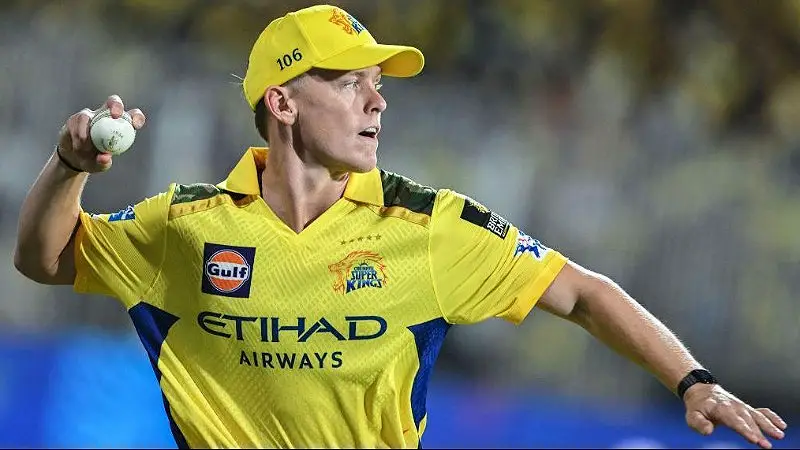

Nathan Ellis is the one bowler in the Chennai Super Kings’ squad who walks to the top of his mark in the 18th over without needing a plan adjusted for the situation. The yorker is his plan. The slower ball is his contingency. The wrist position that produces both from the same delivery stride is why opposition batters cannot settle against him even when they know what is coming. A hamstring injury has taken him out of the early phase of the tournament. CSK have Matt Henry, Khaleel Ahmed, Mukesh Choudhary, and Noor Ahmad available. None of them is Nathan Ellis at the death. The question is not whether this hurts; it does, but the question is whether the combination of what they have can cover the phases he leaves behind.
Ellis owned IPL 2026 Death Overs Alone
The reason Ellis’s absence creates a structural problem rather than a rotation problem is that he was not sharing the death over workload in CSK’s bowling plan. He was owning it. His skill set, reliable yorker execution under pressure, slower ball variation that generates mistimed shots rather than boundaries, and the composure to bowl overs seventeen to twenty without conceding the free hits that normally accompany high-risk lengths, was the entire last-four-overs plan.
Matt Henry offers genuine quality with the new ball and can produce wicket-to-wicket bowling in the middle phase. Jamie Overton brings pace. Neither carries the specific death over profile that Ellis developed through sustained international T20 experience. CSK’s bowling plan for the final phase needs rebuilding, not adjusting.
Noor Ahmad cannot Do This Alone
Noor Ahmad’s 24 wickets from IPL 2025 confirm he is a genuine match-winning option in the middle overs, where left-arm wrist spin on slow surfaces generates turn and bounce that troubles right-hand batters. His economy and wicket-taking record in that phase are elite. His death record is not. Bowling in the final three overs requires a specific skill, reading a batter who has assessed the situation for fifteen overs and arrived knowing exactly which lengths to attack.
That skill develops through experience in those overs, not through talent alone. Using Noor Ahmad as the primary death over option before he has accumulated that experience puts him in a situation where his middle-overs excellence becomes irrelevant, and his inexperience in a different phase decides matches instead.
The Shared Death Over Solution
The most defensible plan available to CSK without Ellis is distributing the death over responsibility across three bowlers rather than assigning it to one. Mukesh Choudhary bowls one over with his slower ball as the primary weapon. Khaleel Ahmed takes one over using left arm angle into the stumps against right-hand batters. Noor Ahmad absorbs one over using his wrist spin variation on surfaces that grip. The fourth over goes to whichever of the three has been most effective through the innings.
No single bowler carries the full burden. No single bowler accumulates the dot balls and boundary balls that define Ellis’s exceptional overs. What this plan produces is functional rather than decisive, contained damage rather than match-winning execution. Against most IPL batting lineups, functional is not enough in the final three overs.
- Can CSK’s batting depth compensate for Ellis’s absence, or does the death bowling gap cost them points they cannot recover in the playoff race? Drop your verdict in the comments and follow for IPL updates.
FAQs
Which CSK bowlers can cover death overs in IPL?
Besides Nathan Ellis, CSK may use Mukesh Choudhary, Khaleel Ahmed, or Noor Ahmad in rotation to handle the final overs.
Why is Nathan Ellis critical for CSK?
Ellis is a specialist in death overs, and his variations, like yorkers and slower balls, make him essential for controlling runs in the final stages.
Can Noor Ahmad handle the death bowling role?
While promising, Noor Ahmad’s IPL career experience is limited, so CSK will likely use him cautiously in conjunction with other bowlers.
How does IPL 2026 news describe CSK’s bowling balance?
Reports suggest the team is struggling to maintain overseas player balance while covering the death-over gap left by Ellis.
What happens if CSK fails to fix death bowling issues?
Ineffective death overs could lead to conceding crucial runs in close matches.