

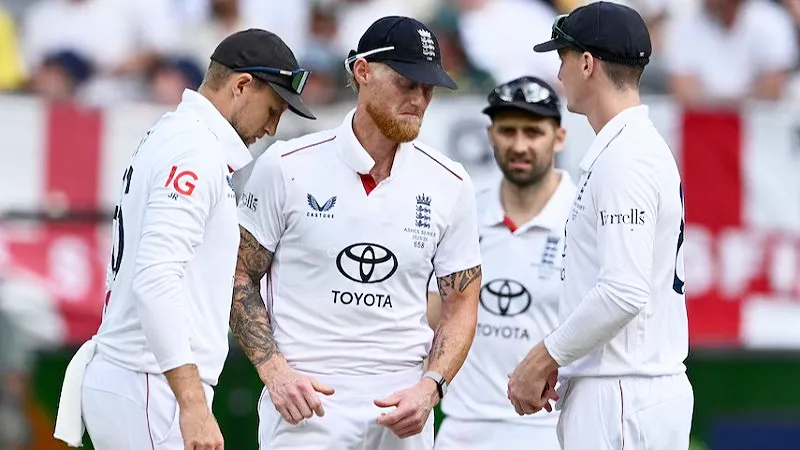

Ashes series are rarely lost in a single session, but they are often defined there. England’s latest Ashes campaign barely lasted 11 days, yet its post-mortem may take far longer because this wasn’t a failure of belief or ambition. It was a failure of timing.
Under Bazball, England promised fearlessness. What they instead encountered was Australia’s ruthless sense of when to strike. Ben Stokes summed it up bluntly after Brisbane: England “let the pressure and the occasion get to our decision-making.” Translation? The moments that tilt Tests are a 20-minute burst, a dropped catch, a mistimed shot repeatedly slipped through English fingers.
When Adelaide Slipped in 11 Balls
England were ahead. Not morally, actually. After Australia’s modest 132, Duckett and Pope had England 99 runs in front at lunch, with only one wicket down. In Ashes terms, this was leverage. Then Scott Boland happened.
In a sequence bordering on surreal, Boland removed Duckett, Pope, and Brook in 11 balls. Duckett fell to quality; Pope and Brook to impatience. Australia didn’t just seize a window; they kicked it open. Starc returned to remove Root and Stokes, and England’s advantage vanished in under an hour. Bazball didn’t fail here; execution did. This was the first key moment England let slide, and Australia never gave it back.
Australia’s Counterpunch That Broke Control
Head and Weatherald capitalised on width and half-volleys as England lost discipline. In seven overs, Australia blasted 64 runs, erasing a third of the target before England could reset. Carse and Wood leaked 41 runs in their first four overs; combined pressure evaporated instantly.
This was an experience in action. Pat Cummins later called it “having seen most situations before.” England bowled as if defending runs; Australia batted as if hunting momentum. That contrast defined another key moment that England never reclaimed.
The Night Session England Couldn’t Catch
If Adelaide Day Two under lights was England’s best chance, it was also their undoing. Australia were 4-290. The ball was new. History and England’s own collapse the previous evening suggested wickets were imminent. Instead, four catches went down in an hour.
Duckett dropped Carey. Duckett dropped Inglis. Carse spilled Neser. Root grazed another. None were simple, but Ashes moments rarely are. Australia survived the session, then built a 167-run lead the next day. What should have been England’s squeeze became Australia’s escape.
Starc’s Second New Ball Checkmate
Ben Stokes doesn’t often miss his moments. This time, he did. Having dragged England back from the brink alongside Jofra Archer, Stokes looked set to level the contest. Then came the second new ball and Mitch Starc’s trap. Two men on the boundary, a tempting single, a wobbly seam delivery through the gate. Game over.
Stokes’ reaction said everything: disbelief, rage, acceptance. England’s last realistic chance to keep the series alive died with that delivery. Australia had waited patiently; England had blinked. Again.
England didn’t lose the Ashes because Bazball is flawed. They lost because Bazball without precision is just noise. Every Test hinged on a handful of key moments: a spell, a catch, a ball, and Australia won nearly all of them.
This isn’t a call for England to retreat into conservatism. It’s a reminder that aggression must be selective. The Ashes punish impatience more brutally than any other contest in cricket. Until England learn not just how to attack, but when, the urn will remain exactly where it belongs on Australian soil.
Key Takeaway
England didn’t lose the Ashes playing brave cricket, they lost it by misreading the key moments that decide great series.
FAQs
- What were the key moments in England’s Ashes defeat?
Collapses after strong starts, missed catches under lights, and failure to capitalise on pressure spells.
- Why did Australia handle pressure better than England?
They recognised decisive phases and executed with clarity.
- How did Bazball influence the outcome?
It created opportunities, but poor execution during key moments undermined its impact.
Disclaimer: This blog post reflects the author’s personal insights and analysis. Readers are encouraged to consider the perspectives shared and draw their own conclusions.
Step into the world of cricket with JeetBuzz News—where expert opinions, trending Blogs, and behind-the-scenes insights meet all your favorite topics. Stay informed, stay entertained, and never miss the stories shaping the cricketing world—only on JeetBuzz News!