

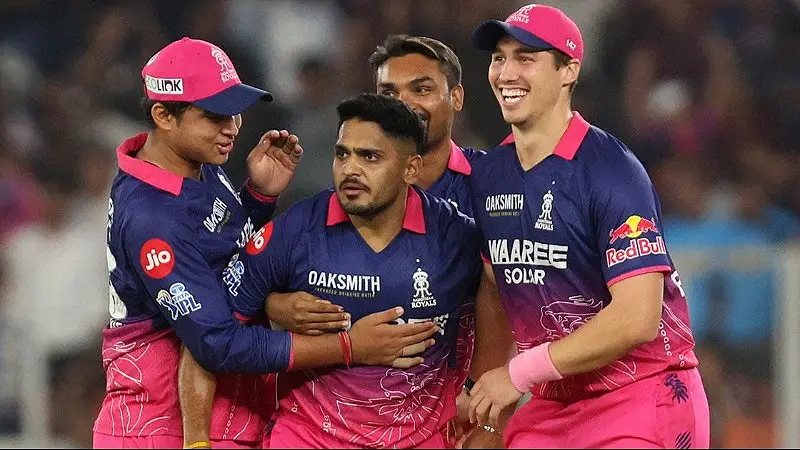

Eleven required. One over remaining. Elite finishers at the crease. The situation that separates death-over specialists from death-over experiments. Tushar Deshpande bowled six yorkers. Not six attempted yorkers with variations mixed in when the pressure climbed. Six yorkers. The four runs GT scored came from the margins of execution rather than from Deshpande changing his plan because the margin felt too thin. He chose his highest-skill delivery under the highest pressure conditions and trusted it repeatedly. GT got four. RR won by seven. One over. One delivery type. One performance that changed how Rajasthan Royals will think about who bowls the final over for the rest of the tournament.
One Delivery Type Bowled Six Times
The specific decision that made Tushar Deshpande’s final over exceptional wasn’t tactical complexity; it was tactical commitment. In T20 death overs, bowlers often mix pace, length, and angle to prevent batters from loading up for a single delivery type. The conventional wisdom is that variation prevents damage. Deshpande’s approach was the opposite: identify the delivery that gives the batter the least margin for error and bowl it six times, trusting execution over deception.
The yorker leaves minimal room for bat swing on a slightly gripping Ahmedabad surface. Six yorkers executed consistently mean six balls where the batter must generate their own pace rather than timing the bowler’s. GT’s finishers couldn’t generate enough.
The Field Setting That Changed Everything
The field placements that surrounded Deshpande’s yorker plan are what converted good deliveries into unplayable ones rather than expensive boundaries. Against left-handers, the offside protection meant squeezed shots through the offside produced singles rather than the boundary that a slightly wider yorker would normally concede.
Against the aggressive right-hand finisher, leg-side boundary riders created a specific pressure zone, scoring through leg required a perfect contact shot that the yorker’s trajectory makes very difficult. Every delivery had a specific field to support it rather than a generic defensive setting. Deshpande wasn’t just executing the yorker; he was executing it into a field that made even the imperfect yorker difficult to get out of the boundary.
IPL 2026 Confirmed Deshpande’s Death Over Role
The context of this performance is what makes it significant beyond the single match result. Death-over bowling in the Indian Premier League requires not just the physical ability to execute yorkers but the psychological profile to choose yorkers when the match is alive and the alternative feels safer. Eleven needed, one over remaining, tournament points at stake, that environment produces the half-volley length that gets hit for four or the wide yorker that becomes a full toss.
Deshpande chose the correct delivery and executed it under conditions that expose psychological fragility as readily as technical inadequacy. Rajasthan Royals needed to know if he could do it in a match that mattered. He answered that question definitively.
RR Found Their Death Over Specialist
The tournament-level implication of this performance is that Rajasthan Royals now have confirmed evidence about their death-over bowling hierarchy. Previously, Deshpande was supporting bowling, used in non-critical phases, while Jofra Archer took the match-defining overs. This performance shifts the allocation question.
A bowler who executes six yorkers under maximum pressure is a bowler who gets trusted with maximum-pressure situations going forward. RR’s captain Riyan Parag will approach close matches differently now; the final-over decision has an answer that wasn’t as clear before Ahmedabad. That clarity is worth more than any single match result.
- Does Tushar Deshpande make RR’s death-over bowling the most dangerous in the tournament, or does one exceptional performance set an expectation that the next close match tests immediately? Drop your take and follow for IPL updates.
FAQs
What made Tushar Deshpande effective in the final over vs GT?
His consistent yorker length and clear field alignment limited boundary options and forced low-risk scoring.
Why are yorkers crucial in IPL death overs?
Yorkers restrict bat swing and power, making them one of the safest deliveries under pressure.
How did the Rajasthan Royals plan the final over strategy?
They backed a fixed plan with specific field placements instead of changing tactics ball by ball.
Can Tushar Deshpande become a regular death bowler for RR?
If he maintains execution consistency, he has a strong chance to secure that role.
What happened in the GT vs RR final over in IPL 2026?
GT needed 11 runs, but Deshpande conceded only 4, sealing the win for the Rajasthan Royals.