

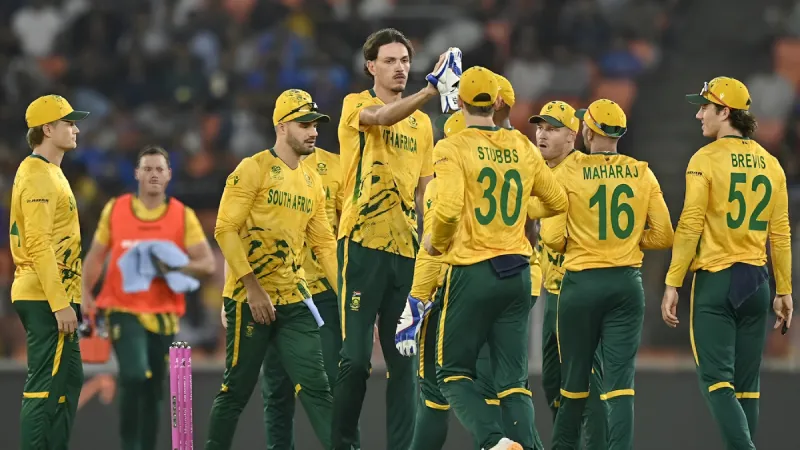

Five semifinal exits. Men and women. Tournaments spanning 27 years. Different captains, different generations, different opponents. The same result. South Africa arrive at knockouts as competitive sides with genuine match winners in their lineups and leave with the same questions about batting collapses, tactical rigidity, and an inability to perform when the margin for error disappears entirely. The 2026 exit against New Zealand is the latest entry in a pattern so consistent it has stopped feeling like bad luck and started feeling like something structural.
2026: Nine Wickets and No Answers
South Africa posted 169 for 8 at Eden Gardens and lost by nine wickets. Finn Allen scored 100 off 33 balls, and the chase was over before South Africa’s bowlers found their rhythm. Marco Jansen conceded 53 in 2.5 overs. Keshav Maharaj went for 33 in three. The field placements stayed defensive when aggression was the only option, and the pace strategy never adjusted to a dew-affected surface that removed the bowlers’ primary weapons.
Tristan Stubbs made 29 not out, and Jansen’s late 55 gave the total some respectability. But 169 was never enough on that surface against that batting lineup. South Africa scored 77 for 5 in 10.2 overs at the halfway point of their innings. That is the match lost, not in the bowling, not in the final overs, but in the powerplay and the early middle phase, where the innings never found the acceleration it needed.
2015: Pacing an Innings Proved Impossible
Against New Zealand in Auckland, South Africa scored 281 for 5 and still lost. A DLS revised target of 298 under lights proved beyond them despite AB de Villiers making 65 and Faf du Plessis contributing 82. Grant Elliott’s unbeaten 84 for New Zealand was the innings that broke them, but South Africa’s inability to pace their own innings in the middle overs created the situation where 281 was not enough.
T20 World Cup Knockout Curse Explained
The T20 World Cup knockout record for South Africa reflects a specific tactical failure that transcends individual tournaments. In 2014, the women’s side was bowled out for 101 against England, losing by nine wickets after misreading England’s opening partnership strategy entirely. In 2022, Sophie Ecclestone took 6 for 36 and demolished a women’s lineup that had performed consistently through the group stage.
Both collapses share a common thread with the men’s exits: the team that performed with structural clarity in the group stage abandoned that clarity the moment knockout pressure arrived. Plans that worked for six consecutive matches stopped working in the seventh. That is not a coincidence. It is a pattern of tactical rigidity that cannot adapt when the opposition raises its intensity by the margin that knockout cricket demands.
1999: Two Run Outs Ended Everything
The 1999 ODI semifinal against Australia at Edgbaston remains the most painful entry on this list. South Africa needed one run off the final ball to win. Lance Klusener pushed it into the offside and ran. Allan Donald did not. The runout ended the match in a tie, and Australia advanced on a higher run rate from the earlier group stage game.
Two critical run-outs in the closing overs. Poor decision-making under the specific pressure of a match decided by margins. It was 27 years ago, and it is still the image most associated with South African knockout cricket because every exit since has echoed something from that afternoon.
What the Pattern Actually Tells Us
South Africa is not a weak side. They are consistently one of the most competitive teams in world cricket across both genders. The knockout problem is not about talent. It is about the gap between how they prepare for group stage cricket and how they prepare for the specific demands of a match where losing means going home.
Group stage cricket rewards consistent execution of a fixed plan. Knockout cricket rewards the ability to abandon that plan the moment it stops working and replace it with something the opposition has not prepared for. South Africa has the players to do that. They have not yet built the tactical culture that makes it automatic when the pressure peaks.
Can South Africa finally build the knockout mentality their talent deserves, or does the pattern run too deep to fix with a new captain and a new cycle? Drop your take in the comments and follow for T20 World Cup updates.
FAQs
Why does South Africa choke in World Cup semifinals?
Repeated tactical errors, batting collapses under pressure, and poor adaptation to conditions contribute to semifinal failures.
Can the Proteas overcome semifinal struggles in the upcoming ICC tournaments?
With improved tactical planning, better powerplay utilization, and death-over strategies, South Africa can potentially reverse its knockout misfortunes.
Is pressure the main reason South Africa fails in ICC knockout games?
Pressure is a factor, but poor tactical decisions, unbalanced batting line-ups, and lack of contingency plans also play significant roles.
Disclaimer: This blog post reflects the author’s personal insights and analysis. Readers are encouraged to consider the perspectives shared and draw their own conclusions.