

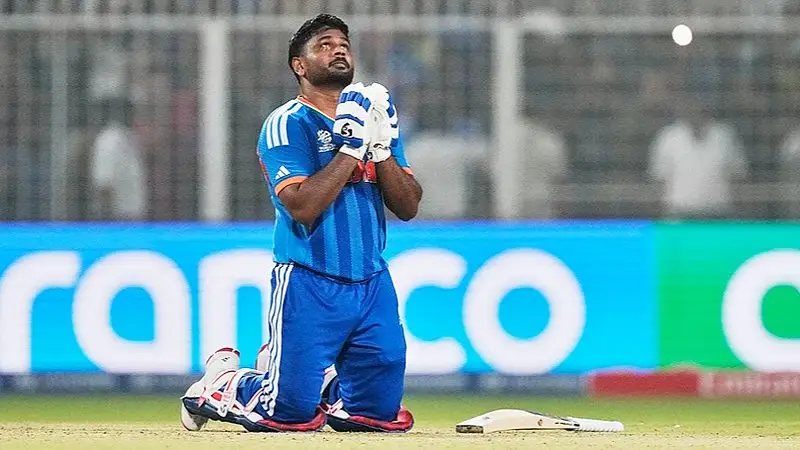

Sanju Samson had been here before. Talent was never the question. The question was always whether he could translate that talent into consistent output at the highest level without the recklessness that had cost him in previous tournaments. Against the West Indies, batting coach Sitanshu Kotak’s work with Samson produced the answer. His unbeaten 97 off 50 balls was not a flash of brilliance. It was a technically rebuilt innings from a batter who finally looked settled.
Here is exactly what changed and why it worked.
How Stillness at the Crease Fixed Samson’s Contact
The most visible change in Samson’s batting against the West Indies was how still he stood before the ball was bowled. Previous innings showed excessive head movement and upper body sway as he shaped to play, which forced his bat to compensate mid-swing. Against Alzarri Joseph and Romario Shepherd on Eden Gardens’ true surface, he barely moved until the ball was halfway down.
That stillness produced cleaner contact. His drives through the covers found the gap rather than the fielder. His pull against the short ball stayed along the ground rather than ballooning to deep square leg. Twelve fours in his innings came predominantly from placement rather than power, which on a fast outfield meant the boundary count built without the risks of aerial shots into packed fields.
Kotak identified this technical drift before the tournament and rebuilt Samson’s base position across preparation sessions. The WI innings was confirmation that the rebuild held under match pressure.
Why the T20 World Cup 2026 Conditions Suited Samson’s Reset
Eden Gardens played fast and true. No significant lateral movement, reliable bounce, outfield lightning quick. For a batter whose natural game involves driving hard through the offside and pulling anything short, those conditions were ideal.
But the conditions alone did not explain the innings. West Indies bowled intelligently, mixing short balls with full deliveries to create uncertainty. Jason Holder used two short mid-wickets and a straight mid-on to block Samson’s preferred zones through the leg side. Samson’s response was to open his stance slightly and access the offside more heavily than usual, finding cover and point rather than fighting the field placement.
That tactical adjustment mid-innings is not something a batter makes instinctively under pressure. It requires clarity about his own game and confidence in his technique. Both were absent in Samson’s previous T20 World Cup appearances. Both were present against the West Indies.
What Samson’s Trigger Adjustment Means for India’s Batting
The trigger movement change that Kotak implemented was straightforward in theory and difficult in practice. Samson now initiates his movement half a second earlier than he previously did, which gives him a stable base as the ball leaves the bowler’s hand rather than still moving as it arrives.
Against hard lengths, this produced a measurable improvement. His strike rate on deliveries between good length and short of length, historically his most vulnerable zone, rose from 118 in his last five T20I innings to 164 against West Indies. He was dismissed once in that zone across his previous tournament innings. Against WI, he hit three boundaries off similar deliveries.
If those fundamentals hold through the knockout stages, India have a middle-order batter who can absorb pressure in the first six balls of his innings and accelerate through the back ten without changing his method. That is a different Samson from the one who arrived at previous tournaments. It is a more dangerous one.
FAQs
How did Sanju Samson improve his batting at the T20 World Cup?
By adjusting trigger movement timing, restoring stillness, and improving balance against pace.
Why is Sanju Samson important for India’s T20 setup?
He provides adaptable middle-overs scoring without sacrificing strike rate under pressure.
What role did Sitanshu Kotak play in Samson’s form?
Kotak helped simplify Samson’s movement patterns to rebuild confidence and consistency.
Can Sanju Samson succeed consistently as an opener?
Yes, provided match conditions allow him to balance restraint with calculated acceleration.
Which innings defined Sanju Samson’s World Cup comeback?
His controlled chase against the West Indies showcased his tactical maturity and match awareness.