

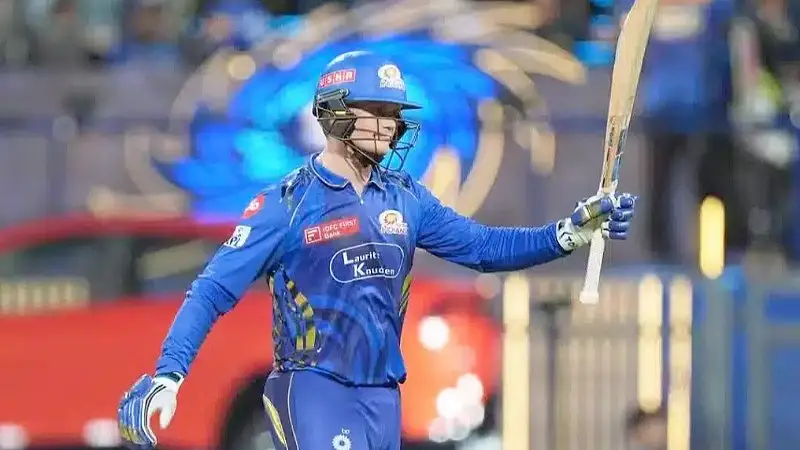

Ryan Rickelton started this season as the Mumbai Indians’ first-choice opener. He earned that position through form and the kind of early promise that gives selectors confidence in a long-term plan. Then Quinton de Kock came back in, faced his first ball after sitting out, and scored 112 not out off 60 balls. Not a scratchy, fortunate innings that happened to go big. A controlled, paced, pressure-absorbing century that carried Mumbai to a competitive total almost entirely on his own. Whatever plan MI had around Rickelton’s development, that performance forced a conversation nobody in the dressing room was expecting to have this quickly.
De Kock Walks Back In and Delivers
The context of de Kock’s century matters as much as the innings itself. He didn’t walk into a comfortable match situation against a weak attack with the team cruising at 80 for 1. He came in when wickets had fallen early, when the innings needed someone to absorb the pressure and rebuild without sacrificing scoring rate, and he produced a 186.66 strike rate while doing it.
That combination of structural composure and aggressive output simultaneously is the specific skill set an opener needs when a T20 innings has been disrupted early. Most batters can do one or the other. They can anchor and score slowly, or they can attack and risk their wicket. De Kock did both across the same innings, and he did it in the kind of match situation where most experienced players would have tightened up and settled for getting through.
IPL 2026 and Rickelton’s Fading Case
The awkward reality of Rickelton’s situation is that he hasn’t done enough to make the decision difficult. His early 80-plus score gave MI a genuine reason to back him, and the initial selection ahead of de Kock reflected a considered choice rather than an impulsive one. What followed hasn’t matched that opening statement.
Modest returns and limited double-digit contributions in subsequent matches haven’t built on the promise of that first innings. In a tournament where every game carries playoff implications, selectors can’t hold a spot open indefinitely for a player who showed potential in one match but hasn’t converted it into consistent impact. Rickelton hasn’t failed dramatically. He’s done something harder to work with; he’s been fine without being convincing, which, in a team with de Kock available and a century on the board from his last appearance, is no longer enough to hold the position.
The Overseas Slot Complication
The selection decision between these two doesn’t exist in isolation. Picking one over the other directly shapes which other overseas players MI can fit into their XI, and that knock-on effect runs through the entire team combination.
De Kock as a confirmed starter simplifies the equation around his slot while creating complexity elsewhere. Rickelton’s inclusion offered MI flexibility in a different direction. Neither option is straightforwardly better for the overall balance; it depends on which other overseas players MI are prioritising in the bowling and all-round positions. What de Kock’s century has done is shift the question from “which opener gives us the best XI balance” to “which opener gives us the best chance of posting or chasing a competitive total.”
What the Mumbai Indians Do Next
Tournaments don’t reward long-term planning over short-term results. They reward the team that fields the best XI for the next match. Right now, de Kock has made the argument for that position in the most convincing way available, not in a training session, not in a warm-up game, but in a competitive IPL fixture against a quality attack when the innings needed him most. Whether MI sticks with that momentum or rotates back to Rickelton for combination reasons will define not just their opening position but the message they send to both players about what actually earns a spot in this team.
- Should MI stick with de Kock or bring Rickelton back for team balance? Drop your pick in the comments and follow for IPL updates.
FAQs
What makes Quinton de Kock a better opener for the Mumbai Indians?
His ability to handle pressure, control innings tempo, and convert starts into big scores gives him an edge.
Why was Ryan Rickelton preferred earlier in IPL 2026?
He offered form, freshness, and a long-term option, which MI initially prioritized.
How does MI vs PBKS impact this selection decision?
De Kock’s century in that match significantly strengthened his case as a first-choice opener.
Which opener fits better in Indian Premier League conditions?
De Kock’s experience across seasons makes him more adaptable to varying match situations.