

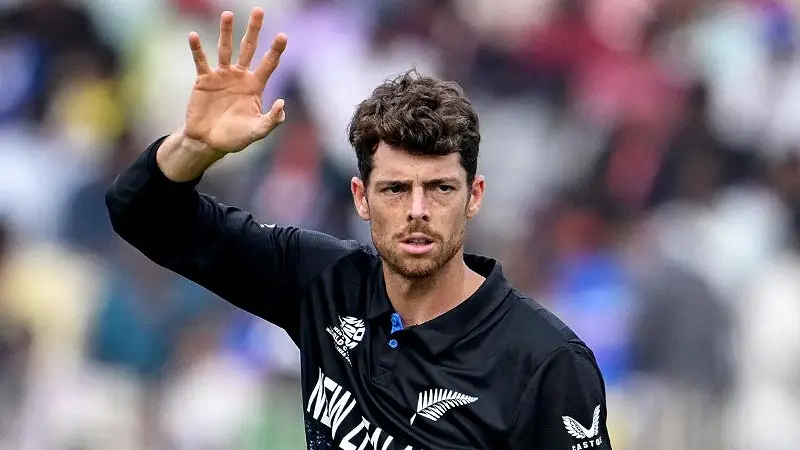

Mitchell Santner does not captain the way most T20 leaders do. There are no dramatic gambles, no panic field changes, no ego-driven bowling spells extended past their usefulness. His method is quieter and more calculated: strangle the middle overs, trust the spinners, and let the pressure build until the batting side makes the mistake. At Eden Gardens, with South Africa waiting in the semi-final, that method is about to face its sternest examination.
How He Controls the Middle Overs
The phase between overs 7 and 15 is where Santner does his most important work. As a left-arm spinner leading the attack in that window, he sets the tempo before his fielders do. When he lands his stock delivery on a wearing surface, the scoring options shrink. Batters cannot drive, cannot sweep safely, and cannot afford to wait because the required rate keeps climbing.
New Zealand’s blueprint under Santner is to make this phase feel longer than it is. Two tight overs at the start of the middle period force a batter into a decision they are not ready to make. That is not luck. It is architecture.
Reading Batters Before They Settle
What separates Santner from a competent spinner is his ability to adjust before a batter gets comfortable. He watches early footwork and triggers movements to decide whether to push the ball wider or drag it into the stumps. Against batters who press forward early, he holds his length back. Against those who wait deep in the crease, he goes fuller.
That reading of intent means he rarely bowls a bad ball by accident. When he does concede a boundary, he recalibrates rather than retaliates. South Africa’s power hitters thrive when bowlers lose their plans under pressure. Santner does not give them that opening.
T20 World Cup 2026 Pressure Decisions
The moments that define captaincy rarely appear in scorecards. In tight T20 World Cup 2026 group stage fixtures, Santner has made bowling changes that looked conservative in real time but proved correct by the final over. He pulls back a seamer one over early if the dew has arrived. He brings Ish Sodhi on against a left-handed batter who has not yet faced leg spin in the innings. These are small decisions that accumulate into structural advantages.
What His Bowling Numbers Actually Mean
Santner has bowled over 400 overs in T20 international cricket and maintained an economy rate that places him among the top ten left-arm spinners in the format across that workload. That is not a volume stat. That is a consistency benchmark. Bowlers who go at under 7.5 per over for 400 overs in T20 cricket are doing something repeatable, not something fortunate.
In this tournament, he has taken wickets at the right moments rather than in clusters, which is the harder skill. A middle overs wicket that ends a 40-run partnership is worth three tail-end wickets in terms of match impact. His numbers reflect that understanding.
Why NZ Trust Him in Knockouts
Knockout cricket rewards captains who do not change their approach under pressure. Santner’s game plan in a semi-final looks identical to his game plan in a group stage fixture. The field settings are the same. The bowling rotations follow the same logic. That predictability sounds like a weakness, but it is actually a strength. His players know exactly what is expected of them because the captain never second-guesses the plan publicly.
Against South Africa, Markram, Miller, and Brevis will test consistency. If Santner gets through their middle order phase without conceding a cluster of boundaries, New Zealand control the match. He has done it before in knockout conditions. The question is whether he can do it when the margin for error is zero.
FAQs
What makes Mitchell Santner’s captaincy different from previous New Zealand leaders?
He focuses more on middle-over control and match tempo management rather than aggressive powerplay dominance.
How does Mitchell Santner perform in ICC Men’s T20 World Cup matches?
He contributes through economical spin and useful lower-order runs, strengthening New Zealand’s balance.
Why is New Zealand vs South Africa tactically important in T20 tournaments?
Both sides rely on structured game plans, making captaincy decisions and overmanagement crucial.
Can Mitchell Santner be considered an all-round T20 captain?
Yes, because he contributes with both bat and ball while leading strategically.