

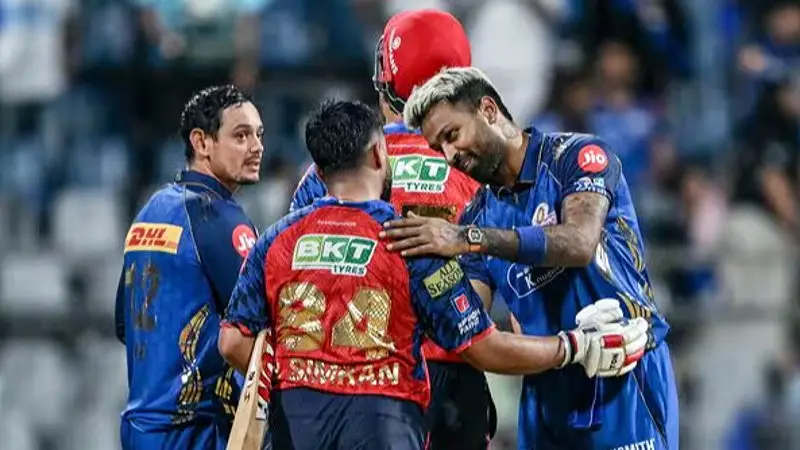

The Mumbai Indians have not been losing games in the power play. Their top order has generally given them decent starts and put them in positions where a competitive total or a manageable chase should follow. The problem arises the moment the power play ends. Overs 7 to 15 have become a graveyard for MI’s innings, where scoring rates collapse, dot balls pile up, and the momentum built in the first six overs disappears almost immediately. This is not a coincidence or a one-off. It is a pattern, and it is costing them matches.
How MI Keep Falling in the Midgame
Opposition teams have worked out exactly how to hurt the Mumbai Indians in the middle overs. The formula is straightforward: introduce spin early in that phase, vary pace relentlessly, and force MI’s batters into low percentage shots by denying them easy singles.
It’s working every time. Instead of rotating strike and building pressure gradually, MI batters are reaching for boundaries they haven’t earned. Wickets fall in clusters, the innings loses its shape, and suddenly a platform of 60 for 1 after six overs becomes 95 for 4 after fifteen. That transition phase is where this campaign is being decided, and MI has no reliable answer to it yet.
Role Confusion Hurting Pandya and Varma
The deeper problem behind the middle overs collapse is that nobody in MI’s batting lineup seems entirely sure of their role once the powerplay ends. Hardik Pandya is the clearest example. He arrives at the crease caught between two modes, neither fully anchoring nor fully attacking, and that hesitation shows in his shot selection. Forcing drives down the ground before he has timed one delivery is a recurring pattern that keeps ending the same way.
Tilak Varma’s struggles against spin compound the issue. He neither accelerates through that weakness nor finds a way to rotate around it, which means he essentially gifts opposition captains a free tactical weapon to use against him every single game. Two key middle-order batters both stuck in uncertainty at the same time is a structural problem, not a form slump.
IPL 2026 Exposes Suryakumar’s Slower Start
Suryakumar Yadav taking extra deliveries to settle before attacking is a strategic shift that simply does not suit the position MI needs him to fill in. When Mumbai is chasing big totals, which happens regularly, given their bowling struggles, every ball Suryakumar spends getting his eye in is a ball that the required run rate is climbing further out of reach.
The ripple effect is severe. Other batters further down the order see the asking rate climbing and start swinging at deliveries they should be manipulating. That panic hitting then causes further collapses, and suddenly a chase that looked manageable at the halfway point becomes impossible by the 16th over. Suryakumar’s individual numbers may look reasonable in isolation. Within the context of MI’s chase situations, his approach is contributing to a bigger problem.
The Pattern That Will Not Stop
The numbers across MI’s matches in IPL tell a consistent story. Boundary frequency drops sharply once the power play ends. The dot ball percentage rises. The scoring rate that looked healthy after six overs looks damaging by the 12th. Teams have identified this vulnerability and are deliberately targeting it by bringing spin on early and staying patient while MI self-destructs.
Without a tactical adjustment from the coaching staff and genuine role clarity from the batters themselves, this pattern has no reason to change. The talent in MI’s squad is not the question. The question is whether they can organize it into something that functions as a unit rather than a collection of individual efforts.
- Which MI batter do you think needs to step up and solve the middle overs problem first? Drop your pick in the comments and follow for IPL updates.
FAQs
What is causing the MI batting collapse in the middle order in IPL 2026?
The main causes are poor shot selection, lack of strike rotation, and confusion in batting roles during the middle overs.
Why is Suryakumar Yadav starting slow?
He appears to be adjusting his approach to stabilize innings, but it is delaying acceleration and affecting team momentum.
How serious are Hardik Pandya’s batting issues?
His inconsistency and forced shot-making are hurting MI’s ability to build partnerships in pressure situations.
Which team has a better middle order, MI or RCB?
Currently, the Royal Challengers Bengaluru have a more structured and effective middle-order approach compared to MI.