

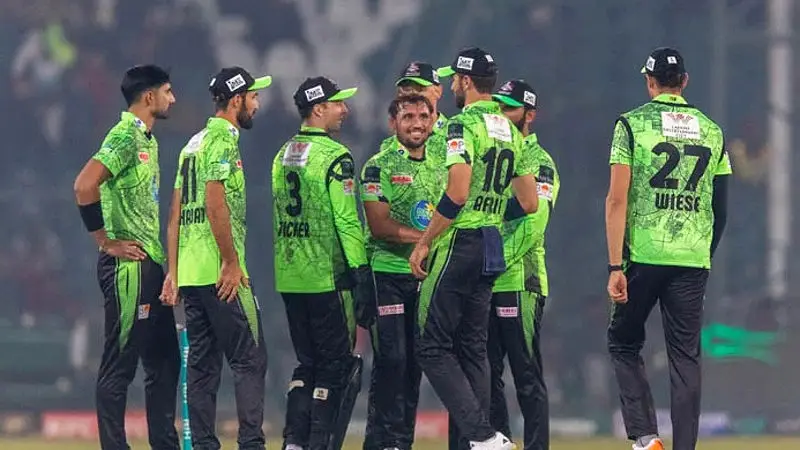

Lahore Qalandars have the playing resources to challenge any side in this competition. They also have the results to confirm that those resources haven’t been applied effectively. Spin vulnerability, a fragile middle order, and a bowling unit that leans far too heavily on one name have combined into a pattern that now defines their campaign more clearly than any individual performance. These are not isolated bad days. They are structural problems repeating across different opponents and different venues, and the scoreboards are making that impossible to ignore.
Karachi’s Spin Trap Exposed LQ
Moving from Lahore’s flat, fast surfaces to Karachi’s slower, grippier pitches required an immediate tactical shift. Opposition captains recognised the opportunity before LQ’s batting unit recognised the threat. An attack built around spin through the middle overs generated mistimed shots, false strokes, and wickets in clusters, and LQ walked straight into that plan without adjusting.
The correct response on a slow surface is rotation, patience, and waiting for the bad ball. LQ’s response was to keep attacking at the tempo Lahore surfaces reward. In PSL 2026, scores of 100 against Islamabad United and 97 against Peshawar Zalmi arrived on Karachi pitches against sides that loaded spin into the middle overs specifically to target LQ’s preference for aggression. Those collapses are not bad luck.
The PSL 2026 Middle Order Meltdown
Fakhar Zaman at the top remains a genuine match-shaping option on his day. The problem surfaces immediately after he departs. The middle order sitting behind him lacks the depth and role clarity to handle transition phases without losing momentum rapidly.
Sikandar Raza and Asif Ali are capable contributors when conditions are right. Those conditions require them to bat with a platform already built beneath them. LQ consistently asks both batters to rescue innings rather than accelerate them, a situation that limits what any middle-order player can produce regardless of quality. Between overs 7 and 15, LQ’s scoring rate has dropped sharply in multiple matches, handing back momentum at exactly the phase where the innings should be pressing hardest.
Shaheen Alone Cannot carry the Bowling
Shaheen Shah Afridi has delivered exactly what was expected. His spells have been consistent, threatening, and genuinely wicket-taking at moments that matter. The issue is that Shaheen cannot bowl from both ends simultaneously, and the support around him has been insufficient when LQ needed it most.
Haris Rauf has been expensive in crucial phases this season. The absence of Naseem Shah through injury removed the one bowling option most capable of sharing Shaheen’s workload and applying pressure from the other end. When one end leaks at a rate that undoes whatever damage Shaheen creates, even an excellent spell from the senior bowler becomes a contribution without consequence.
The Numbers Behind LQ’s Decline
The results table confirms what each match already suggested.
Opponent | Result | Margin | LQ Score | Opponent Score |
|---|---|---|---|---|
Hyderabad Kingsmen | Won | 69 runs | 199/6 | 130 |
Karachi Kings | Lost | 4 wickets | 128/9 | 131/6 |
Multan Sultans | Won | 20 runs | 185/5 | 165/5 |
Islamabad United | Lost | 9 wickets | 100 | 104/1 |
Peshawar Zalmi | Lost | 76 runs | 97 | 173/7 |
Quetta Gladiators | Lost | 6 wickets | 134 | 138/4 |
Rawalpindiz | Won | 32 runs | 210/4 | 178/9 |
Four losses against three wins. The winning totals sit between 185 and 210. The losing totals sit between 97 and 134. There is no overlap. LQ either bats well and wins or bats poorly and loses heavily. A team with no middle ground between those outcomes is impossible to rely on.
What LQ Must Change Right Now
The problems are identifiable, which is one advantage LQ holds right now. Their spin vulnerability demands a genuine batting adjustment on slower surfaces, rotation over aggression, cleaner strike rotation between overs 7 and 15, and fewer attempts to hit across the line against quality spin. That requires a shift in approach that must be coached and committed to before the game rather than discovered after the third wicket falls.
The middle-order fragility requires a clear role definition before every match. Raza and Asif Ali need to know whether they are building or rescuing on a given day, because those two tasks require entirely different approaches, and currently, LQ is asking both batters to figure it out mid-innings.
Without Naseem, Rauf carrying the support bowling role responsibly is non-negotiable. LQ still has the talent for a playoff push. Whether they apply it with enough tactical awareness is the only question remaining, and right now, the honest answer is uncertain.
- Between the spin vulnerability and the middle-order collapse pattern, which problem do you think LQ absolutely must fix first to save their PSL campaign? Drop your pick in the comments and follow for PSL updates.
FAQs
Why are Lahore Qalandars struggling?
They are struggling due to poor performance against spin, middle-order collapses, and inconsistent bowling support.
How has spin affected Lahore Qalandars’ batting?
Spin bowling has slowed their scoring rate and triggered collapses, especially in the middle overs on Karachi pitches.
What is the biggest weakness of LQ?
Their inability to stabilize innings after the power play is the most consistent weakness.
Which area needs the most improvement for LQ?
Their middle-order batting and death bowling require immediate tactical correction.