

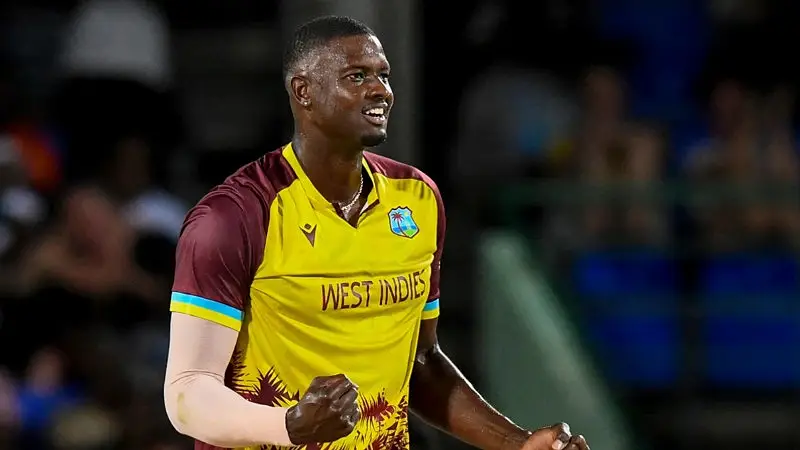

The West Indies have always been a team of match-winners. But match-winners need someone to hold the structure together, and that’s exactly what Jason Holder does. His 100 T20I wickets didn’t arrive by accident. They came from being the man captains turn to when the game is slipping, when the batter is set, when the over needs to be survived. That kind of reliability is what the West Indies are banking on again.
Specialist Phases, Sharper Execution
Gone are the days when Holder was asked to plug gaps across every part of an innings. West Indies now deploy him with precision either to create early breakthroughs in the powerplay or to lock down the death overs when run rates spike. That clarity of role matters more than most fans realise. When a bowler knows exactly what he’s walking into, his preparation sharpens. His field settings are pre-planned. His length is locked in before he reaches the top of his mark. For younger bowlers watching, it also removes the anxiety of unclear expectations; they see a senior pro operating with purpose, not improvising.
One Statistic That Tells the Whole Story
100 T20I wickets for West Indies. Holder is the only player in their history to reach that mark. But the number alone isn’t what makes it significant; it’s when those wickets came. Death overs. Powerplays. Moments where a bad over doesn’t just cost runs, it hands a team the match. Keepers of that kind of record don’t get there by bowling in garbage time. They get there because captains keep handing them the ball in situations that matter.
How Jason Holder’s T20 World Cup Conditions Work in His Favour
On the used, gripping pitches that ICC tournaments tend to produce deep into knockout rounds, Jason Holder’s T20 World Cup effectiveness reaches its peak. His 1.96m frame lets him extract awkward bounce even when a surface has flattened out. Hard lengths that sit up uncomfortably at chest height become far more dangerous than cutters or slower balls on a gripping track. And when conditions do assist seam movement, his ability to hold length and hit a nagging line means even settled batters can’t free their arms. Most seamers struggle to adapt when pace isn’t the primary weapon. Holder doesn’t. That adaptability is what separates tournament bowlers from the ones who go missing in knockout cricket.
The Leadership Nobody Talks About
Holder hasn’t captained West Indies in this format for a while now. But leadership doesn’t expire with the armband. Watch him between deliveries, the field placements he suggests, the words he has with a young bowler after a bad over, the calm he projects when a powerplay goes wrong. West Indies have historically self-destructed not through lack of talent but through lack of composure at critical moments. Having Holder in the dressing room and on the field acts as a pressure valve; it gives the team permission to stay calm because someone experienced is already calm.
When West Indies Need Him Most
Tight chases. Defending modest totals. Any game where the margin between winning and losing is one point. That’s Holder’s territory. He’s not there to win matches by himself; he’s there to make sure West Indies don’t lose them through a collapse of discipline in the 18th over. That distinction is vital. The West Indies have enough match-winners. What they’ve sometimes lacked is the control that keeps those match-winners in the game long enough to decide it. If he stays fit and gets his overs in key phases, Holder could be the difference in the match against India.
Key Takeaway
His T20 World Cup value lies in control, clarity, and composure, the traits West Indies need most in tight matches.
FAQs
What role does Jason Holder play for the West Indies in the T20 World Cup?
He operates as a senior all-rounder focused on key bowling phases and on-field leadership rather than volume overs.
Why is Jason Holder important despite not being the captain?
His experience, decision-making, and calm under pressure influence outcomes beyond formal leadership roles.
How many T20I wickets has Jason Holder taken for the West Indies?
He is the only West Indian to reach 100 T20I wickets, highlighting long-term consistency.
Can Jason Holder still play other formats after the T20 World Cup?
He has not ruled out future involvement in longer formats, depending on team needs and fitness.
Is Jason Holder’s impact more tactical or emotional?
Primarily tactical on-field, with secondary influence through mentorship and team stability.