

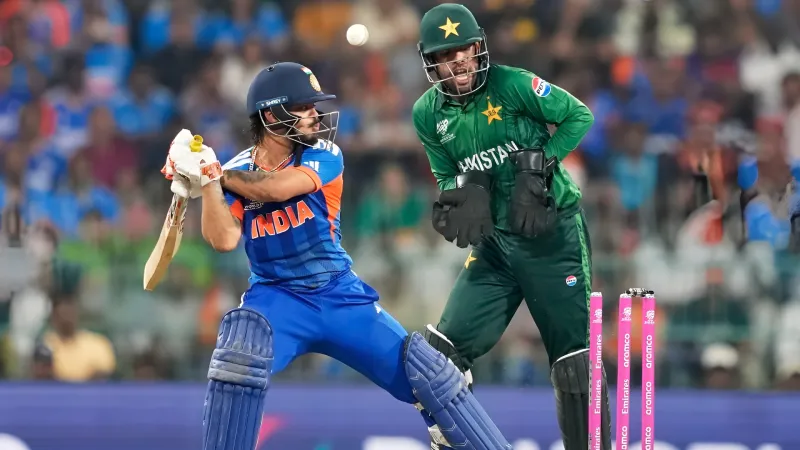

India’s off-spin issue in the T20WC has quickly become a clear tactical focus because India vs spin numbers, repeated wicket loss patterns, and the visible India left-hand batters off spin weakness have encouraged opponents to attack with this method. Teams targeting India with off-spin have found success, including notable spells against India on Wednesday that showed how match-ups, angles, and conditions can slow India’s scoring. This trend is not random. It reflects tactical planning against India’s batting structure in the World Cup.
Left-Hand Heavy Batting Risk
India’s top order composition plays a major role in the India off-spin issue at the T20 World Cup. A batting lineup filled with left-handers naturally creates favorable angles for off-spinners, especially early in the innings when field restrictions apply. Off-spin turns away from left-hand batters, forcing them to hit against the spin, which is statistically and technically harder.
This is why India vs spin has looked less fluent compared to pace. The problem is not only the scoring rate but the rhythm disruption. When early momentum disappears, it increases pressure on incoming batters and leads to more wicket loss situations, changing the entire innings tempo.
Opponents recognize that controlling India early through spin increases their chances of controlling the match.
Tactical Match-Ups And Control
The India off-spin issue in the World Cup is also about match-up planning rather than pure bowling quality. Modern T20 strategy relies heavily on favorable batter-bowler combinations. Teams like the South Africa national cricket team, with players such as Aiden Markram, and the Zimbabwe national cricket team with Sikandar Raza, have off-spinners capable of exploiting this specific weakness.
Similarly, the West Indies cricket team can use options like Roston Chase in flexible roles.
These bowlers are not always frontline specialists, but their value lies in tactical timing. Bowling off-spin in the powerplay or immediately after wickets maximizes pressure.
Tilak And Suryakumar Spin Impact in the T20 World Cup
The discussion around Tilak Varma off spin performance and Suryakumar Yadav‘s vs off-spin stats highlights how this issue influences India’s batting tactics in the T20.
Tilak Varma has often been tasked with maintaining scoring momentum early, which increases risk against spin. This role naturally exposes him to more attacking situations and increases dismissal probability.
Suryakumar, on the other hand, tends to build his innings gradually. While this reduces early dismissal risk, it can temporarily slow scoring against spin before acceleration later. This tactical balance explains why India has not drastically changed their batting order despite off-spin challenges.
Conditions Making Spin Dangerous
Pitch and surface conditions have amplified the India off-spin issue in the T20 WC. Slow surfaces that offer grip allow off-spinners to vary pace and extract deviation, while even skiddy surfaces can make consistent length difficult to attack.
The spell from Aryan Dutt against India on Wednesday demonstrated how accuracy and subtle variation can restrict scoring and create wicket opportunities. When batters cannot predict spin behavior early, they often adopt a cautious approach, allowing bowlers to dominate the phase.
The India off-spin issue in the T20 is a genuine tactical challenge, but not yet a crisis. Teams targeting India with off-spin have succeeded mainly due to match-ups, left-hand batting structure, and smart use of conditions rather than a technical flaw alone. India vs spin remains an area of concern, especially regarding early innings control and wicket loss patterns, but their batting depth and adaptability still provide solutions.
Key Takeaway
India’s off-spin challenge is real, but tactical adaptation and batting depth will determine whether it becomes a decisive weakness.
FAQs
Why do teams use off-spin more against India in the T20WC?
Because India’s lineup includes multiple left-hand batters, off-spin creates favorable bowling angles and reduces scoring freedom.
How serious is India vs spin in recent matches?
It has slowed scoring and created pressure phases, but India’s batters have still managed recoveries in many games.
How effective is Tilak Varma off spin performance in the T20 World Cup?
He plays an aggressive role, which increases risk against spin but also supports India’s attacking approach.
Can Spin decide India’s knockout matches?
Spin can influence momentum, but overall match results depend on multiple factors, including pace bowling and batting depth.
Which teams targeting India with off-spin can be most dangerous?
Teams with experienced spin-bowling all-rounders and flexible tactics are more capable of exploiting this strategy.
Disclaimer: This blog post reflects the author’s personal insights and analysis. Readers are encouraged to consider the perspectives shared and draw their own conclusions.