

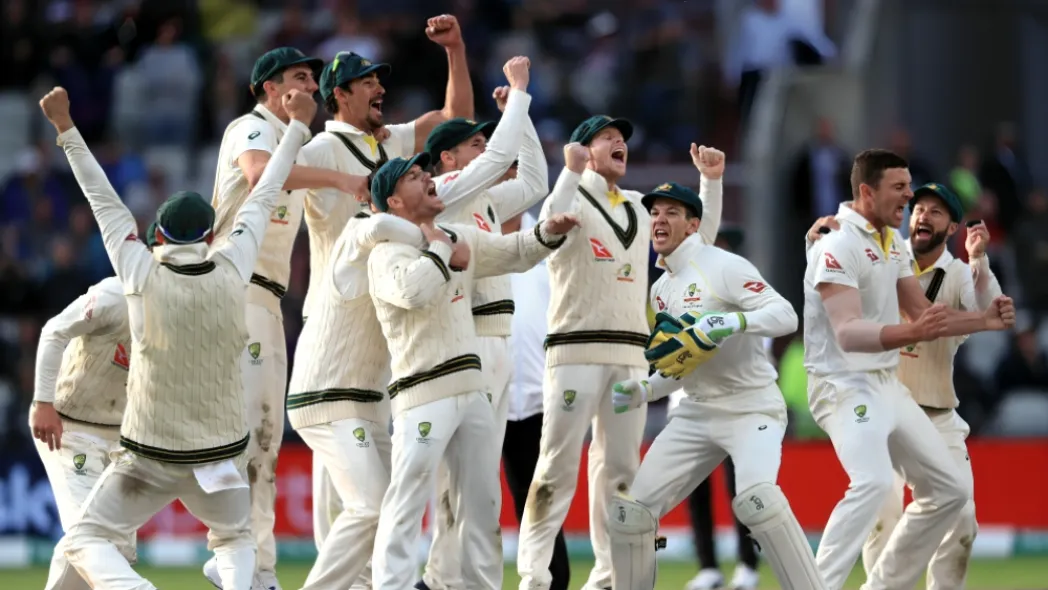

There was a time when Australian cricket seasons followed a predictable rhythm: summer dominance at home, long winters spent squinting at overseas tours on dodgy time zones. But 2026 laughs at that tradition. This is a calendar that bends geography, challenges comfort zones, and quietly reshapes how Australia prepares for global dominance.
The men begin the year already holding the Ashes at home, 3–1 up, with the Pink Test at a sold-out Sydney set to open the calendar and Australia sitting comfortably near the top of the World Test Championship table. Meanwhile, the women step into a high-voltage multi-format showdown against India, culminating in a rare day-night Test at the WACA.
Ashes Momentum Meets Strategic Continuity
Winning the Ashes at home is one thing; banking its momentum into the World Test Championship is another. Australia’s 3–1 Ashes position heading into 2026 isn’t just symbolic; it’s structural. Home victories have increasingly become the backbone of WTC qualification, and Australia’s ability to close series decisively has separated them from teams stuck in perpetual rebuild cycles. The Pink Test at Sydney isn’t merely ceremonial; it’s a pressure-free platform to consolidate points while rotating depth intelligently.
Women’s Cricket Claims Center Stage
Hosting India across formats is no longer a scheduling novelty; it’s a commercial and competitive statement. The WACA day-night Test is particularly revealing. Australia is betting that elite women’s cricket can thrive outside traditional summer windows and marquee venues. With India’s women now a genuine red-ball force, this isn’t nostalgia-driven scheduling; it’s a calculated attempt to future-proof the women’s calendar with context-rich contests.
A T20 World Cup Built on Subcontinental Reality
To earn their second title in the 2026 T20 World Cup, Australia’s men will need to focus on preparation over pride. The warm-up games are being played in Pakistan, and the tournament is going to be divided into two locations: one in Sri Lanka and one in India. This requires Australia to be flexible with their approach as there will be slow bowling pitches, an abundance of spinners in the middle overs, and a need for them to be tactically adaptable. Like we have seen in the past, where Australia were able to find success in T20 cricket (most notably in 2021) when they adapted to local conditions as opposed to trying to impose their fast bowling template. The conditions of this upcoming T20 World Cup require the same type of humility.
Winter Tests Break the Australian Mold
It would be easy to dismiss two Home Tests against Bangladesh in August, most probably in Darwin and Mackay, as afterthoughts, but they are a major turning point. The Tests represent a complete paradigmatic shift for Cricket; Cricket is no longer a sport of the Summer Months or Metropolitan Cities alone. Darwin has not hosted a Test Match since 2004, and with Mackay becoming Australia’s twelfth Test venue, it represents the first time cricket will go to Development First areas. The expected outcome will be faster pitches, unpredictable bounce, and an additional test for even the most experienced Australian batsmen.
South Africa: Talent Meets Unfinished History
Australia’s three-Test tour of South Africa will be their first since 2018, and no one needs reminding what that year represented. This tour isn’t about redemption slogans; it’s about competitive clarity. South Africa remains formidable at home, especially with fast-bowling depth. For Australia, success here would signal that their current core forged post-sandpaper can win in the toughest environments without narrative baggage.
Key Takeaway
Australia’s 2026 season isn’t about dominance; it’s about adaptability becoming their new competitive edge.
FAQs
1. What makes Australia’s 2026 calendar unusual?
Winter home Tests, new venues, and heavy subcontinental exposure mark a major shift from tradition.
2. Why is the South Africa tour so significant?
It’s Australia’s first Test series there since 2018, carrying competitive and symbolic weight.
3. How does this year impact Australia’s long-term strategy?
It aligns squad planning with the ICC’s expanding Future Tours Program and global scheduling demands.
Disclaimer: This blog post reflects the author’s personal insights and analysis. Readers are encouraged to consider the perspectives shared and draw their own conclusions.
Step into the world of cricket with JeetBuzz News—where expert opinions, trending Blogs, and behind-the-scenes insights meet all your favorite topics. Stay informed, stay entertained, and never miss the stories shaping the cricketing world—only on JeetBuzz News!