

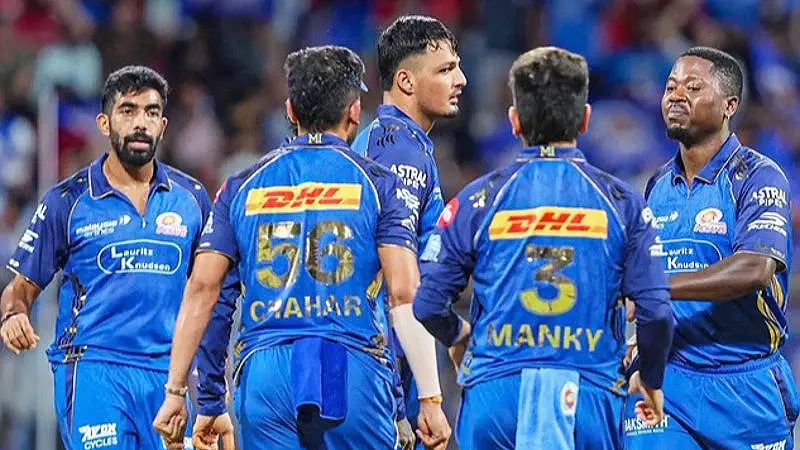

Mumbai Indians have been here before. Not just once. The slow start, the losses piling up early, the questions about captaincy and balance, and whether this squad is actually as good as it looked on paper. It’s a pattern that has appeared in 2014, 2018, 2022, and now again. What makes the current situation interesting isn’t the slump itself. It’s what happened the last time MI started a season looking this lost. They won the title. Understanding how they got there from where they were tells you more about this current situation than any analysis of the last three matches.
IPL 2026 and the Familiar Pattern
The structural problems aren’t new to this squad. Even with Hardik Pandya leading and experienced names throughout the lineup, MI have slipped into the same early-season pattern that has defined their worst starts across multiple seasons.
The bowling rotations in the middle overs have been the most consistent source of damage. Opposition batters have attacked freely through phases where MI needed dot balls and pressure. Death bowling precision has been poor enough that even competitive totals haven’t been defended. Wankhede’s nature of favouring chasing teams compounds this further.
IPL 2022 Was a Complete Collapse
The 2022 season remains the reference point for everything MI don’t want to repeat. Eight losses in eight games under Rohit Sharma didn’t just end the campaign early. It left the franchise without any realistic recovery path before the halfway point of the tournament had even arrived.
What made 2022 uniquely bad was the absence of any functioning phase. Batting partnerships weren’t being built. The bowling attack offered neither control nor wicket-taking ability across the same games. Unlike the current season, where individual performances still appear, 2022 was a total system failure rather than a collection of fixable issues.
IPL 2014 Exposed Their Adaptability Problem
The 2014 season introduced a different kind of early failure. Five losses in the UAE leg before the tournament returned to India exposed a specific weakness that has reappeared in various forms since. Slower pitches in unfamiliar conditions neutralised a batting lineup built for pace and power. MI couldn’t adapt its approach quickly enough to match what the surfaces demanded.
Once the tournament returned to Indian venues, the team found its feet rapidly. That recovery showed that the squad’s quality was never the real issue. Adjusting to conditions that fell outside their preparation had been the problem. The lesson from 2014 is that MI’s slow starts are sometimes environmental rather than structural. The current season’s challenges look more structural, which makes them harder to solve through a venue change alone.
IPL 2018 Showed Decision-Making Costs
One win from the first six games in 2018 followed a pattern that feels familiar from the current season. Frequent changes to the batting order disrupted player roles before they could settle into a consistent approach. Bowling combinations shifted match to match without giving any combination enough games to find a rhythm.
The instability in decision-making that hurt 2018 is visible again in IPL 2026 under Pandya. Captaincy transitions carry this risk. A new captain establishing authority while also managing a struggling squad faces pressure from multiple directions simultaneously, and that pressure shows in the consistency of selection decisions.
IPL 2015 Proved Recovery Is Possible
What separated 2015 from the genuinely broken seasons was the speed of the correction. The team identified the specific issues, settled on a stable playing XI, and executed a clear tactical plan across the second half of the tournament without reverting to experimentation. The slow start wasn’t the problem. Letting it become a structural issue would have been. MI stopped it from becoming that.
If the current group can identify their fixes quickly enough and commit to them across consecutive matches, 2015 shows that the gap between a bad start and a title is not as large as it looks from the outside. The question is whether Pandya’s squad has enough time left to find out.
- Can MI repeat their 2015 recovery in IPL, or has the damage already gone too far? Drop your take in the comments and follow for IPL updates.
FAQs
Why do the Mumbai Indians always start slow in IPL?
They often experiment with combinations early and take time to settle on a stable playing XI, which delays momentum.
Can the Mumbai Indians recover in IPL 2026?
Yes, but only if they quickly fix bowling execution and stabilize team roles under Hardik Pandya.
Is Hardik Pandya’s captaincy affecting MI’s performance?
The transition phase may be impacting tactical decisions, especially in bowling rotations.
Which season shows MI can recover from a bad start?
IPL 2015 is the best example, where they won the title despite a very poor beginning.