

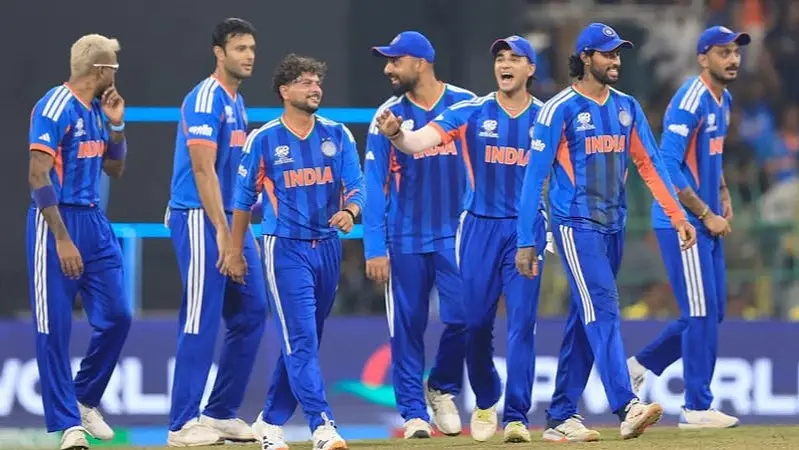

After the Zimbabwe demolition, team management has a problem that most coaches would love to have: a combination that actually works. The top order finally clicked, the middle order had defined roles, and the bowling held its shape under pressure. Heading into a Super 8 fixture against West Indies at the T20 World Cup 2026, the question isn’t who comes in. It’s why anyone would be dropped.
Top-Order Balance Finally Clicks
The Sanju Samson experiment at the top is no longer an experiment; it’s a statement. Promoting him as an opener restored a right-left combination that immediately cuts down a bowler’s ability to settle into a single line. Abhishek Sharma, given the freedom to play his natural game rather than compensate for someone else’s role, responded with a fluent half-century that answered a lot of questions about his place in the XI.
What this structure also does, and this part gets underappreciated, is push Ishan Kishan into a position where he can hunt spin after the powerplay, with the field spread and the pressure already absorbed. That’s a far better use of his skills than asking him to absorb early pressure himself.
Middle-Order Roles Remove Uncertainty
Tilak Varma at No.6 gives India something they’ve historically struggled to maintain in T20 tournaments: a defined anchor who doesn’t need to attack from ball one. If two wickets fall in the powerplay, Varma steadies. If the top order fires, he finishes. Both outcomes are covered without reshuffling the order mid-innings.
Against Zimbabwe, India crossed 10 runs per over across the final five overs. That didn’t happen by accident; it happened because every batter knew their role before they walked out. Constant changes would dismantle exactly the trust that makes that kind of finishing possible.
Why India’s Playing XI Holds Up Against West Indies Specifically
West Indies bring pace, bounce, and genuine powerplay aggression, a very different challenge to Zimbabwe’s controlled medium-pace. And yet India’s Playing XI actually suits this matchup well. A settled top order with a right-left combination gives their seamers less room to settle into a rhythm. Depth to No.8 means India can absorb an early onslaught without the innings falling apart.
On the surface, conditions expected at the Super 8 venues are true, even bounce that rewards clean striking batting depth is worth more than an extra bowling option. Against a side that can clear the boundary at will, India’s ability to post 190-plus and defend it is a more useful weapon than marginal bowling tweaks.
Tournament History Makes the Case for Continuity
India’s best ICC campaigns have shared one trait: selection stability once the knockout phase begins. The 2014 and 2016 T20 World Cup runs both featured a settled combination that the management backed even through difficult patches. The teams that tinkered, constantly rotating combinations looking for a perfect XI, rarely made deep runs because they never built the internal chemistry that knockout cricket demands. This isn’t sentiment. It’s pattern recognition. A working XI in the Super 8s is rarer and more valuable than it looks. When you find one, you don’t disrupt it for the sake of looking proactive.
Execution Is the Only Variable Left
Barring injury, the XI picks itself. Samson and Abhishek at the top, Varma in the middle, depth through the lower order, and a bowling unit that knows its phases. West Indies will test India’s top order with short-pitched aggression in the power play. How quickly the openers find their footing in those first three overs will define the shape of the game. India needs to outplay them on matchday. The combination is already there; now it’s about execution.
- Who do you think starts for India against the West Indies? Drop your XI in the comments and follow for daily T20 World Cup 2026 team news and analysis.
FAQs
What is India’s strongest playing XI in the T20 World Cup 2026?
India’s strongest XI is built around a flexible top order, a stable middle, and finishers who can accelerate without panic.
Why is Sanju Samson’s opening important for India?
Sanju Samson’s presence adds a right-left combination and reduces matchup predictability in the powerplay.
How does Zimbabwe Cricket influence India’s selection thinking?
The dominant win over Zimbabwe confirmed role clarity, encouraging India to stick with the same setup.
Can India afford to change their playing XI at this stage?
At the Super 8 stage, frequent changes increase risk; settled teams generally perform better under pressure.
Which factor matters more against the West Indies: bowling or batting depth?
Batting depth is critical, as the West Indies rely heavily on aggressive bowling spells and power-hitters.