

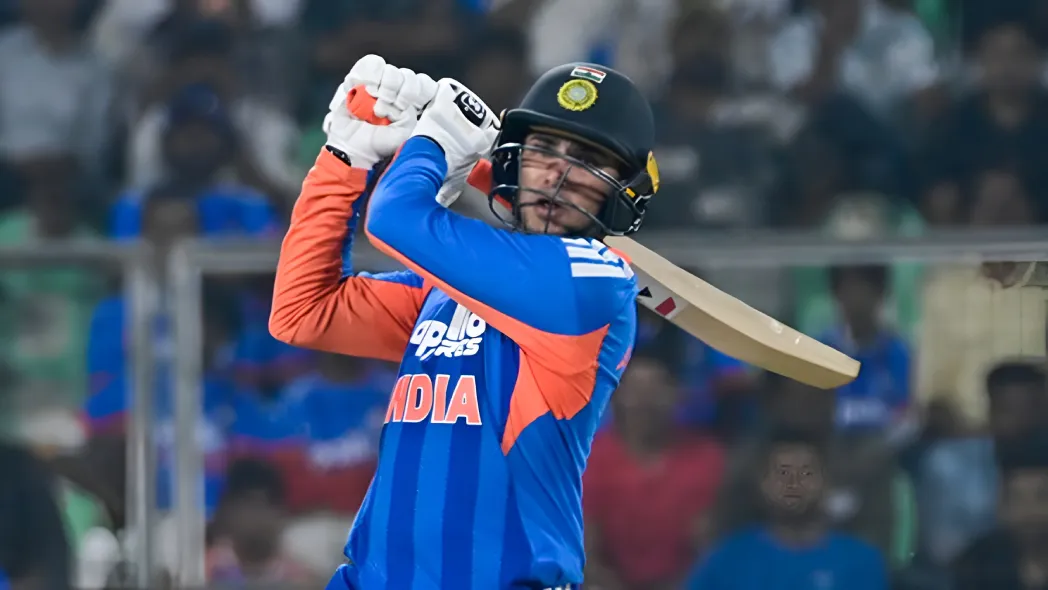

Team India’s over-reliance on Abhishek Sharma is a clear tactical warning: India’s batting structure becomes fragile when the left-handed opener falls early. India’s batting collapse vs USA exposed how heavily the team depends on his explosive starts. After his first-ball dismissal, India slipped to 77/6 before Suryakumar Yadav 84 vs USA* rescued the innings. Balaji also pointed to concerns around Shivam Dube’s batting position criticism, questioning India’s decision-making under pressure. The issue isn’t talent, it’s balance, situational awareness, and structural dependency in high-stakes T20 cricket.
Early Wicket, Structural Instability
The biggest takeaway from Lakshmipathy Balaji on Abhishek Sharma’s over-reliance is structural vulnerability.
When Abhishek was dismissed for a first-ball duck, India’s scoring tempo collapsed immediately. The side went from expected power-play dominance to damage control. The numbers tell the story:
- 77/6 inside 13 overs
- 161/9 final total
- Match rescued largely by one innings
This highlights the impact of Sharma’s early dismissal. India lacks a seamless transition plan when it fails. Tactically, teams are now placing square offside fields against him, forcing aerial risks early. Without a stable partner to absorb pressure, India’s aggressive template becomes high-risk.
Suryakumar’s Rescue Act
While the collapse grabbed attention, Suryakumar Yadav’s 84 vs USA* masked deeper problems.
His 49-ball 84* rebuilt the innings through-
- Controlled middle-over acceleration
- Smart strike rotation before boundary bursts
- Calculated risk against pace and spin
However, using rescue methods is not sustainable for tournaments similar to the ICC Men’s T20 World Cup 2026. India will not be able to continue using Suryakumar as their saviour in multiple instances where they find themselves in positions of 77/6 or worse. This is why Lakshmipathy Balaji’s statement about Abhishek Sharma’s over-dependence is not an attack against him personally; it is an attack against the design of the team.
Middle-Order Role Confusion
Balaji’s Shivam Dube batting position criticism adds another layer. Dube walked in during the power play at 46/3, a scenario demanding composure, not pure power-hitting. His first-ball dismissal amplified the slide. This also fuels the Hardik Pandya finishing role debate. India is holding Hardik back for death overs, but extreme collapses may demand flexibility.
Meanwhile, the Axar Patel middle-order option appears tactically sound in pressure moments. Axar’s temperament across formats suggests better adaptability in early-crisis phases. India’s issue isn’t batting depth; it’s batting sequence logic under pressure.
Field Awareness & Tactical Evolution
Another key point in Lakshmipathy on Abhishek’s over-reliance is game awareness. Oppositions are:
- Setting square off-side fields
- Attacking outside off-stump channels
- Forcing early aerial drives
In tournament conditions where pitches slow down, and swing is available early, reckless aggression can backfire. Respecting the first two overs may extend Abhishek’s impact deeper into the innings. T20 aggression works best when structured, not impulsive.
A Familiar Tournament Pattern: Historical Dependence Patterns
India has faced similar structural dependency before. During earlier T20 World Cups, collapses following early dismissals of top-order anchors exposed middle-order rigidity. Even in the Rohit–Kohli era, India struggled when powerplay plans failed. What adds credibility to this warning is that it comes from Lakshmipathy Balaji, a former international seamer who understands powerplay tactics and field dynamics.
Tournament cricket magnifies small flaws. One-dimensional batting templates are exposed quickly, especially when teams prepare specific matchup strategies. Balaji’s analysis fits a recurring global T20 pattern: heavy dependence on explosive openers can create fragility.
India’s aggressive template has delivered success, but the USA match proved that early disruption can destabilize the structure. The solution lies in tactical flexibility, smarter powerplay awareness from Abhishek, adaptive batting order decisions, and situational promotion of experienced players when needed.
If India recalibrate their response mechanisms, they remain strong contender. If not, sharper teams later in the tournament could exploit the same vulnerability. The warning has been issued. The response will define India’s campaign.
Key Takeaway
India’s problem isn’t talent, it’s over-structuring their batting around one explosive start.
FAQs
Why did Lakshmipathy Balaji criticize India’s batting vs USA?
He pointed to over-reliance on one player and questioned middle-order decisions during early pressure.
How does Sharma’s early dismissal impact India?
It disrupts powerplay momentum and forces the middle order into damage-control mode.
Was Shivam Dube sent too early against the USA?
Balaji suggested the match situation did not suit Dube’s power-hitting strengths.
Should Hardik Pandya bat higher in T20 matches?
It depends on the match context; flexibility may help during collapses.
Is Axar Patel a better middle-order stabilizer option?
His multi-format temperament makes him a viable crisis-management option.
Disclaimer: This blog post reflects the author’s personal insights and analysis. Readers are encouraged to consider the perspectives shared and draw their own conclusions.