

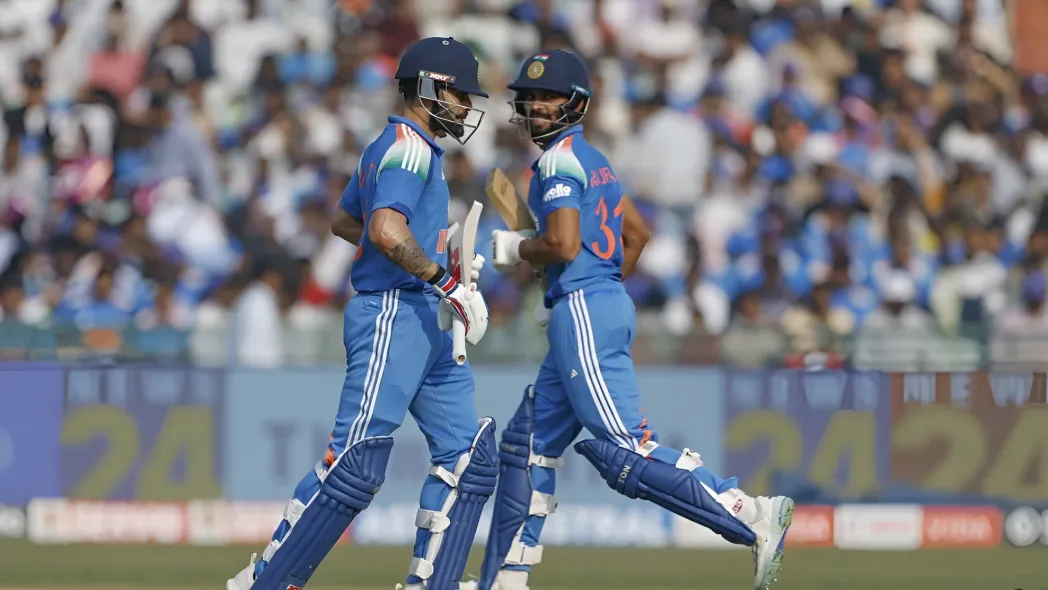

On most days, when a team shells out 358 for 5, its second-highest ODI total against South Africa, the statisticians pack up early, the broadcasters rehearse victory lines, and fans quietly settle the “Kohli vs Tendulkar” debate for the 900th time. But Raipur had other ideas.
A 195-run stand between Virat Kohli and Ruturaj Gaikwad, India’s highest ever against South Africa in ODIs, briefly made the contest look like a batting exhibition. Kohli ticked off century No. 52 in ODIs, his 11th instance of back-to-back tons, a record that sits miles ahead of AB de Villiers’ six. Ruturaj finally shelved the “when will the ODI hundred come?” discourse with a blistering 77-ball masterpiece, the second-fastest by an Indian vs SA.
And yet, for the second time in ODI cricket, India watched a 359-run chase slip through their fingers.
South Africa Flip the Script (Again This Year)
South Africa is now the 1st team to have completed this task after Australia did so against India in Mohali in 2019 (India and England are tied for having completed 3 successful third-chase victories).
Markram’s fourth ODI hundred came after scoring three prior as of 2023. In every sense of the word, Aiden Markram’s 100 appeared unafraid to be in a position where the total was being chased, the crowd was watching, and the previous history of South Africa failing to post enough for the runs required to win were all irrelevant. This was Markram’s first time he has scored a 100 while chasing and in under 90 deliveries. With each delivery, Markram hit it felt as though he was making a statement about what the modern one-day international chase looks like today, and no longer a gamble, but a model to follow.
Matthew Breetzke, meanwhile, continued his statistical absurdity: 7 fifty-plus scores in 11 innings, the most alongside Sherfane Rutherford, with 682 runs, the highest ever after 11 ODI knocks. South Africa didn’t chase the target; they systematically dismantled it.
India’s Batting Is in Historic Overdrive
What India did with the bat was ridiculous in its own right. Their Raipur total (358) and Ranchi total (349) now form their 2nd and 3rd highest scores vs South Africa. Kohli alone extended so many records that broadcasters might need an hourly “Kohli Stat Update” banner.
- 7 ODI tons vs South Africa, more than any batter ever
- 34 venues with ODI hundreds equalling Tendulkar
- 33 partnerships of 150-plus now above Sachin’s 32
Ruturaj Gaikwad added another quirky gem: Before his maiden ODI century, he already had 17 List A hundreds, the highest ever before a first ODI ton. India’s batting isn’t just performing, it’s rewriting.
The Bowling Is Still Stuck in a Time Loop
India’s biggest headache isn’t the ability to score; it’s the inability to defend. For the second straight match, their bowlers were dragged around Raipur like GPS markers in a fielding drill. The entire series has produced 1401 runs in two games, the fourth-highest such aggregate in bilateral ODI history.
India keeps finding itself in 350-plus shootouts that feel less like cricket and more like an arm-wrestling contest where only one arm is in shape. Just two things are consistent:
- India bats
- Opponents chase bigger.
When 700-Run Games Are the New Normal
The Raipur clash produced 720 runs, the highest aggregate in an India–South Africa ODI and a clear sign that this series isn’t following classical 50-over rhythms. It mirrors the 2017 India–England series, the only other one where both teams crossed 330 in the opening two matches. If ODIs needed a revival, this is it. If bowlers needed sympathy, they should look elsewhere.
To make sure that each of the ODIs does not turn into a batting circus, India needs an immediate review of the bowlers’ structures in the middle overs, or else the number of centuries India scores will continue to grow.
Key Takeaway
India can score any total, but right now, they can’t defend any total.
FAQs
1. Why did South Africa’s chase succeed despite India’s huge total?
Because their top order paced the chase perfectly, with Markram and Breetzke neutralising India’s middle-overs threat.
2. What made India’s batting historic in this match?
The Kohli–Ruturaj stand, Kohli’s venue record, and India’s second-highest total vs South Africa highlighted rare individual and team-level peaks.
3. How does this match change India’s ODI outlook?
It exposes a growing imbalance: world-class batting paired with increasingly inconsistent bowling in high-scoring games.
Disclaimer: This blog post reflects the author’s personal insights and analysis. Readers are encouraged to consider the perspectives shared and draw their own conclusions.
Step into the world of cricket with JeetBuzz News—where expert opinions, trending Blogs, and behind-the-scenes insights meet all your favorite topics. Stay informed, stay entertained, and never miss the stories shaping the cricketing world—only on JeetBuzz News!