

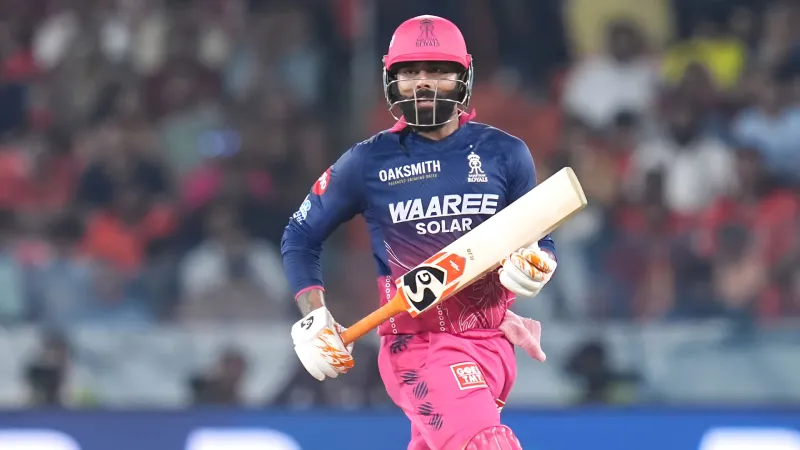

Faf du Plessis didn’t mince his words. Jadeja can bat. Nobody questions that. The problem isn’t the ability; it’s when he decides to use it. Against Lucknow Super Giants, Jadeja walked in under pressure and came out with 43 off 29 balls. That looks fine on a scorecard. Watch the breakdown over and over, and a clear pattern emerges: the runs came far too late to change the match on RR’s terms rather than LSG’s. Faf identified exactly what the numbers quietly confirm every time Jadeja bats.
Middle Overs Are Where He Stalls
Between overs 12 and 16, Jadeja consistently rotates rather than attacks. He finds singles, keeps the scoreboard ticking, and stays at the crease without putting bowlers under real pressure. On most surfaces, that approach is defensible. On the Ekana Cricket Stadium surface against LSG, where stroke-making was already difficult, and timing required deliberate intent, it handed control back to the bowling side precisely when RR needed to take it away.
This is the phase where modern T20 innings are shaped. Teams that score at 9 or 10 an over through overs 12 to 16 arrive at the death with options. Teams that rotate at 7 arrive there needing boundaries from every delivery, which is a far harder ask for any finisher, regardless of quality.
What the 43 off 29 Reveals
An unbeaten 43 off 29 balls carries a strike rate of 148. That sounds competitive. The issue is that the majority of those runs arrived after the 17th over, which means the strike rate is a product of late hitting rather than sustained pressure across multiple overs.
Elite finishers in modern T20 cricket don’t wait for the 17th over to shift gears. They begin applying pressure in the 14th or 15th, which forces bowling captains to burn their best death over options early and arrive at the final two overs without their first-choice bowler available. Jadeja’s acceleration is real and effective. It simply starts two overs too late to reshape matches rather than merely improve final totals.
The comparison with Dhoni is instructive. At his peak, Dhoni paced innings without ever surrendering middle-over momentum. He rotated when necessary but accelerated the moment the bowling side showed the slightest vulnerability, not after a fixed number of overs had elapsed.
All-Round Value Masks the Ceiling
Jadeja picked up the wicket of Nicholas Pooran and contributed with genuine control through his bowling spell against LSG. His all-round output remains one of the most reliable in the tournament. The concern isn’t whether he contributes. He always does. The concern is the gap between “effective contributor” and “match-defining batter” that his timing problem keeps open.
When RR has aggressive batters around him, that gap is manageable. Jadeja stabilises while others attack, and the innings functions. When the batting order is under pressure, and he’s the senior batter at the crease, his instinct to reset rather than build becomes the difference between a competitive total and a match-winning one.
IPL 2026 Needs a Different Jadeja
IPL has raised the standard for what all-round batters must contribute across all phases. A finisher who begins his assault in over 13 rather than over 17 disrupts bowling plans rather than reacting to them, which is a fundamentally different and more damaging approach.
If Jadeja accelerates even two overs earlier in his typical innings pattern, RR’s middle order becomes significantly harder to contain. The ability is unquestioned. The adjustment required is small. The impact on RR’s consistency through the tournament could be enormous.
- Does Faf have a point? Is Jadeja’s delayed acceleration a genuine tactical flaw for RR, or is the stabilising role he plays more valuable than early aggression would be? Drop your pick in the comments and follow for IPL updates.
FAQs
Q: What did Faf du Plessis say about Jadeja’s batting in IPL 2026?
He pointed out that Jadeja delays his attacking phase and could impose himself on matches earlier rather than waiting for the final overs.
Q: How did Jadeja bat against Lucknow Super Giants?
He scored an unbeaten 43 off 29 balls but accelerated mainly after the 17th over, limiting his overall impact on the match’s scoring momentum.
Q: Why does Jadeja’s middle overs approach hurt RR’s total?
Rotating strike between overs 12 and 16 allows bowlers to settle and maintain control during the phase where RR needs to be building match-winning scores.
Q: How does Jadeja’s bowling contribution compare to his batting in this match?
His bowling was excellent; he picked up Pooran’s wicket and maintained control, but his batting ceiling remains visibly lower than his bowling impact.
Disclaimer: This blog post reflects the author’s personal insights and analysis. Readers are encouraged to consider the perspectives shared and draw their own conclusions.