

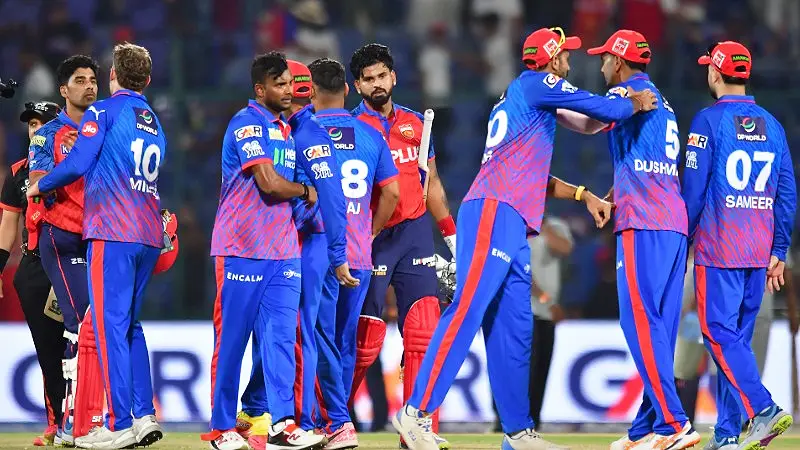

Delhi Capitals set 265. They lost. That sentence should be impossible after a first innings like that, but DC’s powerplay bowling made 265 feel like a par score within six overs. Conceding 116 runs in the first six overs of a chase is not a bowling failure caused by exceptional hitting alone. It’s a failure of tactical planning, captaincy timing, and the most basic principle of defending a large total: make the chase feel hard from the first ball. DC made it feel easy, then spent 14 overs watching it become inevitable.
116 Powerplay Runs Ended the Match
Prabhsimran Singh and Priyansh Arya didn’t need to take risks to score 116 in six overs. They played conventional cricket shots against predictable pace bowling on a flat Arun Jaitley Stadium surface that offered nothing to work around. DC’s powerplay plan relied on pace on a pitch where pace was the easiest thing for PBKS’s openers to face. No cutters, no slower balls, no variation in length or angle that forced either batter into a decision they hadn’t already made.
116 in the power play removes scoreboard pressure from every batter who follows. Iyer walked in needing to maintain, not accelerate. DC’s powerplay bowling turned their 265 into a chase that didn’t feel like one.
Axar Patel Was One Over Late
Kuldeep Yadav’s introduction was delayed past the point where it could have changed anything. In high-scoring IPL games, momentum runs in phases. The powerplay momentum PBKS built didn’t require a miracle to disrupt. It required one wicket or one maiden over at the start of the middle phase to reset the required run rate and force PBKS to take risks they hadn’t needed to take until that moment.
Kuldeep arriving one over earlier, with PBKS still in full flow and the rate still climbing, changes what PBKS’s middle-order batters need to do immediately. Reactive captaincy loses the psychological moment where a batting side can be told the chase is harder than it looks. DC never delivered that message.
Mukesh Kumar Gave PBKS a Blueprint
Mukesh Kumar’s powerplay spell didn’t just concede runs. It confirmed to PBKS’s opening pair that DC’s pace plan had no backup option. When a seamer bowls predictably without variation on a flat pitch, experienced T20 batters stop watching the ball and start watching the field. Scoring becomes almost mechanical.
The absence of cutters, slower deliveries, or angled variations meant PBKS never faced a ball they hadn’t already processed. In IPL conditions, handing the batting side a powerplay template in the first three overs guarantees it gets used for the remaining seventeen. Mukesh’s overs gave PBKS that template before DC had registered a single difficult over.
IPL 2026 Pitch Read Exposed DC
The Arun Jaitley Stadium surface favoured batting, which is precisely why DC needed a spin or variation-led bowling plan rather than a pace-first approach. Mumbai Indians and Chennai Super Kings have repeatedly shown across IPL seasons that defending high totals on flat surfaces requires early cutters, spin options, and length variations that force batters through slower deliveries rather than pace.
DC arrived with a one-dimensional strategy on a surface that punished it immediately. The T20 World Cup winner’s assessment that a PBKS batter “could be eight off eight balls” against this bowling plan was an accurate description of what DC were offering: deliveries that asked nothing of the batter. Even 265 doesn’t defend itself. Tactical aggression does, and DC brought none of it.
- Does Axar Patel need to overhaul DC’s powerplay bowling plan entirely, or was this a one-match tactical error that their best bowling attack can correct? Drop your pick in the comments and follow for IPL updates.
FAQs
Q: Why did the Delhi Capitals fail to defend 265 against the PBKS?
DC conceded 116 runs in the powerplay, removing all scoreboard pressure before the middle overs began.
Q: How did Axar Patel’s captaincy cost DC vs PBKS?
Delaying Kuldeep Yadav meant DC missed the moment to disrupt PBKS’s powerplay momentum.
Q: Which PBKS players dominated DC’s bowling in the powerplay?
Prabhsimran Singh and Priyansh Arya scored freely using conventional shots against DC’s predictable pace attack.
Q: Why is powerplay bowling critical in IPL 2026 high-score chases?
Conceding heavily early removes scoreboard pressure, letting incoming batters build without any risk.