

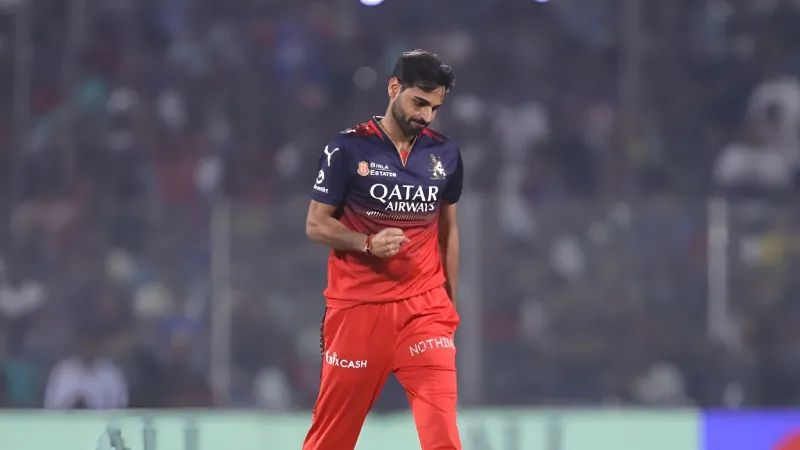

Bhuvneshwar Kumar hasn’t bowled consistently above 135 km/h for years. He doesn’t need to. What he does instead is something considerably harder to prepare for: he makes batters hesitate, then punishes the hesitation. His slower balls look identical to his faster ones until the ball is halfway down the pitch. His yorkers arrive at lengths batters have been conditioned not to expect. He has crossed 200 T20 wickets through deception, sequencing, and a level of tactical patience that most fast bowlers never develop. Understanding why he still works at RCB tells you something important about what T20 bowling actually requires at the highest level.
Angles and Deception Before Everything Else
Bhuvneshwar doesn’t target the stumps. He targets the fourth or fifth stump line consistently, which forces batters to reach outside their natural hitting arc and lose balance before contact. The shot that looks like it should go to the boundary instead finds the fielder at cover point because the batter was already stretched when they played it.
His slower balls compound this. The arm speed is identical to his regular delivery. The grip changes at the last possible moment. Batters who have spent the previous three deliveries reading his arm speed pick up nothing useful, and the reduced pace means even perfectly timed contact arrives softer than expected. On surfaces with grip and hold, that combination is extraordinarily difficult to counter consistently across a full spell.
Slower Balls Make Yorkers Unreadable
Most death bowlers set up slower balls with yorkers. Bhuvneshwar does it backwards, and that reversal is the foundation of his entire approach.
He bowls slower balls first, repeatedly, often wide outside off stump. The batter waits. The timing window they’re looking for keeps arriving slightly late. Their weight distribution shifts accordingly. By the time the yorker comes, the batter’s stance has adjusted to accommodate slow deliveries rather than full-pace ones. The yorker then arrives at the base of the stumps before the batter can reset their feet. It’s not a surprise delivery. It’s a conclusion that the batter has been walked toward over the previous five balls without realising it.
This reverse sequencing is what separates Bhuvneshwar from bowlers who simply execute yorkers accurately. He doesn’t bowl yorkers. He earns them through setup.
Two Decades of Smart Evolution
Early in his career, Bhuvneshwar relied on swing in the powerplay and conventional yorkers at the death. T20 batting evolved quickly enough to make both approaches predictable. Instead of doubling down on what had worked before, he added the knuckleball, refined his slower ball disguise, and rebuilt his death over sequencing around deception rather than pace.
The 200-wicket milestone in T20 cricket doesn’t arrive for bowlers who stand still. It arrives for those who read how batting is changing and change first. Bhuvneshwar has done that multiple times across his career, which is why he remains a genuine match-day threat for RCB rather than an experienced name simply managing his way through a tournament.
IPL 2026 Proves Adaptation Beats Pace
IPL has produced some of the most aggressive batting line-ups this tournament has ever seen. Pure pace bowlers are being targeted specifically in powerplay and death overs by batters who have prepared for high-speed deliveries. Bhuvneshwar is harder to prepare for precisely because he doesn’t offer the pace profile those preparation plans are built around.
Conditions influence how heavily he leans on each weapon. Slower pitches bring out the cutters and off pace deliveries. Flat tracks shift the emphasis toward yorker accuracy and angle manipulation. He’s never one-dimensional regardless of the surface, which means opposition captains can’t construct a simple counter-plan before the toss and trust it to survive contact with the actual spell he bowls.
- Is Bhuvneshwar Kumar the most technically complete death bowler in the tournament right now, or does someone else deserve that title in IPL 2026? Drop your pick in the comments and follow for IPL updates.
FAQs
What makes Bhuvneshwar Kumar effective in T20 cricket?
His ability to mix slower balls with precise yorkers and adapt to conditions makes him highly effective.
How does Bhuvneshwar Kumar bowl yorkers so accurately?
He sets them up with slower deliveries, forcing batters to mistime their response before executing the yorker.
What is Bhuvneshwar Kumar’s knuckleball technique?
It is a slower delivery bowled with minimal spin, making the ball dip unpredictably and deceive batters.
Why is Bhuvneshwar Kumar still relevant in modern T20 cricket?
His continuous evolution and tactical awareness allow him to keep up with aggressive batting trends.
Which phase of T20 is Bhuvneshwar Kumar most effective in?
He is effective in both powerplay and death overs due to his control and variation usage.
Disclaimer: This blog post reflects the author’s personal insights and analysis. Readers are encouraged to consider the perspectives shared and draw their own conclusions.