

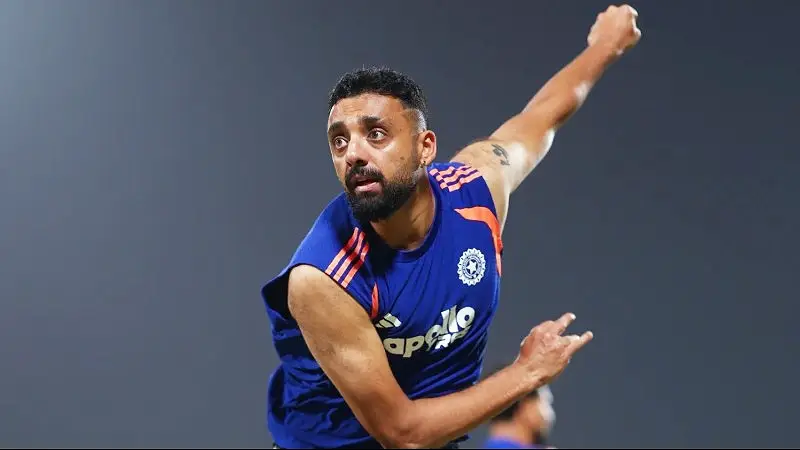

India’s assistant coach Ryan ten Doeschate confirmed it publicly before the West Indies match. Batters are no longer trying to disrupt Varun Chakravarthy by advancing down the track or sweeping across the line. They are planting the front foot, swinging straight, and trusting that his overspin gives them enough pace to clear the infield. The tactic is working. His economy across the last three matches sits at 9.2 per over, against a tournament average of 7.8. That gap tells the full story.
This is not a technical decline. It is a tactical standoff, and Chakravarthy needs to find the answer before the knockout stages arrive.
Why Step Hitting Works Against Chakravarthy’s Overspin
Chakravarthy’s primary weapon is his dip and bounce rather than a sharp sideways turn. His overspin causes the ball to arrive earlier than expected and skid through at a higher trajectory than a flat delivery, making it difficult to read off the pitch. The traditional counters, the sweep, and the charge all require reading the ball early and committing to a line. Get it wrong, and the stumping or lbw follows.
Step hitting removes that uncertainty. The batter plants the front foot on the middle stump, commits to a full swing straight down the ground, and accepts the dip. Because Chakravarthy’s overspin reduces lateral movement, the ball tends to arrive in the hitting zone rather than jagging away at the last moment. Three batters used this method against India in the Super Eights, combining for 38 runs off 22 balls against Chakravarthy specifically.
The trade-off is real. Chakravarthy’s dip still beats mistimed shots. But batters who commit fully and time the ball cleanly are finding the boundary more consistently than they did twelve months ago.
What T20 World Cup 2026 Conditions Are Adding to the Problem
Eden Gardens is not a spinner’s venue in the traditional sense. The black soil surface plays true with even bounce, which means Chakravarthy cannot rely on the ball doing unexpected things off the pitch. On surfaces with variable bounce or rough patches outside off stump, his variations create far more doubt. On true surfaces, step hitting becomes measurably safer.
The boundary dimensions at Eden Gardens also favour the tactic. At 65 metres straight, a well-timed hit with the full face of the bat clears the boundary without needing maximum power. Batters who might hesitate on a larger ground commit more freely here. South Africa’s Dewald Brevis used this method in the Super Eights, hitting Chakravarthy for 18 in a single over almost entirely through the straight boundary.
That specific over cost India two runs off a dropped catch and changed the match momentum. It also confirmed that the tactic works at this venue against this bowler.
How Chakravarthy Must Respond Before India’s Semi-Final
Ten Doeschate outlined the options without revealing exactly which one India plans to use. The most likely adjustment is varying his pace more aggressively within an over, mixing his quicker overspin ball with a slower looping delivery that forces the batter to reassess mid-swing. A batter committed to a full straight drive against a ball that arrives 15 km/h slower will either hit it in the air or drag it to mid-on.
The field setting change is equally important. Chakravarthy currently uses a standard spin field with two short mid-wickets and a straight mid-on. Removing one short mid-wicket and pushing a fielder to long-on creates doubt about whether the straight hit is safe. Batters who are uncertain about the boundary fielder’s position tend to go aerial less confidently.
His wicket tally of 12 remains the joint second-highest in the tournament. He is not in crisis. But nine runs an over in the last three matches for a mystery spinner at a World Cup semi-final is a problem India cannot ignore..
FAQs
How are batters attacking Varun Chakravarthy differently now?
They are stepping forward and hitting straight rather than charging or sweeping, lowering dismissal risk.
Why does step-hitting work against overspin bowlers?
Overspin offers dip and bounce but less sideways movement, making straight hitting safer.
Can Varun Chakravarthy counter this approach?
Yes, through changes in pace, release height, bowling phases, and field placements.
Is this trend specific to India vs West Indies games?
No, but power-heavy teams and flat conditions make it more effective.
What role has Ryan ten Doeschate played in identifying this shift?
He has publicly acknowledged that opponents are approaching Chakravarthy differently, confirming the tactical change.