

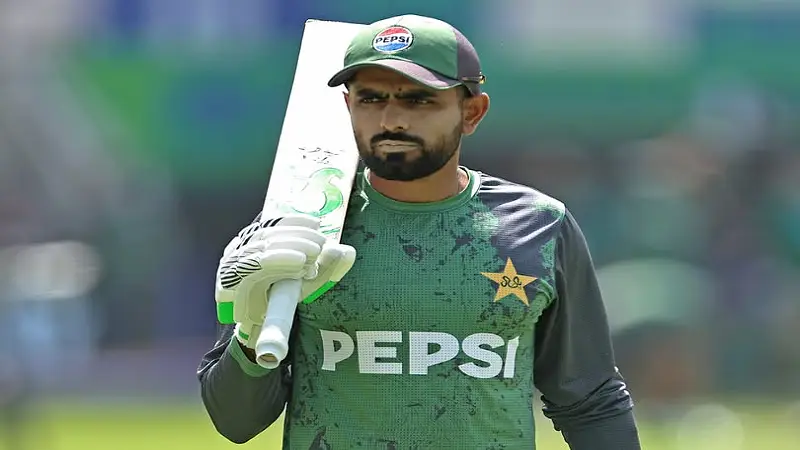

The Babar Azam role in Pakistan’s T20I team has shifted from an opening aggressor to a middle-order stabilizer because Pakistan’s management, led by coach Mike Hesson, believes his strengths are now better suited to controlling innings rather than dominating the powerplay. During the T20WC, Pakistan experimented with flexibility, especially ahead of key games like New Zealand vs Pakistan, to adapt to modern T20 demands where faster scoring upfront has become essential.
Powerplay Strike Rate Concerns
The biggest factor behind Babar’s role change is his power-play scoring tempo. Across multiple T20 World Cups, his strike rate in the first six overs has remained below the aggressive benchmark expected in modern T20 cricket. While he has the technique to preserve his wicket, Pakistan now prioritizes explosive starts to maximize field restrictions. This tactical adjustment allows more aggressive players to attack early, while Babar enters later to stabilize or rebuild if wickets fall.
Mike Hesson’s Tactical Adjustment
Since taking charge, Mike Hesson has emphasized role specialization based on match situations rather than reputation. He sees Babar as a batter capable of controlling pressure in the middle overs, especially if early wickets fall. This tactical thinking reflects a shift in Pakistan’s approach, where adaptability is valued more than fixed batting positions. In matches where Pakistan builds strong starts, the team may even delay his entry, highlighting how situational his role has become.
Middle Overs Against Quality Spin
The middle overs often decide matches, especially against teams like the New Zealand national cricket team that rely on disciplined spin and variation. Babar’s strength lies in rotating strikes and preventing collapses in these phases. However, his strike rate during this period usually stays in the consolidation range rather than acceleration mode. This makes him useful when Pakistan needs stability, but less effective when rapid acceleration is required on flat pitches or high-scoring venues.
Modern T20 Demands Aggressive Intent
T20 cricket has evolved into a format dominated by fearless intent and boundary frequency. Pakistan’s team balance now includes players capable of delivering immediate impact, reducing reliance on anchors. This evolution has directly influenced his role in the Pakistan T20I team, turning him into a situational batter rather than the centerpiece of their batting strategy. His value now depends heavily on match context instead of automatic inclusion as an opener.
The Babar role in the Pakistan T20I team has been reshaped by tactical evolution rather than a sudden decline in ability. Pakistan now views him as a specialist who can rescue innings and guide the middle phase instead of leading early aggression. This adjustment reflects broader changes in T20 cricket, where flexibility and scoring speed define team success. Moving forward, his future depends on adapting his tempo to match modern expectations. If he improves his scoring intent in key phases, he can remain vital, but if the current trend continues, his role may become even more limited in Pakistan’s long-term T20 plans.
Key Takeaway
He is no longer Pakistan’s T20 aggressor but a situational middle-order stabilizer shaped by modern cricket’s demand for faster scoring.
FAQs
What is Babar Azam’s current batting position in the Pakistan T20I team?
He usually bats in the middle order, often around number four, depending on match situations and team strategy.
Why did Mike Hesson change Babar’s role?
The change allows Pakistan to use more aggressive batters in the powerplay while keeping Babar as a stabilizing option later.
How does Babar perform against New Zealand in T20Is?
He has had steady but not highly aggressive performances, often focusing on anchoring rather than dominating.
Can he return as Pakistan’s T20 opener?
It is possible if he increases his power-play strike rate and adapts to the team’s attacking requirements.