

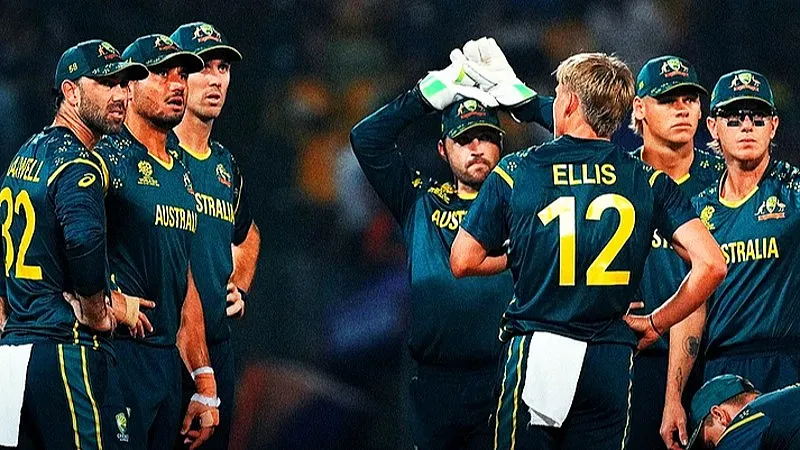

Australia failed in the T20WC because of selection confusion, injury setbacks like Josh Hazlewood’s hamstring injury, and dramatic performance collapses, such as the loss to Sri Lanka and the earlier loss to Zimbabwe. When key figures like Steven Smith and Matt Renshaw were left out despite batting struggles, and core players like Mitchell Marsh and Travis Head failed to sustain consistency, the team’s tactical structure collapsed at the worst possible time.
Selection Decisions Hurt Team Balance
Australia entered the tournament with a rigid power-hitting plan but failed to adjust when conditions demanded flexibility. Calling Smith into the squad late but not playing him signaled uncertainty. Renshaw, who had shown composure earlier, was dropped, while struggling hitters were retained.
This approach exposed middle-order fragility. Players like Marcus Stoinis and Cooper Connolly were expected to finish innings strongly, but frequent collapses meant they entered under scoreboard pressure rather than attacking freedom. In subcontinent conditions, where adaptability is crucial, Australia stayed committed to Plan A and paid the price.
Bowling Collapse Without Strike Power
Australia’s biggest tactical weakness was its inability to take wickets in crucial phases. The pace attack lacked penetration after Hazlewood’s injury removed their most reliable powerplay weapon.
Key bowlers like Nathan Ellis and Adam Zampa went wicketless in consecutive matches, allowing opposition batters to control run chases. Against Sri Lanka, Australia scored 181 but failed to defend it after the opposition chased the target comfortably. Similarly, in the loss to Zimbabwe, Australia managed only two wickets across the innings, highlighting a systemic bowling failure. Without early breakthroughs, their defensive strategies became ineffective on slower pitches.
Injury Disruption and Squad Instability before the T20 World Cup
Hazlewood’s hamstring injury was not just the loss of a bowler but the removal of Australia’s powerplay anchor. Before the injury, he had been delivering early wickets consistently, controlling opposition momentum.
His absence exposed the lack of depth, forcing selectors to reshuffle roles and recall Smith as a backup option. Meanwhile, bowlers like Ben Dwarshuis struggled to deliver consistent breakthroughs. In tournament cricket, stability builds confidence, but Australia’s constant adjustments created uncertainty in both bowling and leadership execution.
Batting Inconsistency Under Pressure
Australia’s aggressive batting philosophy worked on flatter pitches but failed in spin-friendly conditions. Marsh and Head started well in matches but couldn’t convert starts into match-winning innings. Players such as Cameron Green, along with other middle-order batters, failed to produce impactful scores throughout the competition.
The collapse from 160 for 4 to 181 all out against Sri Lanka illustrated how quickly their batting unraveled once momentum shifted. This pattern repeated across matches, showing a deeper structural issue rather than isolated failures.
Historical Pattern of Tournament Struggles
Australia’s current problems mirror their earlier struggles in global T20 tournaments. In past editions, including early exits in previous campaigns, Australia often struggled when their pace attack lacked early wicket-taking ability. Their success in winning the 2021 tournament was built on bowling discipline and role clarity, which contrasts sharply with the instability seen now. That winning team had clearly defined responsibilities, while the current squad appears tactically unsettled.
This comparison reinforces that Australia’s T20 World Cup failure is not sudden but part of a recurring strategic weakness when conditions and injuries disrupt their preferred style. Australia’s T20WC failure was the result of interconnected issues rather than one isolated mistake. Selection uncertainty, Hazlewood’s injury, bowling ineffectiveness, and batting inconsistency combined to derail their campaign.
Key Takeaway
Australia’s inability to replace injured match-winners and adapt tactically was the defining reason behind their World Cup collapse.
FAQs
What caused Australia’s loss to Sri Lanka in the T20WC?
Australia failed to defend a competitive total because their bowlers couldn’t take wickets during crucial middle and death overs.
Why was Steven Smith called in but not played?
Smith was added as injury cover, but selectors chose to stick with their original power-hitting lineup.
How did Hazlewood’s hamstring injury affect Australia?
It removed their most effective powerplay bowler, weakening their ability to control matches early.
Why did Australia lose to Zimbabwe in the tournament?
Australia’s top order struggled against pace, and their bowlers failed to take enough wickets to defend their score.
Is Australia declining in T20 cricket?
Australia remains competitive, but inconsistent selection and injury disruptions have hurt its recent tournament performances.