

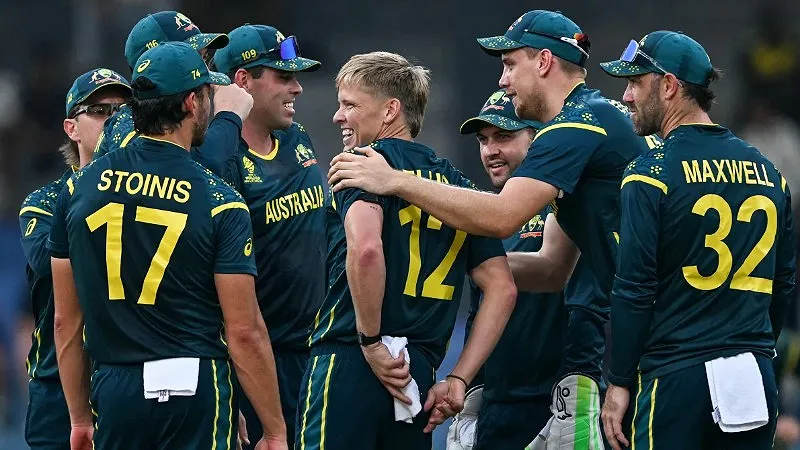

Australia’s cricket transition after the T20WC 2026 exit has exposed structural weaknesses that go beyond one tournament loss. Injuries, retirements, and a lack of replacements have created a clear Australia squad transition phase, especially in bowling. With legends like Mitchell Starc moving on and concerns raised in the Aakash Chopra Australia cricket prediction, the Australia bowling attack depth problem is no longer theoretical. It is a present reality that will shape Australia’s cricket future prediction across formats for the next few years.
Fast Bowling Depth Crisis
For over a decade, Australia’s dominance relied on a stable trio of elite fast bowlers controlling conditions across formats. That stability is now gone. Injuries to senior pacers and the retirement of experienced leaders have forced Australia to rely on bowlers who are still developing consistency at the international level.
This transition affects tactical flexibility. Australia traditionally used aggressive pace bursts in the middle overs and reverse swing in late phases, especially in Tests and T20 knockouts. Without proven replacements, they struggle to maintain pressure across long spells. This Australia bowling attack depth problem is not just about skill but about experience under pressure in global tournaments.
Spin And Balance Concerns
Spin has quietly become another vulnerability. Australia built its strategy around having one elite spinner supported by seam dominance. But in modern T20 cricket, teams increasingly depend on multiple spin options to control middle overs.
Without strong secondary spin support, Australia’s bowling combinations become predictable. Opponents can target specific phases, especially on slower pitches in Asia. This lack of variation is a key tactical weakness, accelerating Australia’s cricket transition after the T20 World Cup 2026 exit.
Batting Core Losing Stability
Australia’s batting still has match-winners, but its consistency has declined. Previously, their strength was having multiple players capable of controlling innings tempo in different conditions.
Now, batting performances fluctuate more. Senior players are nearing the end of their careers, while younger players are still adapting to international pressure. This creates fragile phases where Australia loses momentum quickly, especially in knockout scenarios. The Australia squad transition phase is visible not just in bowling but across the entire team structure.
Tournament Exit Revealed Structural Gap
Australia’s elimination scenario itself highlighted deeper problems. Their inability to stay in qualification contention showed that the margin for error has shrunk significantly.
In earlier years, Australia could recover from one loss through superior squad depth. Now, injuries or off-form players have a much greater impact. This shift reflects why the Australian cricket future prediction includes a temporary decline while the next generation develops.
Historical Transition Comparison from the T20 World Cup
Australia has faced similar transitions before. After legends like Shane Warne, Glenn McGrath, and Adam Gilchrist retired in the late 2000s, the team went through several years of rebuilding. During that period, Australia briefly lost its dominance before developing a new core.
The recent exit from the T20WC 2026 marks the end of an era for Australian cricket; however, it also represents a generational change rather than a permanent decline. Australia can still call upon solid fast bowlers but lacks quality spin options because of significant variables amongst current batsmen and emerging batsmen, all contributing to their eroding dominance at the international level.
However, Australia’s cricket system has historically produced elite replacements over time. The current phase will likely bring inconsistent results in the short term, but their long-term future remains stable. The key challenge will be how quickly new players gain experience and rebuild the tactical strength that once made Australia the most feared team in world cricket.
Key Takeaway
Australia’s cricket transition after the 2026 exit marks the beginning of a rebuilding cycle caused by bowling depth loss, aging stars, and generational change.
FAQs
What caused Australia’s decline after the T20WC 2026 exit?
A combination of retirements, injuries, and lack of experienced replacements weakened their overall team balance.
Why is Mitchell Starc’s retirement important for Australia?
He provided experience, wicket-taking ability, and leadership, which are difficult to replace immediately.
How long does a cricket team’s transition phase usually last?
It typically takes a few years for new players to gain experience and rebuild team strength.
Is Aakash Chopra’s Australia cricket prediction realistic?
His prediction reflects visible squad changes and follows historical patterns seen in past Australian transitions.
Can Australia become dominant again in world cricket?
Yes, Australia has a strong development system, and rebuilding phases have historically been followed by successful eras.