

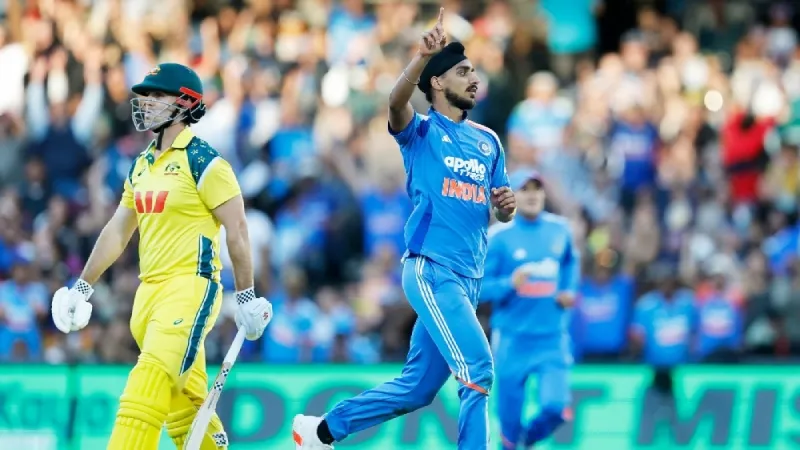

Indian cricket seems to have an unusual pattern; each time it finds a world-class fast bowler, it appears to find no space to bowl him. Arshdeep Singh joins the strange trend as the most successful (in terms of wickets) Indian in Twenty20 International Cricket, and one of ten Indians with 50-plus wickets, for he can bowl more frequently than Kuldeep Yadav. However, Arshdeep Singh did not start the Asia Cup series for India’s first-choice eleven. He played two token games against Afghanistan, once the qualification had been confirmed.
Then came Australia. India kept Arshdeep out for the first two matches, again leaning on the same old we can’t play all our best bowlers because none of them bat dilemma, an echo of the Kohli-era ODI puzzle when Bumrah, Shami, Kuldeep, and Chahal rarely fit together.
But early-season Australia is a different beast. It rewards high release, late swing, and seam chatter. So, when Arshdeep finally entered the XI, the question grew louder: why did it take so long?
Powerplay Pressure That Redefined the Match
In a contest otherwise shaped by standard T20 rhythms, the opening four overs of Australia’s chase flipped everything. Australia crawled to 24/2; India had blasted 41/0 in their own start. Those 17 runs were not a gap; they were a verdict. Arshdeep dismissed Travis Head and Josh Inglis, but the real story was the combined choke: Bumrah’s presence at one end, Arshdeep’s movement at the other. The left-armer’s ability to swing the ball both ways from a high release point produced awkward bounce and seam deviations that few early-season Australian decks allow you to waste.
Selection Math That Never Quite Adds Up
India finally played Arshdeep and then immediately dropped Kuldeep for Washington Sundar, not because of form but because the combination simply couldn’t hold three fast bowlers, two spinners, and a deep batting lineup without removing someone essential. The balancing act is so tight that one tactical tweak forces two compromises. In this case, India ended up short on pace: Washington never bowled, and Shivam Dube plus Abhishek Sharma leaked 56 in their four combined overs.
Twin Threats Built for Australian Conditions
When conditions offer seam, both Bumrah and Arshdeep become non-negotiable. Their contrasting angles, pace variation, and threat profiles intensify each other. Arshdeep’s returns at the death, especially paired with Bumrah’s surgical Yorkers, denied Australia any finishing surge. India has four elite strike bowlers, but only one left-arm quick of this quality. That variety alone is worth structural sacrifice.
The Old Four-Bowler Puzzle Returns
India is no stranger to these issues either. During the period of 2019-21, India experienced problems of being able to play Bumrah, Shami, Kuldeep, and Chahal at the same time, as none of them were capable of batting. This led to a bowling group that, at times, was two players undermanned in close-run chases. However, while Arshdeep and Varun Chakravarthy are now modern alternatives for some of those players, the problem remains the same. While having great bowling options can lead to difficulties with player selections, it does not create harmony between players.
Arshdeep Singh did not just get a couple of early wickets; he exposed one of India’s biggest truths about T20 cricket: they are missing one strategic piece from achieving perfection. Not for a lack of talented players, but simply that their best bowling options come to the table as pure specialists. And in any conditions which allow the ball to move, particularly in Australia, the Bumrah/Arshdeep combination is too powerful, too game-changing to be rested for the sake of balance.
Key Takeaway
Arshdeep isn’t a luxury; he’s a structural necessity disguised as a selection dilemma.
FAQs
- Why wasn’t Arshdeep Singh in India’s first-choice XI earlier?
Because India struggled to fit multiple specialist bowlers who don’t bat into one balanced XI.
- What made Arshdeep effective in Australia?
His high release, dual swing, and seam movement perfectly fit early-season Australian pitches.
- How did Washington Sundar influence the match?
He didn’t bowl but rescued the chase with a crucial 49 off 23, proving his value as a batting all-rounder.
Disclaimer: This blog post reflects the author’s personal insights and analysis. Readers are encouraged to consider the perspectives shared and draw their own conclusions.
Step into the world of cricket with JeetBuzz News—where expert opinions, trending Blogs, and behind-the-scenes insights meet all your favorite topics. Stay informed, stay entertained, and never miss the stories shaping the cricketing world—only on JeetBuzz News!