

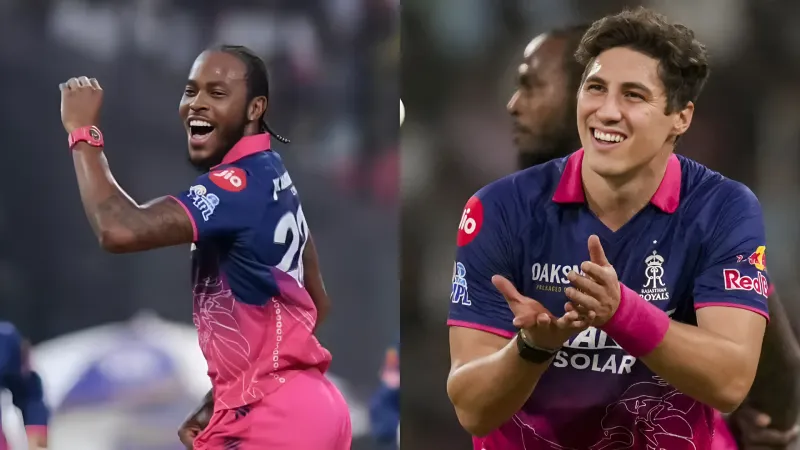

Most powerplay bowling plans ask bowlers to contain and hope for mistakes. Jofra Archer and Nandre Burger don’t contain. They attack from ball one with the specific intention of making the first six overs feel like the most difficult batting period of the entire innings. Archer pushes consistently into the high 140s km/h. Burger generates heavy pace with seam movement that catches batters before they’ve properly assessed the surface. Together, they’ve built one of the most effective powerplay bowling combinations in the tournament, and the method behind it is worth understanding in full.
Pace That Removes Thinking Time Entirely
The most important number in understanding their impact isn’t their wicket tally. It’s the reaction time their pace removes from the batter’s decision-making process. At high 140s km/h, a batter who commits to the wrong shot has no time to adjust before the ball arrives. Errors become inevitable rather than occasional.
Both bowlers target the top of off stump or back of a length consistently. This length isn’t designed to produce lbws or clean bowled dismissals. It’s designed to remove the batter’s ability to free their arms through the line, which means boundaries require perfect timing rather than simply finding a gap.
How They Structure the First Six
Neither Archer nor Burger chases wickets with risky deliveries early. Their power play strategy is built on pressure accumulation rather than immediate breakthroughs, which is a more sophisticated approach than it sounds.
Archer angles the ball across batters who favour the off side, inviting drives but releasing the ball just short enough to find the edge rather than the middle. The batter sees the length and commits. The ball doesn’t arrive where the feet have moved. Burger complements this with seam movement on surfaces offering early assistance, which means even when his pace isn’t producing edges, the ball is still doing enough to make clean contact genuinely difficult.
Short Ball Used as a Weapon
Archer’s bouncer works because he earns it. He spends four or five deliveries establishing a hard length pattern that forces the batter’s hands low. Then the bouncer arrives with a sharp lift and pace that the batter’s hands are completely unprepared for.
Burger’s short ball targets the body rather than the helmet. That distinction matters. A bouncer aimed at the head gives a batter the option to sway or duck. A ball aimed at the ribs removes both options and limits scoring zones immediately. Used together, their short-ball tactics function as a tactical disruptor through the power play rather than a defensive fallback.
IPL 2026 Conditions Make Them Unstoppable
IPL surfaces have provided enough early swing and seam movement to amplify natural pace rather than neutralise it. When the ball moves even slightly at Archer’s pace, the adjustment required from a batter is almost impossible to make cleanly. Burger’s seam position at high speed on these surfaces generates late movement that arrives before batters can reset their weight.
What makes them genuinely difficult to plan against is their adaptability. On flat tracks without movement, both bowlers shift to pace variation and hard lengths and remain effective through different means. Their performance doesn’t depend entirely on conditions cooperating. They produce results regardless, which is the difference between bowlers who dominate in ideal conditions and those who dominate throughout a tournament.
Bowler | Key Weapon | Powerplay Method | Impact |
Jofra Archer | Pace + angled seam | Full-length drawing drives | Edges, false shots |
Nandre Burger | Heavy seam movement | Back of length into body | Restricted scoring, body discomfort |
Combined | Short ball variation | Established after hard lengths | Mistimed pulls, wickets |
- Is the Archer and Burger powerplay combination the most dangerous new ball pairing in the entire tournament, or is there another pair giving batters more trouble right now? Drop your pick in the comments and follow for IPL updates.
FAQs
Q: What makes Archer and Burger so effective, specifically in the power play?
Their high pace removes batter reaction time while their disciplined hard lengths prevent batters from freeing their arms through the line.
Q: How does Burger’s approach differ from Archer’s in the first six overs?
Archer angles the ball across the bat to find edges; Burger uses seam movement and body line pressure to restrict scoring and create discomfort.
Q: Why does Archer’s short ball work so consistently in IPL 2026?
He establishes a hard length pattern first, then produces the bouncer when the batter’s hands are positioned too low to react cleanly.
Q: Can batters develop a counter-plan against this powerplay combination?
Yes, but it requires early adaptation and calculated shot selection rather than aggression, which most top-order batters resist naturally.
Disclaimer: This blog post reflects the author’s personal insights and analysis. Readers are encouraged to consider the perspectives shared and draw their own conclusions.