

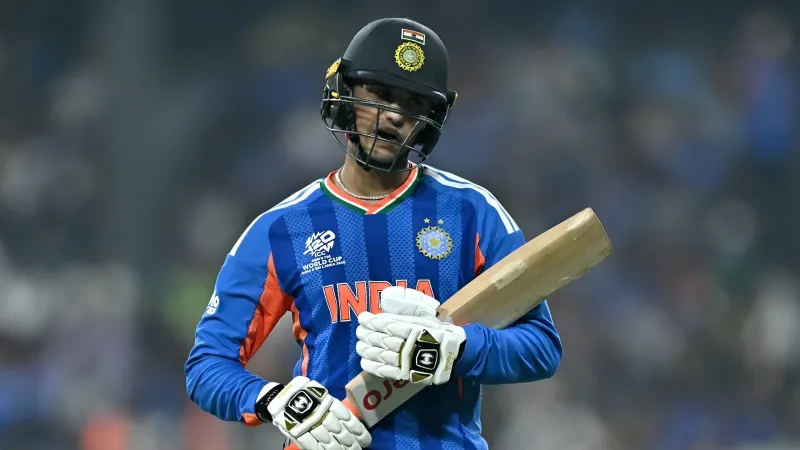

Abhishek Sharma’s T20WC form has become a genuine concern because his early dismissals are exposing deeper flaws in the India opening partnership and raising India Super Eight batting concerns. His string of failures, including multiple early exits, has disrupted India’s powerplay batting analysis patterns and highlighted the risks behind India’s aggressive T20I batting strategy. While India continues winning, their dependence on middle-order recovery suggests Abhishek’s batting failure analysis is no longer just about individual form but about structural stability.
Powerplay Failures Changing Match Momentum
The biggest impact of Abhishek Sharma’s T20 World Cup form is visible in how India starts their innings. India’s entire batting model depends on explosive starts, but repeated early wickets have forced the middle order to rebuild rather than accelerate. When an opener falls inside the first two overs, the opposition gains immediate control of field placement and bowling rotations.
This shift affects intent. Instead of dominating the power play, India often stabilizes it. This completely alters the pressure dynamic and gives bowlers more room to attack new batters under less scoreboard pressure.
India T20 World Cup Opening Partnership Under Pressure
The India opening partnership has delivered inconsistent results despite the team’s overall success. Players like Shubman Gill and Ishan Kishan have produced impactful individual innings, but partnerships have frequently ended early. This reveals a key issue: individual brilliance is masking partnership instability.
In T20 cricket, partnerships matter more than individual scores because they maintain scoring momentum. When one opener fails early, bowlers can immediately target the new batter with attacking fields, reducing scoring efficiency during the most critical phase.
Aggressive Strategy Carrying Structural Risk
India’s aggressive batting strategy T20I philosophy is built on attacking from ball one, accepting dismissals as part of the process. This approach has produced high-scoring rates but also increased vulnerability.
Conditions play a major role here. In tournaments like the T20WC, pitches often offer early assistance to bowlers through seam movement or grip for spinners. Left-handers like Abhishek are also targeted with off-spin early, reducing their scoring options and increasing dismissal probability.
This tactical matchup is now being consistently exploited by opponents who understand India’s aggressive template.
Data Reveals Middle Order Dependency
India’s powerplay batting analysis shows a clear pattern: when openers fail early, scoring acceleration slows significantly in the next phase. The middle order, including players like Suryakumar Yadav, has repeatedly been forced into recovery roles.
This dependency is dangerous in the knockout stages. Against stronger bowling attacks, early damage cannot always be repaired. The margin for error becomes smaller, and early wickets can define match outcomes.
This makes Abhishek Sharma’s T20 WC form not just an individual slump but a strategic vulnerability.
Knockout Pressure Will Multiply Risk
Group stage dominance often hides structural flaws, but knockout matches expose them. Better teams attack weaknesses more aggressively and adapt faster.
Opponents will continue targeting Abhishek with specific bowling plans, especially spin in the powerplay. Without a strong start, India risks losing scoreboard control in matches where recovery becomes significantly harder.
The performance of Abhishek Sharma raises serious concern due to India’s current loss of matches by India currently and how they depend on an initial strong start to perform consistently at a high level throughout the tournament. Consequently, Abhishek Sharma’s early dismissal provides a glimpse into the difficulty of maintaining the balance of power within the batting order based on an offensive style of play.
Key Takeaway
India’s aggressive batting strategy can survive Abhishek Sharma’s failures in group stages, but knockout matches may not offer the same margin for error.
FAQs
What is Abhishek Sharma’s role in India’s T20 batting lineup?
He attacks early to build momentum and set the innings tempo.
Why are India’s opening partnership performances important in the T20WC?
Strong opening partnerships maximize powerplay scoring and reduce pressure on the middle order.
How does India’s aggressive batting strategy T20I increase risk?
Attacking early increases scoring potential but also raises the chances of losing wickets quickly.
Can India win the T20 World Cup if Abhishek Sharma continues in poor form?
Yes, but it becomes harder against stronger teams that can exploit early weaknesses.
Which bowlers are most effective against Abhishek Sharma?
Off-spinners and bowlers who move the ball early have created the most challenges for him.
Disclaimer: This blog post reflects the author’s personal insights and analysis. Readers are encouraged to consider the perspectives shared and draw their own conclusions.