

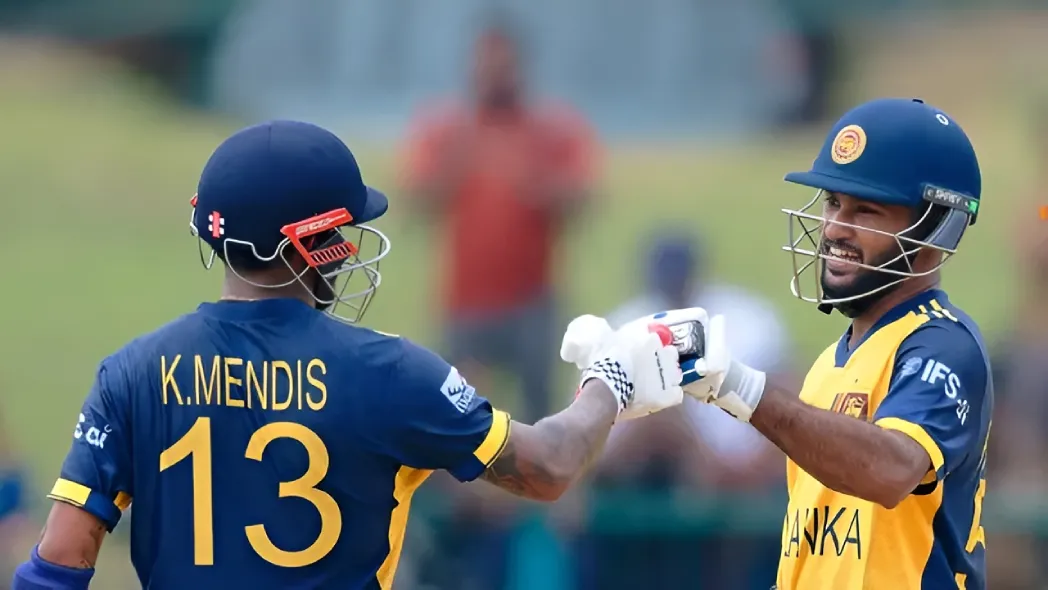

Pavan Rathnayake 60 off 28 vs Oman powered Sri Lanka to a commanding Sri Lanka 200+ total at Pallekele, combining a high strike rate with remarkable control. In this Sri Lanka vs Oman T20 analysis, his balance between acceleration and stability allowed Dasun Shanaka’s 20-ball cameo and Kamindu Mendis’ late cameo to flourish. Rather than reckless hitting, Rathnayake’s strike rate and control percentage reflected a calculated middle-overs approach aligned with the Vikram Rathour T20 batting approach. The innings directly answered Sri Lanka’s long-standing middle-order concerns with a blueprint built on tempo, strike rotation, and role clarity.
Controlled Aggression Blueprint
The defining trait of Pavan Rathnayake’s 60 off 28 vs Oman was not just speed; it was composure. He blended boundary precision with consistent strike rotation, ensuring the innings never stalled.
Instead of relying solely on six-hitting, Rathnayake collected ten singles and six twos, meaning over a third of his runs came through gap-finding. On a Pallekele surface with relatively big boundaries, this method minimized risk while sustaining momentum.
Strike Rate Meets Control Percentage
The debate around Rathnayake’s strike rate and control percentage often assumes the two cannot coexist. This innings challenged that theory.
Scoring 60 off 28 delivers a strike rate above 200 elite territory. Yet he faced only two dot balls, showing sustained pressure without reckless slogging. Against Oman’s spin-heavy middle overs, Rathnayake prioritized angles and placement rather than aerial risks. That tactical maturity ensured Sri Lanka crossed the 200-run mark, their first 200+ first-innings total since January 2025.
Shanaka’s Power-Hitting Impact in the T20 World Cup
While Rathnayake laid the foundation, Dasun Shanaka’s 20-ball cameo shifted the match beyond reach. Arriving at 136 for 3 in the 14th over, Shanaka wasn’t tasked with recovery. His role was clear: accelerate. Within fewer than five overs, the total surged to 199.
The Shanaka power-hitting impact in the T20 World Cup becomes most effective when the top order provides stability. Rather than rebuilding, he attacked from ball one, reinforcing how role clarity maximizes output. This structural alignment between anchor and finisher was decisive.
Late-Overs Surge Formula
Kamindu Mendis’ late cameo added finishing polish. His rapid 19 off seven balls ensured the final overs produced maximum value.
From a Sri Lanka vs Oman T20 analysis perspective, this showed phase awareness:
- Middle overs: strike rotation
- Death overs: clean boundary hitting
- Minimal dot-ball pressure
The Vikram Rathour T20 batting approach emphasizes tempo without stagnation, and this innings embodied that principle.
Evolution of Sri Lanka’s T20 Template
Compared to recent tournaments where Sri Lanka failed to breach 180 consistently, this 200+ total at Pallekele marks a tactical shift. Analysts have long argued that Shanaka’s finishing thrives only when the platform exists. This match validated that theory through execution rather than rhetoric.
Pavan Rathnayake scored his 60 off 28 balls against Oman wasn’t merely an example of playing quickly, but rather a way for Sri Lanka to build a deeper innings through high strike rotation and hitting boundaries consistently, allowing the Sri Lankan team to create a layered innings with an appropriate peak time of completion. The reason for the 200+ score by Sri Lanka (at Pallekele) was not by accident, but rather by deliberate clarity regarding what each player would do.
If this model continues, controlled middle overs followed by defined finishing, Sri Lanka may finally stabilize their volatile T20 identity. Rathnayake’s method suggests he could cement himself as a long-term middle-order accelerator rather than a situational gamble. The blueprint is now visible. The challenge is consistency.
Key Takeaway
Sri Lanka’s 200+ total was built on structured aggression, and Rathnayake proved that control and strike rate can coexist at elite T20 levels.
FAQs
What was Pavan Rathnayake’s strike rate in the Oman match?
He scored 60 off 28 balls, giving him a strike rate above 200.
Why was Sri Lanka’s 200+ total at Pallekele significant?
It was their first 200-plus first-innings total since January 2025.
How did Dasun Shanaka’s cameo change the momentum?
His 20-ball stay accelerated the scoring rapidly in the death overs when the platform was already set.
Is Rathnayake suited for Sri Lanka’s permanent T20 middle-order role?
His ability to rotate strike and accelerate suggests he fits a modern middle-overs accelerator profile.
What does Vikram Rathour’s T20 batting approach emphasize?
It focuses on scoring quickly through placement and tempo management rather than relying only on six-hitting.
Disclaimer: This blog post reflects the author’s personal insights and analysis. Readers are encouraged to consider the perspectives shared and draw their own conclusions.