

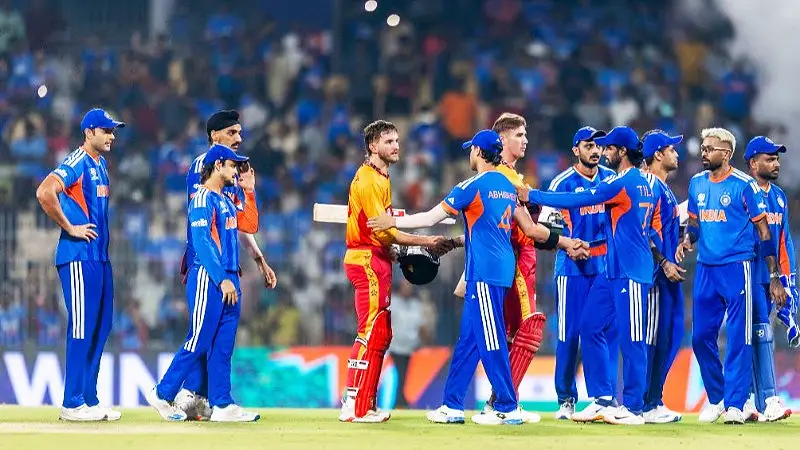

India’s match vs Zimbabwe produced one of the most dominant statistical performances of the T20WC 2026 as the Indian Cricket Team comprehensively outplayed Zimbabwe in the Super 8s stage. India’s 72-run victory was not just about the margin but about rewriting tournament history across batting and bowling. A record-breaking team total, unprecedented power-hitting, and a landmark bowling achievement by Arshdeep Singh defined the contest. This match added three major records to India’s T20 World Cup legacy, underlining why they remain one of the most complete sides in the competition.
India’s Highest T20 World Cup Total
India’s score of 256/4 became their highest-ever total in T20 World Cup history, surpassing the long-standing mark set during the inaugural 2007 edition. The conditions at the MA Chidambaram Stadium played a crucial role, with the pitch offering consistent bounce and little assistance for bowlers once the ball softened. India’s tactical clarity was evident in their phase-wise batting approach, where early momentum was preserved through the middle overs before an explosive finish. Zimbabwe struggled to adjust lengths, allowing Indian batters to target straight boundaries with minimal risk.
Joint-Most Sixes in a World Cup Innings
India equalled the record for the most sixes hit in a single T20 World Cup innings by smashing 17 maximums. This record was not driven by one individual but reflected collective intent across the batting order. The combination of short square boundaries in Chennai and Zimbabwe’s pace-heavy bowling attack allowed Indian batters to consistently access high-percentage hitting zones. The six-hitting spree showcased India’s modern power-hitting structure, where multiple batters are capable of clearing the ropes from ball one.
T20 World Cup 2026: Arshdeep Singh’s Historic Wicket Record
The match also marked a significant individual milestone as Arshdeep Singh became India’s highest wicket-taker in T20 World Cup history with 35 scalps. His performance highlighted tactical intelligence rather than raw pace, using variations in length and angle to exploit scoreboard pressure. Zimbabwe’s batters were forced into aggressive strokes early in the chase, allowing Arshdeep to capitalize with controlled death bowling. This record reflects sustained excellence across multiple tournaments rather than a single standout performance.
India’s record vs Zimbabwe T20 World Cup 2026 match was not an anomaly but a reflection of India’s tactical maturity in modern T20 cricket. Each record, whether batting or bowling, stemmed from clear planning, adaptability to conditions, and depth in personnel. India’s ability to stretch advantages rather than merely secure wins sets them apart at this stage of the tournament. As the T20WC 2026 progresses, this performance serves as a warning to opponents that India is not just winning games but redefining benchmarks. If similar execution continues, more records may fall as the tournament reaches its decisive phase.
Key Takeaway
India’s clash against Zimbabwe showed that structured aggression and tactical clarity naturally lead to record-breaking performances in T20 World Cups.
FAQs
What records did India make against Zimbabwe in the T20WC 2026?
India registered their highest T20 World Cup total, equalled the record for most sixes in an innings, and saw Arshdeep Singh become their leading wicket-taker in the tournament.
How significant was Arshdeep Singh’s performance?
It underlined his long-term consistency and cemented his role as India’s most successful T20 World Cup bowler.
Why was the Chennai pitch important in this match?
The surface offered even bounce and minimal assistance for bowlers, allowing batters to play through the line with confidence.
How does this match compare to India’s past World Cup performances?
Unlike earlier tournaments, this performance reflected collective dominance rather than reliance on individual brilliance.
Can this win influence India’s path to the semifinals?
Yes, the win significantly boosts net run rate and reinforces India’s tactical momentum heading into tougher fixtures.