

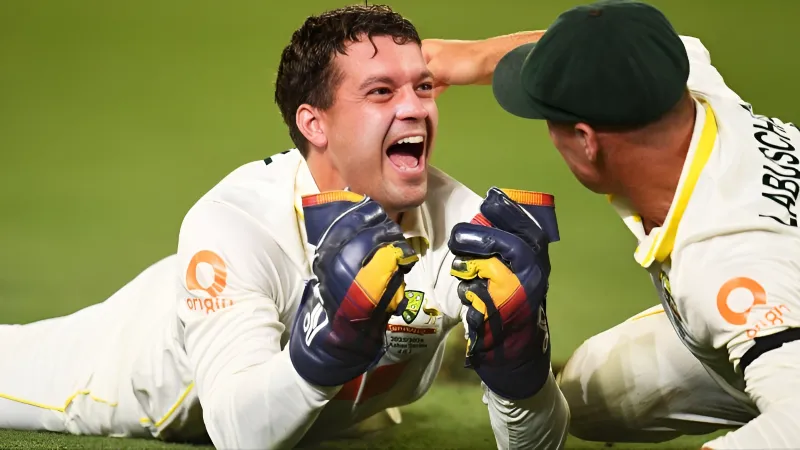

In cricket, greatness is often loud centuries announced with raised bats, spells punctuated by roars. Alex Carey’s brilliance, however, arrived quietly, hidden behind the thud of leather into gloves. After Brisbane, some of Australia’s finest former wicketkeepers called his work “one of the best wicketkeeping performances” they’d ever seen, high praise in a lineage that includes Healy, Gilly, and Haddin.
Yet Carey’s reaction was telling. No victory lap. No social-media flourish. Just a gentle deflection and a reminder that wicketkeepers aren’t judged on highlight reels, but on the chances they don’t miss. Across the first two Ashes Tests, Carey has been flawless, with zero chances, razor-sharp standing up, and seamless control over bowlers operating at vastly different speeds.
Judged by Series, Not Sessions
Andre Borovec’s blunt measurement strips away the romanticism of measuring a wicketkeeper’s performance; it is how many opportunities he misses (not how much applause he receives). Carey seems to understand that aspect of his work more than many others do. That he will not elevate the Brisbane Test to the status of “Test” also reveals a mindset that is focused on a long series of playability (a difficult lesson to learn for wicketkeepers before him) as seen in the career of Adam Gilchrist; the legacy of which was constructed on a series of consistent play over several years, rather than simply on a single Test. Carey has a continued forward-thinking perspective; the next innings, the next edge, the next time of importance.
Quiet Coaching, Stronger Autonomy
The impact of Borovec is quite small in comparison to the overall effect it has. He was a grade cricketer for many years before becoming a coach. Borovec works at a “coach” level with Carey; he does not work at a dictator or teller level. That is important because Carey is not simply being told what to do as a wicket-keeper – he is learning how to approach each situation as a wicket-keeper. Because of that method of coaching, Carey learns to be adaptable in game situations; he will adjust his foot placement, angle of body, and even his focus point based on the fielding conditions rather than by what he has been instructed to look like while doing so.
Deliberate Drills Over Brute Intensity
At Adelaide Oval, Carey wasn’t sprinting or diving. He was slowing things down. Used pitches. Soft-edged “nick” bats. Offspin tossed deliberately wide. This wasn’t casual; it was controlled chaos. The drills weren’t about repetition, but recognition. Neuroscience backs this up: skill retention improves when practice mimics decision-making, not mechanical repetition. Carey’s training looks simple because the complexity is internal.
Why He Never Practices Standing Up Fast Bowlers
Here’s the paradox: Carey doesn’t practice standing up to 130kph seamers yet excels at it in Tests. Why? Because he trains fundamentals until instinct takes over. By mastering set-up, balance, and initial movement, he frees his body to react under match intensity. It’s the same principle that made MS Dhoni such a formidable keeper late in his career, less flourish, more inevitability.
Adapting Like a Subcontinental Keeper
Since Borovec joined the setup in 2022, Carey’s evolution has leaned toward problem-solving over tradition. On tours like Pakistan, low bounce demanded a football goalkeeper’s approach, staying low, reading trajectory, reacting late. This adaptability is Carey’s edge. He’s no longer an Australian keeper shaped solely by hard pitches and carry; he’s a global one, fluent across conditions.
The real test isn’t whether Carey can repeat Brisbane, it’s whether he can keep doing this when the pitch flattens, the edges dry up, and the scrutiny sharpens. Judging by his process, betting against him would be foolish.
Key Takeaway
Alex Carey’s brilliance isn’t magic; it’s method, repeated calmly under pressure.
FAQs
- What makes Alex Carey’s wicketkeeping stand out this Ashes?
His flawless execution, adaptability across bowlers, and zero missed chances.
- Why doesn’t Carey practice standing up to fast bowlers?
He focuses on fundamentals, so instincts take over during match intensity.
- How has Andre Borovec influenced Carey’s growth?
By emphasizing problem-solving, reflection, and purposeful practice over rigid technique.
Disclaimer: This blog post reflects the author’s personal insights and analysis. Readers are encouraged to consider the perspectives shared and draw their own conclusions.
Step into the world of cricket with JeetBuzz News—where expert opinions, trending Blogs, and behind-the-scenes insights meet all your favorite topics. Stay informed, stay entertained, and never miss the stories shaping the cricketing world—only on JeetBuzz News!