

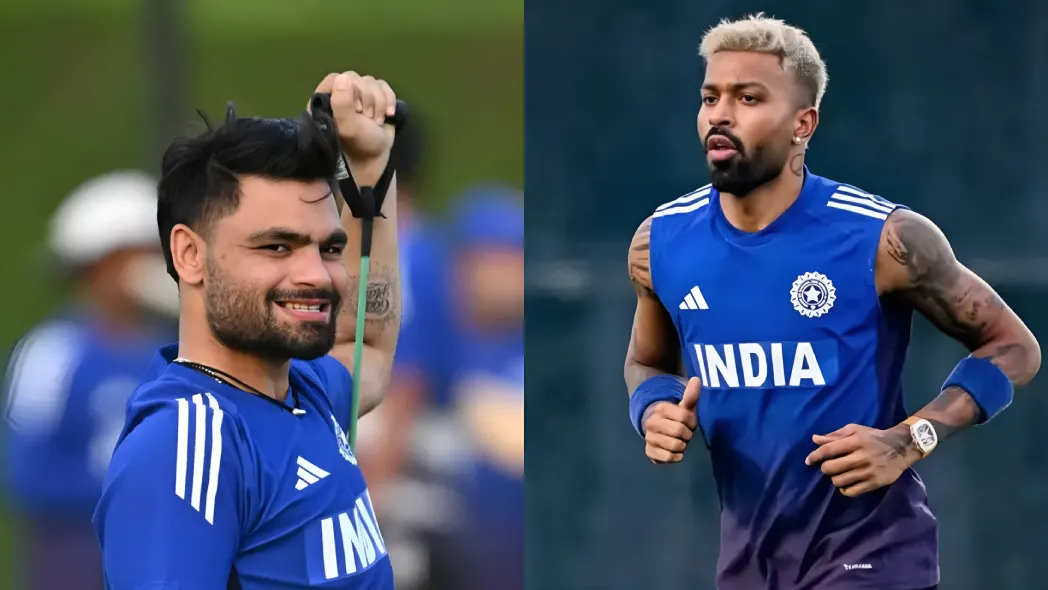

Every World Cup cycle has its sacrificial lamb, a player who does almost everything right, but still ends up wearing the unlucky tag because the team room suddenly gets crowded. For India in late 2025, that player is Rinku Singh. The same Rinku whose strike-rate reads like an IPL highlight reel. The same Rinku who bailed India out in tricky chases last year. And yet, with one man’s return, his name quietly slipped off the South Africa T20I sheet.
That man, of course, is Hardik Pandya, India’s once-fragile, now-crucial all-rounder returning from a quad injury. According to Irfan Pathan, the omission wasn’t a shock but an obvious outcome. In fact, Pathan suggested that 90–95% of India’s 2026 World Cup squad is already locked. Hardik walks in, someone walks out, and the pecking order dictates that Rinku becomes the ripple effect of a much bigger strategic reset.
But the real question is: Does India’s Hardik-first template justify sidelining a proven finisher? Or are they leaving a match-winner cooling on the bench purely because of the arithmetic of roles?
Hardik’s Return Reshapes Everything
Hardik Pandya isn’t merely a player; he’s a selection domino. His return instantly restores India’s six-batter + all-rounder template, a structure Rohit and Dravid clung to through the successful 2024 T20 World Cup run. Irfan Pathan calls Hardik’s role “most crucial” for India’s 2026 title ambitions, and the logic holds: India trusts him as both a death overs hitter and a seam-bowling stabiliser.
But the trade-off is brutal: a side with Hardik, Dube, Axar, and three spinners suddenly has no breathing room for a specialist finisher unless that finisher is also a sixth bowler, which Rinku isn’t. In India’s rigidly role-defined structure, versatility beats explosiveness. And Rinku is paying for that rigidity.
India’s Middle-Order Chaos Makes the Axe Look Premature
Ironically, India’s middle-order shuffle is part of why Rinku’s exclusion stings. Across their 15 completed T20Is this year, 13 of which they’ve won, several players batted out of position a fact Pathan highlighted sharply. With the World Cup barely months away, India still hasn’t clearly settled who bats at 4, 5, or 6.
In a setup starved for positional stability, dropping the one guy who excels at batting out of chaos feels counterintuitive. Rinku thrives in crisis overs, absorbs pressure, and explodes late, a skill set India historically waited decades to find. Removing him at a time of reshuffling seems more like convenient arithmetic than performance-based logic.
The Bowling Conundrum Forces Tough Calls
Pathan’s concerns around India’s pace configuration further tighten the squeeze. He stresses that Arshdeep Singh must bowl regularly with Bumrah, especially in the powerplay, while Hardik slots in as the third quick. If these three are locked, the team must compensate by deepening the batting through all-rounders, a structure that again disadvantages Rinku.
India, playing a home World Cup with spin-friendly tracks, prefers security: Axar + Kuldeep + Varun Chakravarthy. That’s already seven locked spots. Gill’s return adds another. Suddenly, the finishing role becomes a game of musical chairs, and Rinku is left without a seat.
Squad Clarity vs Opportunity Cost
If Pathan is right that this is “90–95%” of the World Cup squad, then India aren’t experimenting, they’re finalising. And that is where Rinku loses not just matches, but momentum. He played only one match in Australia, despite being in the touring squad. Now he’s left out entirely.
India might be prioritising a settled core, but at what cost? Depth? Flexibility? X-factor finishing? The very qualities that once defined their new-age T20 approach seem replaced by caution dressed as clarity.
Rinku Singh isn’t merely another name. He’s a specialist in a role India haven’t mastered for a decade, a finisher who handles panic the way Bumrah handles yorkers. Leaving him out now means limiting his reps before the biggest tournament on home soil.
If the Hardik-first template fires, India will look like geniuses. If it falters, they’ll be left wondering whether the man they left out was the man they needed in crunch time.
Key Takeaway
India’s selection isn’t wrong; it’s risky because it sidelines the only pure finisher they have.
FAQs
1. Why was Rinku Singh dropped despite good form?
Hardik Pandya’s return reshaped the team balance, reducing room for a specialist finisher.
2. What makes Hardik indispensable for India’s T20 setup?
His dual role as a late-overs hitter and third seamer makes him central to India’s preferred combination.
3. How crucial is the South Africa series for India’s World Cup plans?
It’s a near-final rehearsal to settle roles, bowling combinations, and middle-order clarity.
Disclaimer: This blog post reflects the author’s personal insights and analysis. Readers are encouraged to consider the perspectives shared and draw their own conclusions.
Step into the world of cricket with JeetBuzz News—where expert opinions, trending Blogs, and behind-the-scenes insights meet all your favorite topics. Stay informed, stay entertained, and never miss the stories shaping the cricketing world—only on JeetBuzz News!