

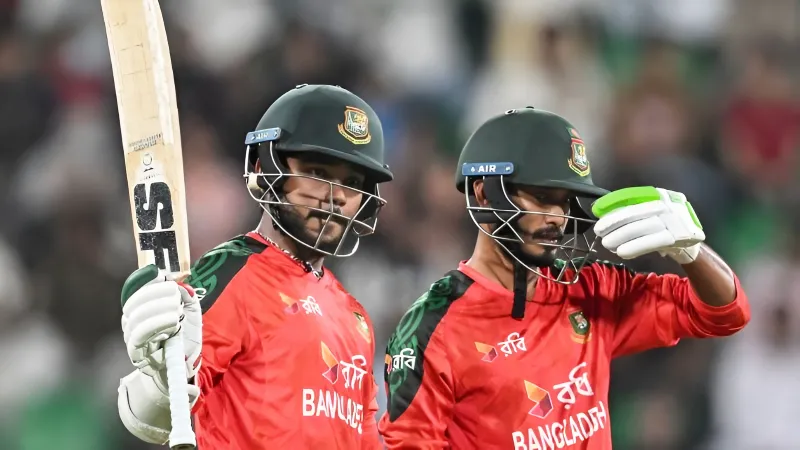

At times, an otherwise unassuming cricket team will send a subtle message that something is fundamentally going to shift. A quiet yet unmistakable signal of change was what Bangladesh’s week-long T20 batting camp at the BCB Academy had to offer: a low-key, non-dramatic experience. There were no last-minute drills, no last-second power-hitting or slogging rehearsals. Rather, Phil Simmons and his strategic thinkers created an entirely new offside maze for Parvez Hossain Emon and Tanzid Tamim, a training maze which would be specifically designed to force the most instinctual leg side hitters in Bangladesh to look the other way.
The goal? Correct a chronic flaw that has haunted the Tigers for two years: predictable, one-directional batting that collapses under pressure. In the last 20 T20Is, nearly 63% of Bangladesh’s boundaries have come on the leg side, a pattern opponent now anticipates with GPS-level accuracy.
Reprogramming the PowerPlay Mindset
The first strategic shift became clear the moment Simmons stationed fielders on the offside and asked the openers to hit through them, not over them. This wasn’t a six-hitting drill; it was a recalibration of tempo. Bangladesh’s top order often loses shape trying to blast through the first six overs, and Salahuddin admitted it bluntly: “We tend to over-hit.”
In T20 cricket, the PowerPlay is not a license to panic-swing; it’s a spacing contest. If a bowler is sending down 140 kph thunderbolts, as Salahuddin noted, the batter doesn’t need to invent power; he needs to redirect it. The difference between a reckless swipe and a well-timed cover punch could easily be 12 dots saved, a margin that has cost Bangladesh entire games.
Fixing the Head-Movement Domino Effect
The more detailed intervention was with Emon, whose jerking head and unstable backlift were creating a chain reaction of errors. A moving head in T20S is like a shaky camera in an action movie; the brain processes chaos instead of clarity. Salahuddin’s explanation was beautiful in its simplicity: “The better you see the ball, the better decisions you make.”
If the head wobbles, timing falters. If timing falters, synchronisation collapses. Then comes the worst outcome in T20 powerplay batting: late contact, skewed shots, and good-length balls toe-ended to point. Bangladesh’s problem has never been a lack of talent; it’s been the disconnection between technique and decision-making under pressure.
Turning Gaps Into a Scoring Philosophy
The offside tunnel wasn’t just a drill; it represented a new scoring ideology. Instead of relying on perfect timing to clear a fielder, the batters were taught to trust angles, pace, and geometry. Bangladesh’s strike rotation chronically poor in T20Is stems from this same issue. Too many good shots go straight to fielders; too many singles are surrendered without contest.
T20s reward batters who manipulate spaces, not just bowlers who exploit them. By practising lower-risk boundary options and enhancing the ability to pick off singles, Simmons aims to raise the team’s base scoring rate, something Bangladesh desperately needs. Their average PowerPlay score across 2023–24 (27/2) is among the lowest in top-tier teams.
A Training Window Bangladesh Rarely Gets
One quietly overlooked detail: this camp exists because Bangladesh finally found a break in their schedule. Over the last 18 months, continuous bilateral cricket has prevented the team from addressing technical flaws.
Salahuddin emphasised that this rare window is their chance to make targeted upgrades before the BPL tournament that will essentially determine Bangladesh’s final T20 World Cup squad. From mental rhythm to physical conditioning to technical stability, the coaching group plans to track every element.
If the Tigers can turn clarity into confidence and geometry into runs, Bangladesh may finally escape their one-dimensional batting tag and enter a phase where their T20 cricket becomes not just competitive, but clever.
Key Takeaway
Bangladesh’s T20 reboot begins not with new shots, but with better decisions.
FAQs
- What was the main focus of Bangladesh’s special T20 batting camp?
Improving offside play, reducing over-hitting, and stabilising technique under pace.
- Why were Emon and Tanzid specifically targeted for this training?
Because they often lose shape in the PowerPlay and rely too heavily on leg-side hitting.
- How will coaches measure the success of this camp?
Through player performances and decision-making patterns during the upcoming BPL.
Disclaimer: This blog post reflects the author’s personal insights and analysis. Readers are encouraged to consider the perspectives shared and draw their own conclusions.
Step into the world of cricket with JeetBuzz News—where expert opinions, trending Blogs, and behind-the-scenes insights meet all your favorite topics. Stay informed, stay entertained, and never miss the stories shaping the cricketing world—only on JeetBuzz News!