

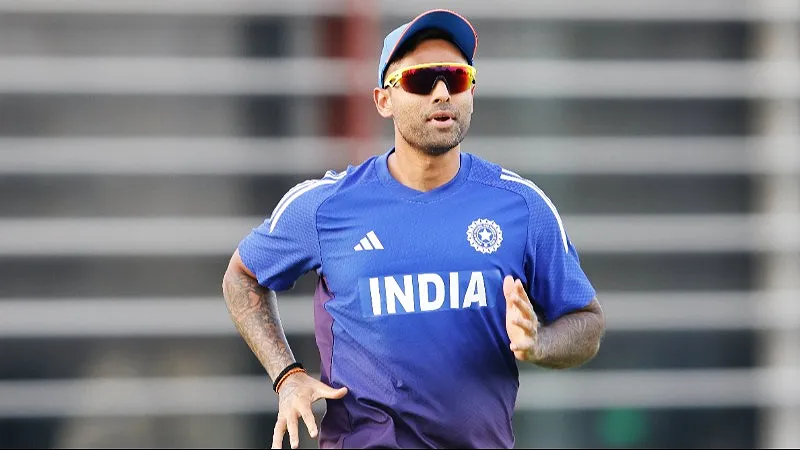

There was a time when Suryakumar Yadav didn’t just play T20 cricket; he bent it to his will. Field placements felt optional, bowling plans felt theoretical, and even Virat Kohli once looked like a spectator at the non-striker’s end. So, when Surya recently insisted, he is “out of runs, not out of form,” it sounded familiar, even comforting. Cricket folklore loves that line.
But cricket data is a ruthless interrogator. And over the last 15 months, it has been asking uncomfortable questions. Since November 2024, Suryakumar’s returns against pace, the very fuel of his dominance, have nosedived. An average of 8.11, a strike rate hovering around 110, and 18 of 19 dismissals to seam don’t describe a minor drought. They suggest structural stress. The difference between “bad luck” and “bad patterns” is repetition, and repetition is exactly what the numbers reveal.
When Intent Outruns Control
Suryakumar has never been a conservator. His genius lies in proactive risk. But intent without precision is not innovation, it’s exposure. Since November 2024, 16 of his 18 dismissals against pace have been catches, almost all from aerial shots. This is not bowlers sneaking through gates or jagging one past the edge. It’s Surya choosing elevation and losing execution.
More damning is the timing. Thirteen of those dismissals came within his first 10 balls, the phase where survival matters most. In T20s, early overs are not about domination; they are about permission to dominate later. Surya is skipping the permission stage.
The New-Ball Trap He Can’t Escape
Context matters, and here, it cuts both ways. In international T20s since November 2024, nearly 80% of the balls Surya has faced in his first 10 deliveries have been seamers. India’s recent schedule has been SENA-heavy, where pace remains the default weapon even outside the powerplay.
This means Suryakumar keeps walking into his toughest matchup at his most fragile moment. Hard lengths. Cross-seam deliveries. Deep fields are already in place. What once felt like an invitation now feels like an ambush.
Why IPL 2025 Told a Different Story
The Problem with this theory is that if Surya was in a slump, the I.P.L should have shown some evidence of that. Instead of showing evidence of that, it showed the opposite. He batted at 3 & 4 for 16 straight innings while scoring 25 or better, and did not get out before the 10th ball every time. There is no magic here; there is only mixology.
His first 10 balls were almost evenly split: 82 pace, 77 spin. Across the season, the split stayed symmetrical. Spin allowed him to access angles, pace allowed him to cash in in that order. Internationally, he’s being rushed. In the IPL, he was being phased in.
Aerial Inflation, Control Deflation
Shot selection data quietly confirms what the eye already suspects.
Aerial shots against pace (first 10 balls):
- Pre–Nov 2024: 16.1%
- Post–Nov 2024: 23.3%
Control of aerial shots:
- Earlier: 86%
- Now: 52%
That’s not variance. That’s a behavioral shift. Surya is hitting more balls in the air, earlier, and barely half of them. In a format where bowlers now defend with geometry and pace-off variations, this is an open invitation.
How Slower Balls Have Rewired the Contest
Five of his 16 caught dismissals against seam have come off deliveries under 80 mph. Not thunderbolts decoys.
Oppositions have stopped feeding his bat speed. They’re dragging him into it. For a batter whose rhythm depends on pace-on-contact, early cutters and roll-finger slower balls are breaking his timing before it settles. This is smart bowling, not a coincidence. And it’s working.
The Collapse of a Signature Scoring Zone
Nothing captures Surya’s decline more starkly than behind square on the leg side, once his private playground.
- Average vs pace behind square (pre–Oct 2024): 58.55
- Average since: 7.83
The flick shot has fallen from an average of 53 (SR ~250) to 6.14. Bowlers no longer fear the whip, so they don’t overcorrect. Straighter lines have returned and with them, control.
Key Takeaway
Suryakumar Yadav isn’t out of form; he’s out of sync with how international T20s now begin.
FAQs
- What explains Suryakumar Yadav’s recent slump?
A combination of early seam-heavy exposure, increased aerial intent, and reduced shot control.
- Why was IPL 2025 different for him?
A balanced pace-spin mix allowed him to settle before attacking.
- How can Surya fix this before the World Cup?
By prioritizing control in his first 10 balls and delaying aerial risks.
Disclaimer: This blog post reflects the author’s personal insights and analysis. Readers are encouraged to consider the perspectives shared and draw their own conclusions.
Step into the world of cricket with JeetBuzz News—where expert opinions, trending Blogs, and behind-the-scenes insights meet all your favorite topics. Stay informed, stay entertained, and never miss the stories shaping the cricketing world—only on JeetBuzz News!