

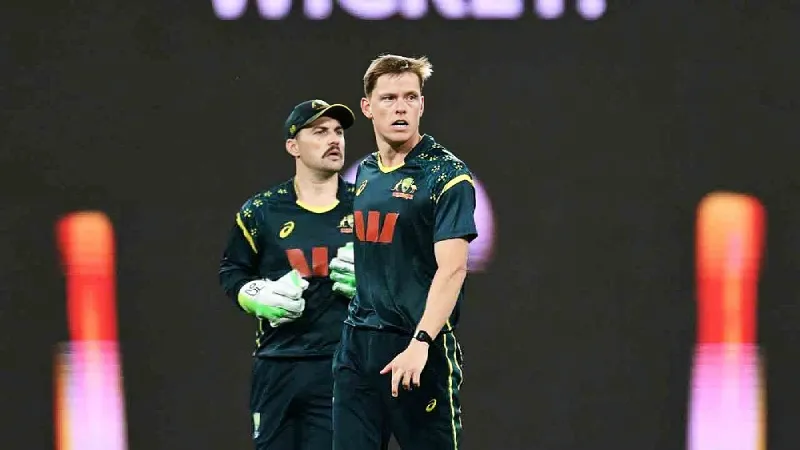

Each World Cup cycle seems to have an Aussie cricketer who quietly begins his rise to prominence through hard work & ultimately makes it extremely difficult for selectors to overlook him; in 2021 Nathan Ellis arrived on the International scene after taking a debut hat-trick which at the time appeared to be a sign of things to come; instead of being able to build on this performance, Ellis spent most of both of the last two World Cups sitting on the sidelines: omitted from selection in 2022, & used very little in 2024.
But cricket has a funny way of realigning justice. With Mitch Starc stepping away from T20Is and Ellis topping the recent India series with nine wickets at a strike rate of 9.55, the pendulum has finally swung toward the Tasmanian paceman.
Reinventing the Powerplay Puzzle
For years, Ellis was the classic middle-and-death specialist, brought on once the ball softened and batters tried to muscle the pace off. Without Starc, Australia has shoved him straight into the furnace over one to six. And the surprising bit? He thrives there.
His Gold Coast spell showed why Australia trusts him early: 10 runs in his first three balls, a pitch slowing under lights, and then 3 for 11 from the next 21 deliveries on what Suryakumar Yadav himself called subcontinent-like conditions. That adaptability is gold-dust for a World Cup in India/Sri Lanka.
Ellis doesn’t swing the ball extravagantly; he out-thinks batters, outpaces expectations, and plugs whatever tactical hole Marsh points at. That’s exactly the kind of bowler teams win tournaments with, not glamorous, but indispensable.
Australia’s Chase-First Identity Isn’t Just a Tactic, It’s a Philosophy
Australia’s recent toss obsession would sound ludicrous if it weren’t working. They’ve chosen to field first 93% of the time this cycle, a number that dwarfs the global average of 55%.
Mitch Marsh’s logic isn’t revolutionary; it’s simply data-aligned. In 2024, Australia won 81.82% of matches when they won the toss and bowled. On subcontinent pitches, especially under lights, chasing remains the safest path for a power-heavy side.
The IPL trend backs it up: captains bowled first in 60 of 73 matches this year. Marsh isn’t copying; he’s aligning with a global read on conditions. And with Ellis now a key Powerplay operator, this philosophy gains even more teeth.
Maxwell’s Off-Spin: Australia’s Quietest Vulnerability
For all the noise around batting aggression, Australia’s World Cup viability still hinges on Glenn Maxwell’s bowling shoulder behaving itself. Without him, the fifth-bowler duties fall to Marcus Stoinis, who is reliable everywhere except the subcontinent, where his economy rate touches 9.75. Maxwell sits at 8.40 in India across formats, which is a significant margin in T20s.
Cameron Green could theoretically fill that gap, but with just 12 T20I overs in his career, Australia can’t pencil him in with confidence yet. Maxwell, fit and firing, remains the balance point of this XI.
Nathan Ellis isn’t the story of a player regaining a spot; he’s the story of a team reshaping itself around new realities. Australia knows it cannot bully Asian conditions with bounce, pace, and traditional firepower. They need adaptability, control, smart resource allocation, and batters who embrace chaos rather than resist it.
Ellis represents that modern identity. His Powerplay evolution, his adaptability in changing conditions, and his high-IQ bowling give Australia a multi-phase weapon they simply didn’t have in 2022 and barely used in 2024.
If Australia lifts the trophy next March, it won’t be because of a single match-winning spell. It will be because they finally built a team where players like Ellis are not luxuries but necessities.
Key Takeaway
Australia’s T20 revival hinges on a flexible thinker, and Nathan Ellis is leading that shift.
FAQs
- Why is Nathan Ellis likely to be picked for the 2026 T20 World Cup?
Because of Starc’s exit, his elite strike rate, and his new Powerplay role make him central to Australia’s plans.
- Why does Australia prefer chasing in T20Is?
Data, conditions, and an 80%+ win rate with the formula make it an efficient strategy.
- What role will Glenn Maxwell play in the World Cup?
He’s the balancing spinner; without his overs, the bowling attack becomes riskier and less flexible.
Disclaimer: This blog post reflects the author’s personal insights and analysis. Readers are encouraged to consider the perspectives shared and draw their own conclusions.
Step into the world of cricket with JeetBuzz News—where expert opinions, trending Blogs, and behind-the-scenes insights meet all your favorite topics. Stay informed, stay entertained, and never miss the stories shaping the cricketing world—only on JeetBuzz News!