

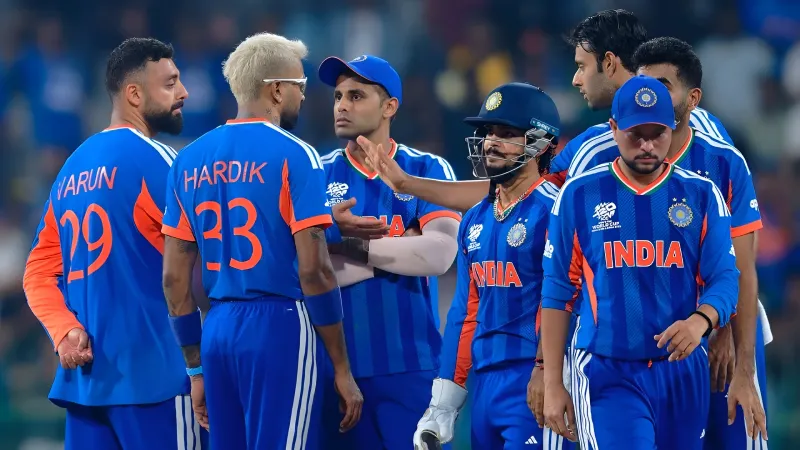

The India T20WC blunders that repeatedly derailed campaigns were not random failures; they were the result of flawed selection calls, role confusion, and tactical misreads under pressure. From 2026 to earlier editions, the Indian Cricket Team has often sabotaged strong squads with avoidable decisions, including the controversial Axar Patel–Washington Sundar swap. This analysis breaks down the five biggest blunders India has made in T20WC history, explaining why they failed, how conditions amplified them, and what lessons still apply to India’s future ICC campaigns.
Biggest selection blunder: Axar Patel benched at the Wrong Time in the T20 World Cup 2026
Dropping Axar Patel for Washington Sundar was a match-up-driven decision that ignored venue conditions. At Ahmedabad, where grip and defensive spin mattered late, India lost a proven pressure bowler and a reliable middle-order floater. Sundar bowled limited overs, while Axar’s absence reduced control against right-handers and batting stability. This India T20 World Cup blunder highlights over-engineering selection without in-game flexibility.
Batting Order Tampering Under Pressure: Rohit–Kohli shuffle that backfired
Repositioning senior batters disrupted rhythm rather than solving balance issues. The Indian Cricket Team sacrificed experience at the top to accommodate a like-for-like replacement, leading to powerplay stagnation. On slow Dubai surfaces, early momentum was crucial and once lost, recovery became statistically unlikely given the rising required run rates.
Ignoring Proven Wrist-Spin Value: Squad construction failure in spin-friendly conditions
Entering a UAE tournament without a frontline wrist-spinner contradicted surface data from the preceding IPL phase. On worn pitches, wrist-spin historically offers higher middle-over wicket percentages than finger spin. This wasn’t just a personnel miss, it was a strategic oversight in reading conditions, making it one of the most costly India T20 World Cup blunders.
Promoting Stability Over Impact: Run-chase misjudgment in a must-win game
Sending a stabiliser ahead of a proven match-winner slowed the chase at a time when boundary conversion rates mattered most. At Lord’s, where stroke-making early was safer than late acceleration, the approach inverted risk logic. Required rate pressure later became the decisive factor.
Makeshift Opening Experiment Gone Wrong: Role miscasting in a high-stakes Super 8 match
Using a bowling all-rounder as an opener weakened both innings. Powerplay strike rates fell below tournament averages, while bowling depth gains failed to offset batting inefficiency. Even when individual scores looked serviceable, the net run-rate damage proved irreversible, a recurring theme in India’s T20 exits.
All these blunders share a common root: decisions that underestimated conditions, disrupted player roles, or ignored proven trends. Whether it was sidelining Axar Patel, misusing Washington Sundar, or reshuffling the batting order, the Indian Cricket Team repeatedly traded stability for theoretical advantage. Looking ahead, India’s success will depend on resisting reactive selection and trusting role clarity under pressure.
Key Takeaway
India’s failures were less about talent and more about avoidable tactical and selection blunders under pressure.
FAQs
What are the biggest India T20WC blunders?
Selection errors, batting order changes, and ignoring conditions-driven strategies.
Why was Axar Patel dropped from the T20WC 2026?
India opted for a match-up-based choice that failed to account for game flow and conditions.
How do team selection mistakes affect T20WC outcomes?
In short tournaments, even one misjudged role or balance issue can decide qualification.
Can India avoid repeating these mistakes in future ICC events?
Yes, with data-backed selection, role clarity, and reduced reactive decision-making.
Disclaimer: This blog post reflects the author’s personal insights and analysis. Readers are encouraged to consider the perspectives shared and draw their own conclusions.