

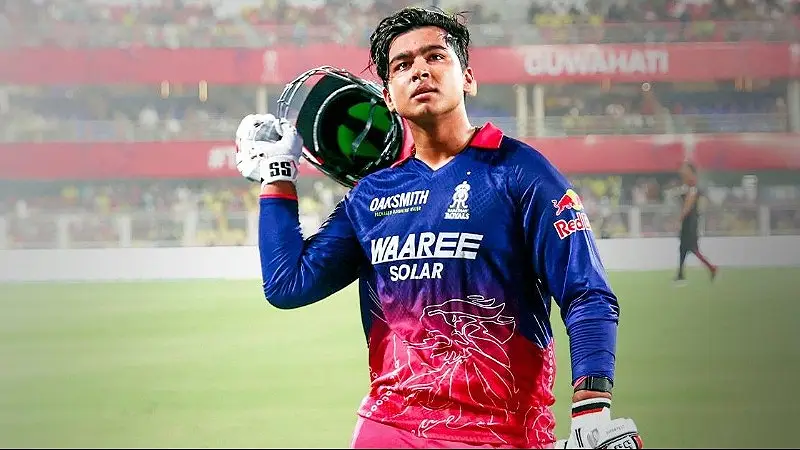

The batting coaching manuals built over decades start at the same place. Sideways stance, soft hands, leave the wide ones, earn the right to attack. That progression from defense to offense has produced some of cricket’s greatest players. It has also produced something that the T20 era is now questioning directly. A teenager raised entirely on franchise cricket who never got the defensive memo and is scoring at a rate that suggests he never needed it.
Built for Power From the Start
His six-hitting isn’t a skill he developed on top of an existing game. It is a game. Most power hitters arrive at their aggression after years of technical work that gives them a base to attack from. He arrived at the base already attacking.
Training systems built around boundary hitting, elevation, and bat speed have replaced the patient accumulation drills of previous generations. Sooryavanshi is the clearest product of that shift. His instinct on any delivery with width or pace is to clear the boundary rather than work it into a gap for one. That instinct, when it works, produces strike rates that redefine what a top-order batter can contribute in the powerplay.
Why Vaibhav Sooryavanshi Has No Defense
The absence of a traditional defensive structure is the most discussed aspect of Sooryavanshi’s batting, and also the most misunderstood. Critics frame it as a weakness. A closer examination suggests it is a deliberate product of how his game was built.
His high backlift and wrist-heavy bat swing generate power without requiring full front-foot commitment. That flexibility allows him to adjust to length variations while maintaining the bat speed his scoring rate demands. What looks like a lack of defense is actually a different kind of answer to the same problem: how do you play a ball you can’t fully read until it pitches? Classical batters defend. He swings.
The risk surfaces on pitches with turn, late seam movement, or uneven bounce. When the ball does something unexpected after pitching, a batter without a defensive foundation has fewer options to fall back on.
How the IPL Generation Thinks Now
Players shaped by franchise cricket carry a fundamentally different set of priorities. Survival is not the goal. Strike rate is. The benchmark isn’t playing out a good delivery; it’s making a good delivery cost something anyway.
That mindset produces a different decision under pressure. Where a traditional batter consolidates after losing a partner, this generation counterattacks. The logic is that momentum matters more than wickets in hand, and that resetting takes time the required run rate doesn’t allow. Whether that instinct translates across formats and conditions is the next question his career will answer.
What Decides His Actual Batting Ceiling
Adaptability is what separates a franchise specialist from a complete T20 batter. On true pitches with even bounce, his method is close to impossible to contain. On slower surfaces where timing becomes difficult and aerial shots carry more risk, the margin for error shrinks significantly.
Teams will target him with pace variation and spin once sufficient match data exists to build a counter-plan. The batters who survive that analysis are the ones who adjust. The ones who don’t become specialists in conditions are players. Everything about his ceiling depends on whether the instincts built through six hitting training can coexist with the situational awareness that a difficult pitch or a quality spell demands.
- Is Sooryavanshi the future of T20 batting or a specialist who will always be vulnerable on difficult surfaces? Drop your pick in the comments and follow for cricket updates.
FAQs
What makes Vaibhav Sooryavanshi’s batting style unique?
His game is built entirely around power hitting from a young age, unlike traditional players who develop defense first.
Why are players raised in the T20 era of cricket more aggressive?
They grow up in systems where scoring quickly is rewarded more than long innings.
How does six-hitting training in modern cricket differ from the past?
Training now emphasizes bat speed, elevation, and boundary hitting rather than just technique and defense.
Can attacking batting succeed in longer formats?
It can, but it requires adaptability and better shot selection under challenging conditions.
Is IPL influencing young cricketers too much?
The IPL has reshaped priorities, but it also provides opportunities and exposure at a very early stage.