

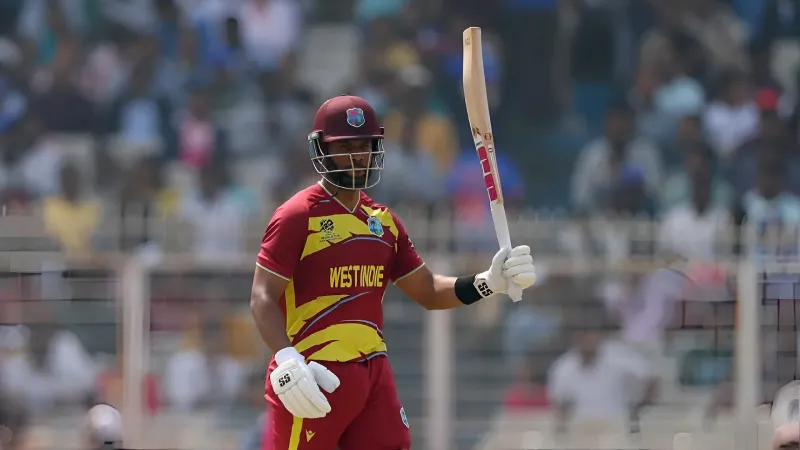

Shai Hope’s T20 batting analysis shows that his controlled, low-risk scoring method is driving the new West Indies batting approach in the World Cup 2026. His crucial 46-ball 75 against Italy highlighted how smart strike rotation and situational awareness can be more effective than constant power-hitting. This shift reflects a wider tactical change in the West Indies cricket team, where efficiency, not just six-hitting, is becoming the foundation of their success and consistency in modern T20 cricket.
Controlled Aggression Defines His T20WC Success
At the center of this calm batting revolution is Shai Hope’s controlled aggression, which focuses on minimizing dot balls and maximizing scoring opportunities. Instead of relying purely on boundaries, Hope builds innings through strike rotation, which keeps pressure on bowlers without exposing himself to unnecessary risk.
This approach is especially effective on slower pitches like Kolkata, where timing and placement are more reliable than power. His method allows the West Indies to maintain scoring momentum even when wickets fall, stabilizing innings during vulnerable phases.
Match Impact Against Italy Explained
Hope’s 46-ball 75 against Italy perfectly demonstrated his tactical value. His innings included a balanced mix of singles, twos, and boundaries, showing how accumulation can match or exceed aggressive hitting over time.
More importantly, this knock came while other batters struggled, proving his role as an innings anchor. He ensured West Indies did not lose control after early wickets, maintaining a competitive run rate without forcing risky shots. This innings reflected a clear tactical understanding of match conditions and bowling patterns, reinforcing why he has become central to West Indies’ strategy.
Statistical Proof Behind His Method
Hope’s T20WC international numbers validate this analytical shift. His strike rate of over 138, combined with an average above 30, proves that controlled aggression can deliver both consistency and scoring speed.
These numbers are significant because they challenge the traditional belief that only power hitters can dominate T20 cricket. His efficiency ensures fewer wasted deliveries, which directly improves team totals. This statistical balance makes him one of the most reliable performers in the tournament.
Driving West Indies Batting Evolution
The West Indies’ calm batting revolution is not accidental. It reflects a deliberate tactical evolution where roles are clearly defined, and efficiency is prioritized.
Hope’s presence allows power hitters to play naturally without carrying the burden of stability. His ability to manage middle overs ensures that the West Indies enter death overs with a platform for acceleration. This balance makes the team complete and more adaptable across different conditions.
Evolution Beyond the Pure Power Era
West Indies’ earlier dominance was built around explosive players like Chris Gayle, whose power transformed T20 cricket. That approach delivered trophies, especially in past world tournaments, but modern bowling strategies and pitch conditions have made consistency more valuable.
Hope’s success represents the next phase of T20 evolution, where tactical intelligence complements power. His role mirrors the broader global trend, where anchors who maintain scoring flow are becoming essential to championship-winning teams. This shift enhances the West Indies’ competitiveness in high-pressure tournaments.
As the men’s T20 World Cup 2026 progresses, this approach gives West Indies a stronger chance of reaching the final stages. Hope’s method ensures the team is no longer dependent solely on power hitting, making them more adaptable in different match situations. If he maintains this form, his influence could define the West Indies’ tournament outcome and shape their T20 future.
Key Takeaway
Shai Hope’s controlled aggression is making West Indies more consistent and tactically complete in modern T20 cricket.
FAQs
What makes Shai Hope effective in T20 cricket?
His ability to rotate strike consistently and avoid dot balls keeps the scoreboard moving without taking unnecessary risks.
How important was Shai Hope’s 46-ball 75 against Italy?
It stabilized the innings and demonstrated how controlled batting can anchor the team under pressure.
Why is the West Indies changing its batting approach?
Modern T20 conditions require consistency and adaptability, not just power hitting, to win major tournaments.
Can Shai Hope maintain this form in knockout matches?
His technique and decision-making suggest he can remain reliable even in high-pressure situations.
Is controlled aggression better than power hitting in T20 cricket?
Both are important, but controlled aggression ensures stability, which is crucial for building competitive totals.
Disclaimer: This blog post reflects the author’s personal insights and analysis. Readers are encouraged to consider the perspectives shared and draw their own conclusions.