

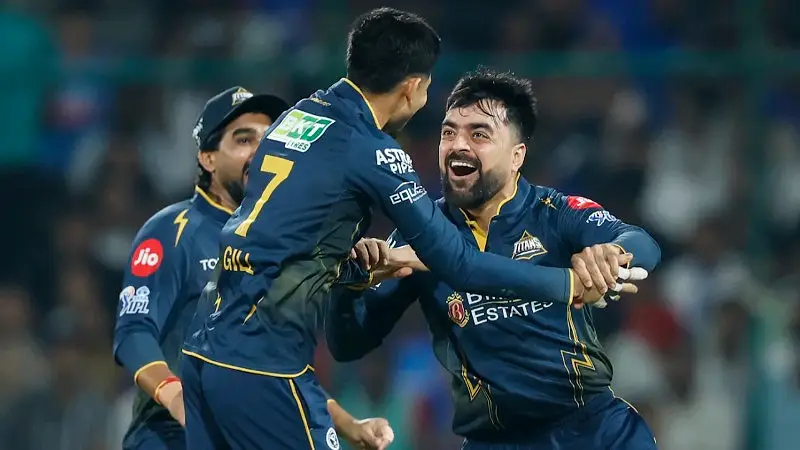

Rashid Khan, returning from back surgery, was always going to involve an adjustment period. What few expected was how quickly opposition batters would identify the specific technical shift that surgery produced. His variations are still dangerous. His googly is still present. His ability to beat batters in the air hasn’t disappeared entirely. But something in his release has changed just enough to give top-order batters a margin they never previously had, and that margin is now showing up in how aggressively teams are approaching him in the middle overs.
What Surgery Did to His Action
The change is subtle enough to miss if you’re watching casually. Before injury, Rashid’s arm speed through the crease generated a late snap at release that made both his stock leg spin and his googly arrive with near-identical pace and trajectory. Batters had almost no visual cue to distinguish one from the other until the ball had already been pitched and deviated.
After surgery, the finishing burst at release appears marginally slower. The snap is fractionally delayed. The result is a slight reduction in pace off the surface and less dip through the air than he produced at his peak. In a format where batters process deliveries in fractions of a second, that margin is enough. A batter given an extra fraction of time to adjust is a significantly more dangerous batter than one reacting purely on instinct.
His IPL 2026 Length Problem Explained
The length issue is where the technical change creates its biggest practical consequence. Batters have identified that the slightly loopier trajectory Rashid now produces means the ball is landing more regularly in the zone where they can extend their arms and generate genuine power through the hitting arc.
Modern T20 batters drill specifically for this zone. When a delivery lands at a length that allows front foot extension with a full swing of the bat, it becomes a scoring opportunity rather than a decision point. Rashid has responded by shortening his length, trying to deny that hitting zone by making batters play off the back foot. That adjustment introduces a different problem. Shorter deliveries with less pace through the air are more straightforward to cut and pull, particularly on the flat surfaces that IPL venues typically offer.
He is currently caught between two lengths, each carrying its own risk. That is an unusual position for a bowler who previously made every length feel threatening.
Why His Googly Looks Different Now
Rashid’s googly was historically his most effective weapon precisely because it was invisible. A high arm action with the ball released close to the ear meant both the leg spin and the wrong one departed from the hand, looking identical. Batters couldn’t commit to a shot until the ball had already landed, by which point the deception had already worked.
The marginally reduced arm speed has introduced an extra loop into the googly’s flight path. That loop creates a visual cue during the delivery stride that experienced batters are beginning to recognise. The googly still turns. The deception is still present. But it is no longer instinctive in the way it was before surgery. Batters who previously defended cautiously against him are now willing to attack earlier in his spell, accepting the risk of misjudging the variation in exchange for the chance to score before he settles into rhythm.
That shift in batter behaviour is the clearest evidence that something has changed.
- Between fixing his arm speed and adapting his length strategy, which approach do you think gives Rashid Khan his best path back to peak form in IPL? Drop your pick in the comments and follow for IPL updates.
FAQs
What changed in Rashid Khan’s bowling after back surgery?
His arm speed and release whip reduced slightly, affecting deception and dip.
Why is Rashid Khan less effective?
Batters are reading his variations earlier due to marginally increased flight and predictable lengths.
How does the hitting arc affect Rashid Khan’s bowling?
Loopy deliveries fall into power-hitting zones, allowing batters to attack more confidently.
Can Rashid Khan regain his peak IPL form?
Yes, if his arm speed and rhythm improve, though adaptation will also play a key role.
Which team does Rashid Khan play for in IPL 2026?
He continues to be a key player for the Gujarat Titans.