

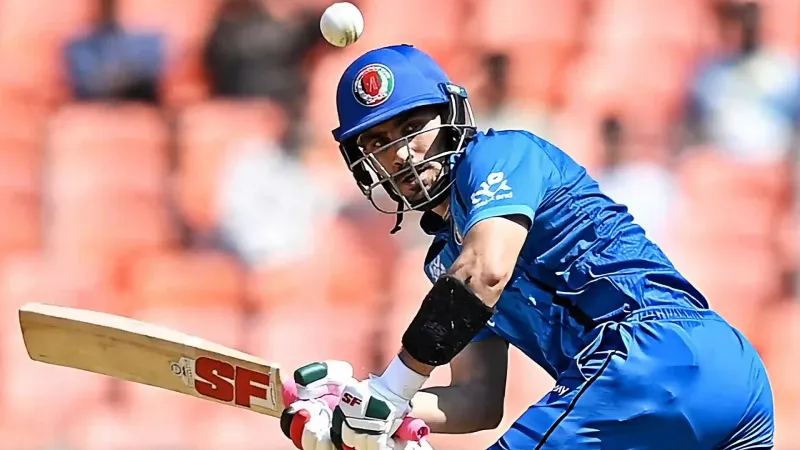

Rahmanullah Gurbaz’s Super Over performance was the defining force in Afghanistan’s dramatic Double Super Over T20WC match against South Africa, but it ultimately fell inches short of sealing victory. After his explosive Gurbaz 84 vs South Africa, he returned in the tie-breaker to attack Keshav Maharaj vs Gurbaz sixes in a high-pressure duel. Even as Noor Ahmad’s final over sixes pushed the contest into chaos, it was Gurbaz’s power against spin that kept Afghanistan alive until the very last delivery.
This was not just a cameo; it was a technical and psychological battle shaped by conditions, matchups, and split-second decisions.
Dominance Against Conditions
Ahmedabad’s surface rewarded pace-off bowling and cutters into the pitch. South Africa quickly recognised that once the ball softened, stroke-making became percentage-based rather than instinctive.
Yet Gurbaz disrupted that pattern. During his 84-run innings, he scored 84 runs across seven overs, while the rest of Afghanistan’s batting unit managed only 37 for 3 in the remaining overs of that phase. That imbalance highlights how heavily Afghanistan relied on one batter.
Keshav Maharaj vs Gurbaz Sixes
The most fascinating subplot was Keshav Maharaj vs Gurbaz’s sixes. On a track where left-arm spin into the surface created hesitation, Gurbaz struck multiple sixes without leaving his crease, a rare method against accurate spin.
Maharaj attempted to adjust by bowling wider outside off stump, the same ploy that eventually dismissed Gurbaz in regulation time. The plan was clear: deny him access to his swinging arc and force square hits against the turn.
In the Super Over, this duel intensified. Maharaj alternated between pace-on deliveries and wider lines. Gurbaz responded with vertical-bat lofted strokes, using pace rather than generating it. The margins were razor thin, some clears were comfortable, others nearly found Marco Jansen in the deep.
T20WC’s Double Super Over Chaos
The Double Super Over T20WC match unfolded with emotional volatility. Noor Ahmad’s late sixes forced the initial tie, while Kagiso Rabada’s overstepping opened windows that Afghanistan nearly exploited.
In the first Super Over, Azmatullah Omarzai did the heavy lifting. In the second, Afghanistan’s decision-making came under scrutiny. The Rashid Khan captaincy decision, Super Over choosing Omarzai to bowl rather than himself, shifted tactical dynamics.
When South Africa defended with spin, Afghanistan sent Mohammad Nabi instead of Gurbaz. That choice proved decisive, as momentum stalled instantly. The margins in tie-breakers are brutal: one matchup can determine the narrative.
Rahmanullah Gurbaz’s Six-Hitting Blueprint Against Spin
One overlooked dimension of the Gurbaz Super Over performance was his method against spin. These were not wild slogs. He:
- Stayed leg-side of the ball
- Used back-foot leverage
- Targeted long-off and long-on
- Avoided risky cross-bat sweeps
His sixes against spin showed premeditated clarity. He waited for the pace rather than over-hitting into the pitch. The dismissal in regulation time came from a wide line, inducing an edge not from mistimed aggression.
Technically, he bent probability repeatedly, but in T20 cricket, probability always reasserts itself eventually.
High-Risk Tie-Breaker Cricket
Afghanistan’s choices echoed similar debates seen in global tournaments: should your premier bowler take responsibility, or do you rely on matchup advantages? The decision not to maximise Gurbaz’s presence in the second Super Over will inevitably be analysed alongside past high-stakes tactical calls in ICC history.
This was elite T20 cricket operating on fractional margins.
So, how did the Gurbaz Super Over performance nearly change the outcome? By defying conditions, attacking spin with calculated intent, and carrying Afghanistan’s scoring burden when others struggled. His 84 laid the platform, and his boundary assault in the tie-breaker kept hope alive until the final wide-line trap repeated itself.
Key Takeaway
Gurbaz nearly overpowered both conditions and strategy in a Double Super Over, but tactical margins ultimately outweighed individual brilliance.
FAQs
Why was Keshav Maharaj effective against Gurbaz eventually?
By bowling wider outside off stump and denying the straight boundary, Maharaj forced riskier square shots.
Why didn’t Rashid Khan bowl the second Super Over himself?
It was a tactical call, possibly based on matchup preferences, but it remains a debated captaincy decision.
How rare is a Double Super Over T20 match?
Extremely rare at the international level, making tactical execution even more critical.
Can Gurbaz’s six-hitting against spin work on slower pitches consistently?
It can, provided he continues using pace and maintaining balance rather than over-swinging.