

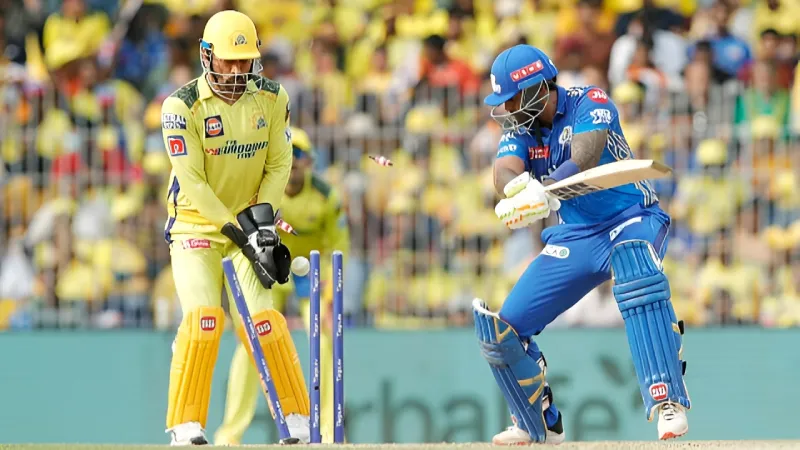

Five defeats. Five different opponents, five different venues, and five different phases of the Mumbai Indians’ history. The same story every time. The power play unravels. The middle order fails to stabilise. The lower order scrambles for runs that are already too far away. MI have won five IPL titles and produced some of the tournament’s most dominant performances. They’ve also produced some of its most catastrophic collapses, and those collapses follow a pattern so consistent it has become the franchise’s most recognisable trait across nearly two decades.
103 Runs Down Against CSK
MI’s biggest defeat arrived at Wankhede in front of their own crowd. Chasing 208 against Chennai Super Kings, they were bowled out for 104. Sanju Samson’s century pushed the target beyond reach before the chase even began, but the collapse itself was entirely of MI’s making.
Three wickets fell inside the power play after MI misjudged the length on a pitch offering consistent bounce. Akeal Hosein exploited grip in the middle overs, and MI’s batters never found an answer to the spin variation. Every time a partnership threatened to consolidate the innings, the next wicket fell to a poor shot rather than a brilliant delivery. By the time the last wicket fell, the margin read 103 runs, a record defeat no franchise wants attached to their home ground.
Rajasthan Royals Expose MI Batting
In Jaipur in 2013, MI chased 162 and were bowled out for 75. Ajinkya Rahane anchored Rajasthan Royals to a competitive total, then the Sawai Mansingh pitch slowed significantly as MI began their reply.
Rather than adjust to a surface demanding strike rotation and patience, MI stayed aggressive. Wickets fell in clusters through the middle overs, and the tail contributed nothing. The pitch wasn’t unplayable. Rajasthan’s batters had found the gaps comfortably enough in the first innings. MI simply refused to recalibrate when conditions demanded a completely different approach.
SRH Pace Attack Finds MI Weak
The 2016 defeat against Sunrisers Hyderabad at Vizag produced MI’s most technically exposed collapse. Chasing 177 under lights, they faced Bhuvneshwar Kumar and Ashish Nehra swinging the ball sharply with a wet outfield adding to the difficulty.
The specific failure was playing away from the body against deliveries moving into right-handers. Two wickets fell in the opening two overs, and once MI were 5 for 2, the innings never recovered. What made the defeat by 85 runs particularly damaging wasn’t the margin. It was the absence of any adjustment from the batters who followed the openers despite watching the dismissals from the non-striker’s end.
Punjab Punish MI Across Two Eras
Kings XI Punjab recorded two of the heaviest victories over MI in different periods of the tournament’s history. In 2008, MI chased Kumar Sangakkara’s 94 and collapsed from 61 for 2 to lose by 66 runs, a sequence that exposed their inability to handle scoreboard pressure in the early IPL years.
Three years later in Mohali, the same blueprint. MI restricted Punjab to 163 and then fell apart for 87 in reply. Praveen Kumar and Bharghav Bhatt exploited variable bounce as MI’s batters kept attacking regardless of what the pitch demanded. Two defeats, separated by three years, driven by the same tactical failure.
IPL 2026 Confirms a Familiar Problem
What connects all five defeats across 18 years isn’t the opposition, the venue, or the conditions. It’s the response when early wickets fall.
IPL has confirmed that nothing has changed. MI lose early wickets, and the middle order reaches for aggression rather than consolidation. The required rate climbs. The big shots multiply. The wickets follow. CSK’s bowlers in the Wankhede collapse didn’t produce anything extraordinary to take MI apart. They simply needed MI to be MI when the pressure arrived. That’s the real problem for a franchise with five titles.
- Is MI’s middle order collapse a structural weakness that no captain can fix mid-tournament, or can a tactical reset before the IPL playoffs break this pattern? Drop your pick in the comments and follow for IPL updates.
FAQs
Q1: What is the Mumbai Indians’ biggest defeat in IPL history?
Their worst loss was by 103 runs against the Chennai Super Kings in IPL 2026 at Wankhede.
Q2: Why do the Mumbai Indians suffer such heavy defeats?
Early wickets combined with a refusal to adapt their approach to pitch conditions consistently trigger collapses.
Q3: Which teams have beaten the Mumbai Indians by the largest margins?
CSK, Rajasthan Royals, Sunrisers Hyderabad, and Kings XI Punjab all feature across MI’s five biggest defeats.
Q4: What tactical flaw drives MI’s worst collapses?
Continued aggression after losing early wickets instead of consolidating and rotating strike through the middle overs.
Disclaimer: This blog post reflects the author’s personal insights and analysis. Readers are encouraged to consider the perspectives shared and draw their own conclusions.