

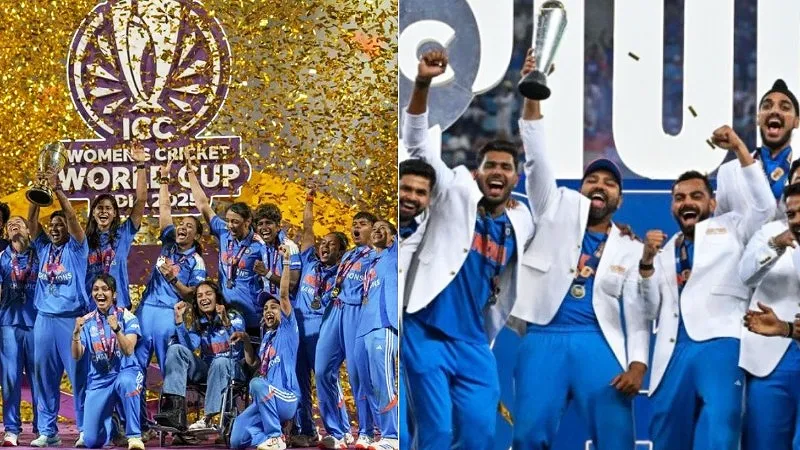

Indian cricket is rarely a straight-line proposition and has always enjoyed a good twist and turn. The Indian cricket team had a great 2025 season, as evidenced by the trophies they won, the rivals they suppressed, and the many new records set. However, under all of the celebration for a job well done was a year that challenged the Indian cricket teams’ ability to dig deep, develop its future leaders, and show emotional strength in each format and gender.
Calm Dominance, Teenagers Leading Loudly
India’s Women’s U19 team, defending their T20 World Cup title in Malaysia, felt routine until you remembered how rare sustained dominance is at the youth level. Unbeaten across group stages, Super Sixes, knockouts, and finals, this was control disguised as ease.
The Indians dominated both semi-final and final matches with nine-wicket victories over England and South Africa, respectively, chasing 114 and 83 runs to achieve those wins. The essence of the two matches was the clinical nature of the Indian batting unit and how effectively India could implement their winning strategy, which clearly reflected India’s strategic approach to the game that was far superior to what would normally be expected from a team of this age.
Familiar Rivals, Repeated Lessons Delivered
Beating Pakistan once in a tournament is satisfying. Beating them three times en route to an Asia Cup title is a psychological seminar.
India dismantled Pakistan in both the Group Stage & Super 4’s & Final in the 2025 Asia Cup (T20) under the captaincy of Suryakumar Yadav. India chased down 147 in the final at Dubai with 5 wickets to spare, without ever looking like they were feeling the pressure of the situation.
It was not so much their technical ability that made this performance stand out as much as it was their understanding of Pakistan’s bowling style and their approach to the middle overs and death overs. This is an example of how mature teams defend titles with planning, not emotions.
Six Runs, One Test, Infinite Nerve
Shubman Gill’s first Test series as captain arrived without Rohit Sharma and Virat Kohli, a leadership vacuum wrapped in English conditions. It nearly ended in heartbreak.
At The Oval, England needed 374 and were cruising at 301/3. Then India found something primal. Mohammed Siraj’s five-wicket burst flipped the match on its spine as England collapsed to 367. India won by six runs, the smallest margin of victory in their Test history, and drew the series 2–2.
For Gill, this wasn’t just a result; it was a validation. For Indian cricket, it was proof that resilience hadn’t retired with its senior batters.
One Tournament, Three Wins, Zero Doubt
The Indian team dominated to regain the ICC Champions Trophy in 2025. The Men in Blue won each of their matches in Dubai, secured first place in Group A, defeated Australia in the Semifinals, and then beat New Zealand in the Final.
Virat Kohli’s 84 from 98 balls vs. Australia was classic pressure batting. Rohit Sharma had 76 in the finals, which showed why tournament cricket is still the place for experience. Chasing 251, India finished with one over to spare, and they won their third Champions Trophy.
The Night Indian Women Rewrote History
India’s success in the women’s One Day Internationals in 2025 did not match the emotional high that they experienced at the time they achieved their first-ever Women’s ODI World Cup.
Upon completing the group stages, India had secured a semi-final berth for which they were scheduled to compete against Australia; therefore, India required an ODI run chase of 338 off Australia and had to successfully defeat them to continue their winning ways through the tournament. In the end, it was Jemimah Rodrigues’ 127* from 118 deliveries that led India to an ODI run chase victory and gave India 5 overs to go before being bowled out, while also leaving India with 9 balls to go before being bowled.
The 298/7 of India vs. South Africa simply dominated the match in which India won by 52 runs on Nov. 2 (Deepti Sharma took a 5-wicket haul), and when Harmanpreet Kaur hoisted up the trophy, it was a signal to the world of a new era of Women’s Cricket.
When Transitions Turn Into Triumphs
Before 2025, there were other “golden” years of Indian cricket in 2007, 2011, and 2013; but 2025 differs from those years in that youth successes, women’s firsts, and male championships all occurred at the same time. Success since 2017 has been almost exclusively format/team-based, with little overlap between them.
Unlike previous generations of Indian cricket, India’s 2025 successes have not been based on an individual era; instead, they suggest a system that will be able to support many simultaneous eras.
Key Takeaway
Indian cricket’s greatest 2025 victory wasn’t a trophy; it was proving that success can survive transition.
FAQs
- What was India’s biggest cricketing achievement in 2025?
Winning the maiden Women’s ODI World Cup stands above all due to its historical significance.
- Why was the Oval Test win so important?
It showcased India’s resilience in a post-Kohli-Rohit Test era under new leadership.
- How did India dominate the Asia Cup 2025?
Through tactical clarity, squad depth, and repeatedly outplaying Pakistan across stages.
Disclaimer: This blog post reflects the author’s personal insights and analysis. Readers are encouraged to consider the perspectives shared and draw their own conclusions.
Step into the world of cricket with JeetBuzz News—where expert opinions, trending Blogs, and behind-the-scenes insights meet all your favorite topics. Stay informed, stay entertained, and never miss the stories shaping the cricketing world—only on JeetBuzz News!