

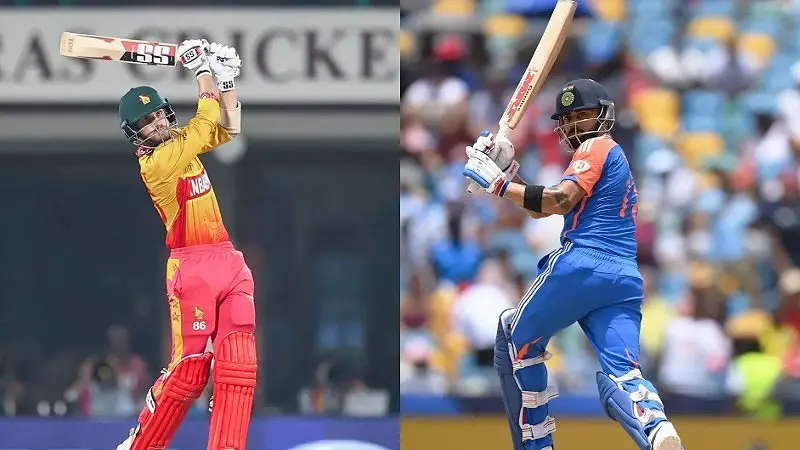

After the ICC Men’s T20 World Cup 2026, a comparison started circulating that deserves a proper look. A Zimbabwe top-order batter, 57 matches into his T20I career, is being measured against the early numbers of one of the format’s greatest players. The stats are closer than most people expect, and the context makes them even more interesting.
Here’s what the numbers actually show, and why the story behind them matters more than the headline figures.
Brian Bennett vs Virat Kohli Overall Numbers: Volume, Average
Player | Matches | Runs | Average | Strike Rate | Highest | 100s | 50s |
Brian Bennett | 57 | 1,873 | 36.72 | 143.96 | 111 | 1 | 12 |
Virat Kohli | 57 | 1,983 | 50.84 | 137.32 | 90* | 0 | 18 |
Kohli leads in runs and average. Bennett leads in strike rate, and he already has a T20I century at this stage, something Kohli hadn’t managed in his first 57 matches. That single fact reframes the entire conversation.
The average gap is real, but averages don’t exist in a vacuum. Kohli batted inside one of the deepest batting lineups in world cricket. Bennett regularly walks out knowing three or four wickets will expose a fragile lower order. That changes how you bat. It has to.
How Bennett’s Scoring Pattern Reflects His Responsibility
Bennett’s 143.96 strike rate isn’t just aggression for its own sake. Watch his innings and a pattern emerges: he attacks early, targets pace in the powerplay, and accepts risk in the middle overs because waiting isn’t an option. On slower African and Asian surfaces where bat-on-ball is harder, those numbers carry extra weight.
Kohli, at the same stage, was building a different kind of innings. Rotation, partnerships, pressure absorption. He could afford to. A batting lineup with Dhoni finishing meant Kohli didn’t need to manufacture 15 runs in the final over alone. Bennett often does.
Wins, Chases, and Where the Gap Really Opens Up
Scenario | Bennett Runs | Bennett Avg | Kohli Runs | Kohli Avg |
Matches Won | 1,094 | 52.09 | 1,361 | 64.80 |
Chasing | 798 | 31.92 | 1,103 | 84.84 |
Brian Bennett vs Virat Kohli chasing numbers are where Kohli separates himself from almost every batter who has ever played T20 cricket, not just Bennett. An average of 84.84 while chasing after 57 matches is extraordinary; it reflects a player who raised his game specifically when his team needed a result. Bennett’s 31.92 while chasing isn’t a failure; it’s a reflection of what happens when you’re the only reliable batter in a lineup and the asking rate climbs past 10.
What ICC T20 World Cup 2026 Opposition Revealed About Bennett
Facing top-ranked bowling attacks at the T20 World Cup 2026 with minimal batting support is as hard as T20 cricket gets. Bennett’s strike rate held up. His average dipped, predictably, given the opposition, but the intent never changed. That matters for a young batter still developing his game at the international level.
Kohli’s early career numbers came against the same elite opposition, but with a bowling attack capable of defending any total and a batting lineup that rarely left him exposed. The conditions of success were fundamentally different, and that gap in team infrastructure goes a long way toward explaining the difference in averages.
The Verdict: Different Roles, Same Stage
Kohli was the more complete T20I batter at 57 matches. Nobody is seriously arguing otherwise. But Bennett is doing something different, carrying an attack-first role for a developing Zimbabwe side, posting a century Kohli hadn’t managed at the same point, and maintaining an elite strike rate across varied conditions.
The comparison was always going to favour Kohli on the numbers. What makes it worth having is what Bennett’s numbers reveal underneath, a batter taking on disproportionate responsibility and still finding ways to score at nearly 144. Zimbabwe cricket is building something. Bennett is the clearest evidence of it.
FAQs
What makes Bennett’s T20I stats impressive despite a lower average
He plays with limited batting support, forcing aggressive scoring even in difficult match situations.
Why was Virat Kohli so dominant in run chases early in his career
Kohli combined shot selection with calm under pressure, allowing him to finish matches consistently.
How did the ICC Men’s T20 World Cup 2026 affect Brian Bennett’s numbers?
Facing stronger teams increased risk-taking, slightly lowering averages while maintaining strike rate.
Which team conditions favored Virat Kohli’s early T20I success?
A deep batting lineup and consistent bowling support allowed Kohli to control innings rather than rush scoring.
Can Brian Bennett reach Virat Kohli’s T20I consistency level?
With improved team balance and experience, statistical trends suggest it is possible over time.