

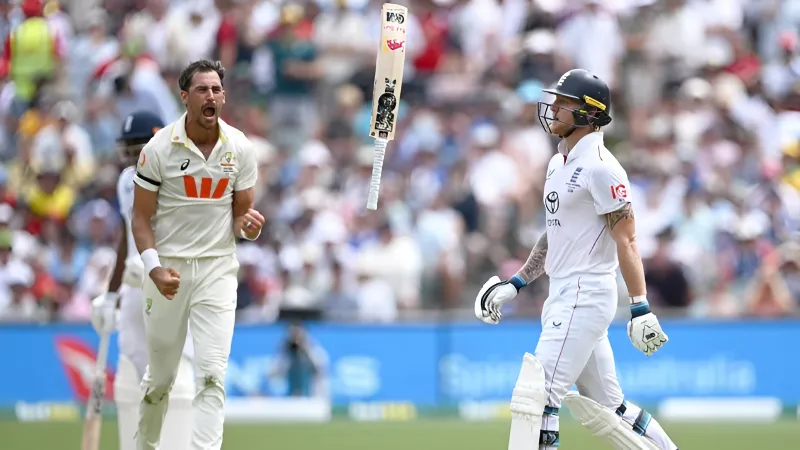

On occasions, Test Cricket can lose its focus on Runs, Wickets, and Tactics and become an issue of Endurance. Day 8 in this Ashes series was one of those days. For most of that day, Ben Stokes had been battling with no support from his teammates. At Adelaide Oval, he faced Mitchell Starc’s short-pitched deliveries (bouncers) and Cameron Green’s inswingers; all while trying to stay cool in the 41-degree heat of South Australia. Meanwhile, around him, 48,849 people were waiting for what was bound to be inevitable.
This wasn’t Bazball as advertised. It was Bazball cornered. And in that corner stood the movement’s founder, playing the most un-Bazball innings of his captaincy: 45 not out from 151 balls, strike rate 29.8, spirit intact but philosophy strained.
Bazball Meets Its First Survival Test
Bazball was built as an antidote to an aggressive purge of fear after one win in 17 Tests and a Covid Ashes that hollowed out confidence. It worked spectacularly at first: 13 wins in 18 matches up to the end of the 2023 Ashes. England played like a team freed from consequence.
But movements designed as reactions struggle when they become dogma. In Adelaide, Bazball faced something it rarely rehearses: survival. Not expression. Not dominance. Just staying alive. When the free hits vanished, England looked unsure whether defence was a skill or a sin.
A Batting Paradise England Refused to Exploit
If you could engineer ideal batting conditions, this was it. True bounce. Minimal lateral movement. Heat that flattened bowlers faster than batters. And yet England’s top order folded not to brilliance, but to indecision.
Ollie Pope and the rest of the top five fell playing defensive shots, not because defence is wrong, but because they no longer trust it. That paradox matters. A team drilled to attack loses its muscle memory when forced to block. Australia didn’t just bowl well; they waited for England to doubt themselves.
Stokes’ Innings as Philosophical Rebellion
Stokes’s unbeaten 45 was heroic in pain and haunting in implication. This was the man who once dismissed the idea of an Alastair Cook-type opener, suggesting conservative batters belonged to another era. Yet here he was, producing a strike rate that would rank as the fourth-slowest of Cook’s 113 Test scores above forty.
This wasn’t hypocrisy; it was necessity. But it was also inversion. The captain who preached pressure through intent absorbed pressure through attrition. Bazball’s founder became its contradiction, playing possum because there was no other option left.
Ben Stokes did keep the Ashes alive technically. Emotionally, too. But strategically, this innings felt like a warning flare. Movements built on freedom must eventually learn restraint, or they collapse the moment freedom is denied.
Bazball was never meant to be a destination. It was a response. In Adelaide, under brutal sun and relentless bowling, England were forced to play “proper stuff” again and discovered how rusty those tools had become.
Key Takeaway
Bazball didn’t fail in Adelaide; its refusal to adapt did.
FAQs
- What made Stokes’ innings unusual?
Its ultra-low strike rate contradicted the aggressive philosophy he helped create.
- Why were Australia’s 371 runs decisive?
Because England squandered ideal batting conditions and lacked tempo control.
- How does this affect Bazball’s future?
It signals the need for balance; intent must coexist with survival skills.
Disclaimer: This blog post reflects the author’s personal insights and analysis. Readers are encouraged to consider the perspectives shared and draw their own conclusions.
Step into the world of cricket with JeetBuzz News—where expert opinions, trending Blogs, and behind-the-scenes insights meet all your favorite topics. Stay informed, stay entertained, and never miss the stories shaping the cricketing world—only on JeetBuzz News!