

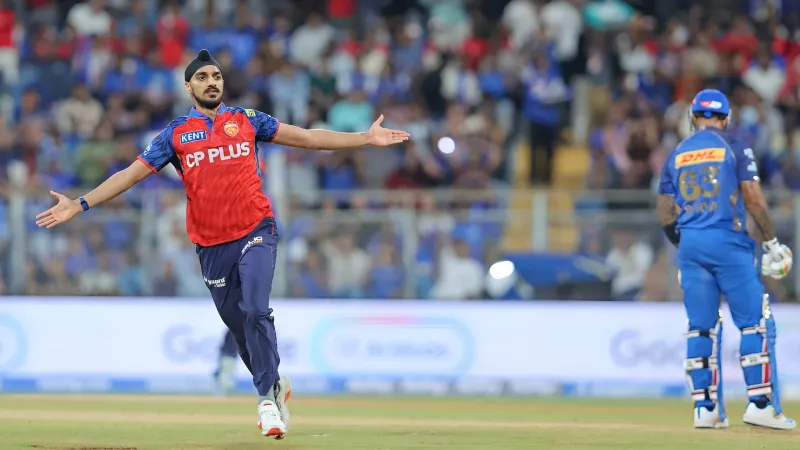

Arshdeep Singh walked into the MI vs PBKS clash carrying a problem everyone could see. Two wickets in four games. A growing wide count. An economy rate that reflected a bowler searching for something that wasn’t quite there. What followed wasn’t a sudden rediscovery of form or a lucky spell on a helpful surface. It was a deliberate technical correction executed under match pressure, and it changed the entire shape of his season. The spell against Mumbai wasn’t where Arshdeep found his rhythm. It’s where he proved he had done the work to get it back.
The Wide Problem Gets Fixed
The most damaging pattern in Arshdeep’s early matches wasn’t expensive overs in isolation. It was wide. Every wide ball is a free delivery; it resets the batter, releases pressure that had been building, and hands momentum back to the batting side without them having to earn it. When wides cluster, they signal a bowler who has lost confidence in his release point.
Against Mumbai, the adjustment was visible from his first over. He went back to targeting a tight channel outside off stump rather than searching for edges by going wider. That sounds simple. Executing it under match pressure after a run of poor games is considerably harder. The immediate effect was dot balls. Batters who expected width to work with found themselves driving at a length that didn’t invite the shot they wanted.
IPL 2026 Swing Returns With Purpose
Arshdeep’s most dangerous version is the one who swings the ball late and makes right-handed openers feel like the outside edge is always in play. That version had been absent before the Mumbai game. It came back decisively on a night where conditions offered enough movement to make outswing a genuine wicket-taking option.
Mumbai’s top order is built for powerplay aggression. They look to get through the new ball phase by hitting through the line and trusting their eye. Outswing that moves late disrupts that approach fundamentally, because a batter playing through the line against a ball moving away has no margin for error. Arshdeep combined that movement with the disciplined length he had corrected.
Yorkers Land When It Matters
The death overs had been the most visible site of Arshdeep’s struggles before this spell. Wide yorkers that missed leg stump. Full tosses that became boundary balls. A batter who has negotiated 14 overs is very difficult to contain at the death if the yorker isn’t landing. Arshdeep knows this better than anyone. His entire death bowling identity is built around that delivery.
Against Mumbai, both wide yorkers and the tailing yorker into the stumps landed with a precision that had been missing. Batters trying to access the leg side boundary found themselves digging out deliveries that they couldn’t get under. The timing of those overs mattered too. Mumbai was building toward a late acceleration when Arshdeep shut it down.
Training Reset Behind the Spell
What made this performance more convincing than a one-off return to form was the process behind it. Arshdeep had been using visual targets in spot bowling sessions before the match, specifically to rebuild confidence in his release point. That kind of targeted practice doesn’t fix everything, but it addresses the root cause directly. A bowler who trusts his release point bowls at the stumps. A bowler who doesn’t bowl wide of them.
The mental side was equally deliberate. High expectations following a strong international run had tightened his approach in ways that showed in execution. Simplifying the mindset, focusing on what the delivery needed to do rather than what the performance needed to prove, allowed the technical corrections to actually function under pressure. Technical resets without the mental reset rarely hold.
- Can Arshdeep sustain this level and become PBKS’s most important bowling weapon for the rest of IPL? Drop your take in the comments and follow for IPL updates.
FAQs
What changed in Arshdeep Singh’s IPL 2026 performance?
He improved line and length discipline while executing swing and yorkers more consistently.
Why was Arshdeep struggling earlier?
Poor control, especially wide and inconsistent execution, affected his rhythm and effectiveness.
How did Arshdeep perform in the MI vs PBKS match?
He delivered a controlled, wicket-taking spell that helped Punjab Kings dominate key phases.
Which skills define Arshdeep Singh in the Indian Premier League?
Swing bowling in the powerplay and yorker execution in death overs remain his core strengths.
Disclaimer: This blog post reflects the author’s personal insights and analysis. Readers are encouraged to consider the perspectives shared and draw their own conclusions.