

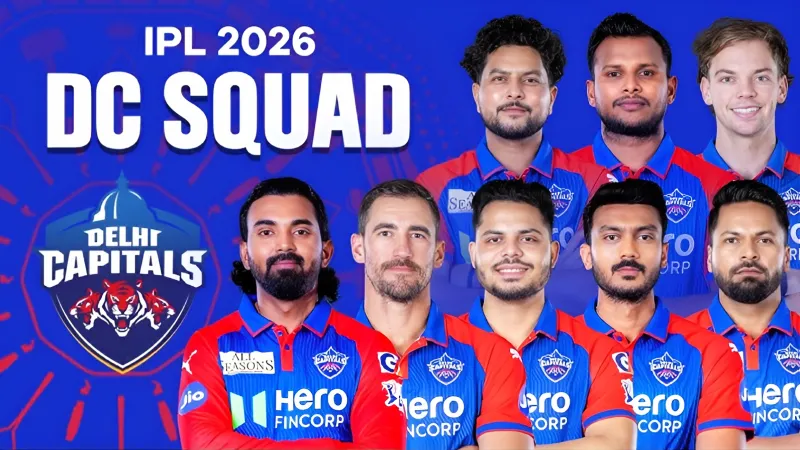

Delhi Capitals have often been IPL’s great underachievers, rich in talent, poor in timing. But something felt different on December 16 at the IPL 2026 auction table. No headline-grabbing bidding wars. No impulse buys. Just quiet, deliberate squad-building, the kind that doesn’t trend on social media but wins tournaments.
DC didn’t just fill gaps; they created options. Multiple openers. Interchangeable middle-order roles. Pace across all phases. Spin control in the middle overs. Suddenly, this looks less like a hopeful rebuild and more like a calculated playoff push.
A surplus problem at the top
Delhi’s opening dilemma is a luxury most franchises would envy. Ben Duckett, Prithvi Shaw, Pathum Nissanka, KL Rahul, Karun Nair, Abishek Porel, that’s an entire batting order fighting for two spots.
The key decision isn’t about talent; it’s about overseas resource optimization. Nissanka’s recent white-ball surge is impressive, but using an overseas slot on an opener becomes inefficient when Shaw is available at INR 75 lakh. Shaw’s ceiling in the powerplay, especially on flat Indian pitches, still outweighs his risks.
Duckett complements him well. His ability to dismantle spin inside the first six overs gives DC a rare powerplay option against teams that open with spinners, something we’ve seen increasingly since IPL 2023. Duckett + Shaw isn’t safe. It’s strategic aggression.
Why Rahul belongs in the middle
The KL Rahul opening spot for most of his time in the IPL has focused on control, but Delhi does not require control early in their innings. Instead, they will require that insurance (stability) be obtained late in the inning. By placing KL Rahul as a floating 3/4, he can help with two aspects; he will help to stabilize the collapse of the top-order batsmen by being able to play more slowly than the rest of the batting lineup. Additionally, he will be able to maintain the pace of the game through the middle innings. He is one of the best hitters of slow bowling in the world, and also gives them a second keeper option, which will add flexibility to the roster without sacrificing a position in the batting lineup.
Nitish Rana, following him, creates a left-right disruption against spin-heavy attacks, especially on slower surfaces. This pairing is less about fireworks and more about maintaining run-rate elasticity, a concept DC has lacked in past seasons.
Axar and Stubbs are non-negotiable
Axar batting at No. 5 maximizes his value not as a finisher, but as a transition batter who prevents stagnation. Since 2022, Axar’s strike rate against spin in overs 11–15 has hovered around the 140 mark, elite for a so-called bowling all-rounder.
Stubbs, meanwhile, is Delhi’s chaos engine. His six-hitting range straight and over extra cover makes him a nightmare at the Arun Jaitley Stadium. He doesn’t need protection; he needs a partner. That’s where David Miller enters.
Why Miller makes the XI
On smaller grounds like Delhi, Miller’s matchup against pace at the death is still among the best in T20 cricket. Leaving him out to accommodate Ashutosh Sharma, who struggles significantly against spin, would be a tactical misread. This isn’t sentiment. It’s surface science. Stubbs + Miller together give DC a finishing duo that can handle both pace and spin without matchup dependency.
Bowling that wins phases, not headlines
Delhi’s bowling unit won’t dominate highlight reels, but it might dominate scorecards. Starc brings powerplay intimidation. Natarajan offers yorker reliability at the death. Auqib Nabi covers middle and end overs with variation. Kuldeep Yadav remains the wicket-taking axis through the middle overs.
This quartet covers all three phases cleanly, a trait shared by past champions like GT 2022 and CSK 2023. No filler. No over-dependence. Sometimes, boring bowling wins trophies.
Delhi Capitals won’t win IPL 2026 at the auction table. They’ll win it or lose it at the selection meeting. The tools are all here: aggressive openers, adaptable middle-order anchors, dual finishers, and phase-specific bowling. The margin between a sixth-place finish and a top-two spot will come down to role discipline, not form fluctuations.
Key Takeaway
Delhi Capitals’ strength in IPL 2026 isn’t firepower, it’s flexibility.
FAQs
- What makes DC’s IPL 2026 squad different from previous years?
Role flexibility and phase-based balance, rather than star-driven selection.
- Why shouldn’t KL Rahul open the batting?
His value increases in the middle order, where he stabilizes, collapses, and controls tempo.
- How important is David Miller to DC’s best XI?
Crucial on smaller grounds, especially as a spin-resistant finishing option.
Disclaimer: This blog post reflects the author’s personal insights and analysis. Readers are encouraged to consider the perspectives shared and draw their own conclusions.
Step into the world of cricket with JeetBuzz News—where expert opinions, trending Blogs, and behind-the-scenes insights meet all your favorite topics. Stay informed, stay entertained, and never miss the stories shaping the cricketing world—only on JeetBuzz News!